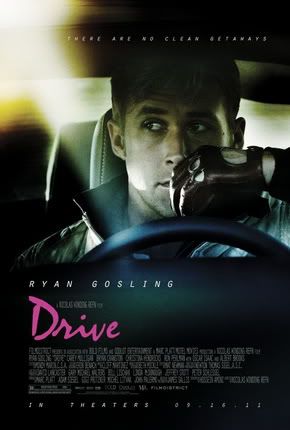
Drive (Winding Refn, 2011)
Showing posts with label crime. Show all posts
Saturday, September 24, 2011
Nobody Gonna Steal My Head Now That I'm On The Road Again
Labels:
2011,
action,
Bryan Cranston,
cannes,
carey mulligan,
Cars,
crime,
drama,
Drive,
film,
movie,
movies,
nicolas winding refn,
review,
ryan gosling
Sunday, July 18, 2010
Try This Trick And Spin It, Yeah, Your Head Will Collapse When There's Nothing In It
Inception (Nolan, 2010)
At some point in time every person sleeps, and at some point we all dream, but in this universal trait of humanity do we ever truly experience this sensation with any sort of uniformity? Is this uniformity even necessary in such a personal experience? What happens if our personal experiences, all of our repression, hopes, desires, and fears are not only open for others to witness but to directly manipulate to the point where we do not know if the process is even personal anymore? But, above all else, when we peel back all the layers of our dreams are we left with the purest essence of our thoughts or behind all the twists and turns - the layers and the puzzles - do we find a nothingness? Christopher Nolan's Inception literally delves into the dream world and starts working out these puzzles, taking us along for the ride as we hope to discover something, or rather anything, at the center.
Running throughout the film the script presents two recurring ideas: ideas can act as a cancer that grow and consume us, setting the stage for the titular act to take place, and dreams are elaborately constructed puzzles in which we willingly or unwillingly lose ourselves. And the entire film follows these ideas to their logical conclusions, adding in parlor tricks to cause the audience to further explore the puzzle in hopes of finding the definitive solution. Yet if we - as DiCaprio's Cobb does in the film - become too focused on this mystery, losing sight of the other elements that make up the film. And for much of the film Nolan's use of action and flash make for interesting spectacle to distract from the lack of substance behind the style.
But for each Joseph Gordon Levitt floating through layer two we also have Cobb explaining the previously unmentioned concept of Limbo, and then having Hardy and Levitt talk about it a few minutes later, and then Page doing so near the end of the film. The film is so loaded with exposition that the world and story have about as much breathing room as a man dangling from a noose constructed from the labyrinth the film displays.
And the deeper I venture into this maze I am able to find a few more conclusions, brief glimpses of answer and satisfaction amidst the entire transformation of cities and case scenes, but the farther in I go the more this creeping notion at the back of my mind becomes more and more prevalent: I am not watching people. By the end of the film we are, quite intentionally, left wondering just how much of the film is reality and how much is fabrication, but in this wonder compassion is absent no matter what conclusion is reached. I can understand the need to purposefully make many of the secondary characters two dimensional in order to make one specific interpretation work, but even if I overlook the lack of humanity on display from any of the secondary players then I should be able to feel incredible compassion, or at least understand the motivation, for Cobb.
Unfortunately Cobb is written in such a way that makes him neither sympathetic nor interesting, despite DiCaprio's best efforts to bring a level of humanity to the character. Cobb needs to get back to his children, to reconcile his past, by any means necessary, but we are never meant to know how honest he is in any of his actions (past, present, or future) until the film's conclusion, and for a specific interpretation to work even then we cannot be completely sure of what motivates the character.
Which reveals the film's most notable flaws. Nolan constructs a film that is so concerned with working as a maze that he fails to present any sort of overarching theme that ties the entire film together. Because the ending poses a very simple dualistic question to the viewer I am led to believe that the film is concerned with the nature of reality and perception, but even when considering if it connections to the meaning of perception the film does not necessarily relate it to any greater purpose. The film strives so hard to be a puzzle, to plant ideas in the viewer's head, that at some point each viewer is going to reach a satisfying conclusion, and then the film stops. I am not sure if I am finished with this film, if I have reached a comfortable conclusion, but I know that if I see it another time, or a few more times, eventually I will reach a point where I will have gotten to the end of the maze.
When I watch a film, when I enjoy a film, I am hooked by the theme, the promise that no matter how much I watch it I will continue to learn more about myself and my place to the world, that even when I reach a conclusion in a year, five years, fifty years I should be able to take what I have learned and discover more from the text. When I call a film, or any work of art, great I do so because it reveals a part of humanity, the film can never end. With Inception a promise of finality exists, found each time Cobb or one of his cronies gave a monologue explaining the intricacies of the world, or the repetition of these same rules time and time again in the film, in the most simplistic manner imaginable. Not only did I feel unfulfilled walking out of the theater, but as I draw closer to the end of the puzzle my sense of completeness will only lessen, and that thought depresses me.
Depressed. Unfulfilled. Hollow. Ultimately meaningless. These are the conclusions that I found in Inception; when the layers of dreams are peeled away, when the smoke has faded, when the mirrors have broken, the core of the film attempts to stand naked and nothing more than a shell remains. I have other problems with the film as well, such as an inconsistent use of shaky-cam mixed with fixed and quick cuts, and an imposing score that acts far too obviously and overtly in every scene. Yet the film has its share of positives including a phenomenal performance from Tom Hardy and some immensely intricate and engaging action sequences. But positives and negatives not only break down along with the film, they seem meaningless in comparison to the lack of any shred of humanity, any real theme or purpose. Like our dreams Inception is an escape that occasionally proves to be exciting and compelling, but eventually we are going to hit a kick, bringing back all the stark, harshly depressing realities.
Comments are encouraged and, for anyone with a literary mind, I encourage checking out my poetry blog filled with all original works for your reading pleasure.
Also I am on the old Twitter thing so I guess you can follow me at twitter.com/FLYmeatwad.
Wednesday, May 12, 2010
Pause And Reflect With The Blade At Your Wrist
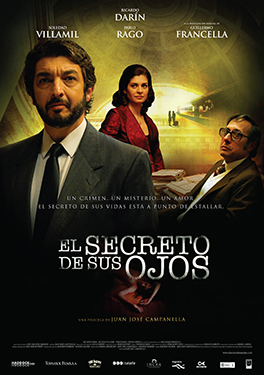
The Secret in Their Eyes (Campanella, 2009)
I walked into The Secret in Their Eyes with a number of reservations. I knew little about the film, but apparently it's a man's recollection, and eventual compilation into a novel, of a murder case that his law firm handled years back. Esposito is haunted by memories of this time in his life, seemingly without explanation, but he knows he has a story to tell and these recurring dreams only further compel him to write. Along the way we learn about lost love, the strength of friendship, and the power of memory in an individual's life. The Argentine film won 2009's Best Foreign Language Film Oscar, besting Michael Haneke's brilliant The White Ribbon and the sleek French prison drama Un Prophete. I love the former and consider the latter to be one of this year's most enjoyable films, so saying this film would need to do a ton of things right in order to convince me that it deserved the victory over the two big name films. But I am getting ahead of myself, I suppose, as the film needs to first and foremost be examined by its own merit and then look at in a broader context. So let's get on with the reflection.
The Secret in Their Eyes is a perfect film. Well, not perfect in a traditional sense, but certainly at a technical level the film is in the upper echelon of movie making. Each and every angle, each cut, every frame. They are all so well timed, so fully realized, so exact and calculated, so beautiful. The film kind of stumbles a bit in the pacing, but that problem is more found in the script rather than in the way the camera is used or how the film is edited together. I suppose the score could have been a bit less imposing, but even that aspect is used fairly well without ever being too distracting. Actually, much like the film itself, the movie never knocks you over on a technical level with sweeping shots of majesty, but taken as a whole it washes over you and prides itself on consistency and precision, producing a wonderful blend that adds to the tension and helps establish more of an investment in the characters on screen.
Despite the script dragging on a bit, The Secret in Their Eyes does a spectacular job of combining comedy with drama, a task that many films have failed at in the past. What this film does is not keep the two worlds separated, in its attempt to capture the reality of life, a trait that is crucial to the overall impact of the film's themes, it lets these two worlds intermingle naturally. The comedy plays off the drama, the jokes don't always land, the characters don't just talk, they actually speak. While the film does tend to stray into the realm of unbelievability with one character in particular, his larger role in the film, as explained by the movie's protagonist, makes these earlier lapses much easier to forgive and adds a layer to this supporting character. The movie actually employs this device a number of times, adding minor details to develop smaller characters slowly in order to make them more complete. But where the script truly succeeds, aside from the thematic material that I will get to shortly, is in the framing device used. As the film plays out it becomes more and more clear that the film is using a framing device within a framing device. The novel frames the murder, the story frames the exploration of Esposito's life, Esposito's life serves as a microcosm for humanity on a grand scale. But how, you may ask. He's just a damn lawman. I'm a rebel!
Well, so is Esposito. He doesn't have time for regulations, these rules, he needs to know the truth behind this murder. And in this examination of obsession and memory the film hits a stride that
As I walked out of the film I still was not sure if this was the best foreign language film from the previous year, but I found myself considering the way life is lived, by myself and the world around me. I am obsessed, obsessed with so many different aspects, and these obsessions, whether great or small, do govern my life. Or perhaps not, perhaps obsessed is not the correct word. Interested works better most of the time, I suppose, but what this film does is examine the point where interest becomes obsession, and what we as people lose when we obsess. But the film never completely paints this quality as negative either; instead we see self fulfillment, therapy, human connection, and justice achieved, partially, through this obsession.
At least until the end of the film when the movie becomes a bit generic, and slightly plodding, as it springs twists, mostly masterfully handled, on the viewer in order to reach a more upbeat ending than I would have expected. But in this ending time is lost, life has gone on, and obsession yields consequence alongside the self fulfillment. For the most part The Secret in Their Eyes is a beautiful and enjoyable film. It blends comedy wonderfully into the drama and is told in a remarkably interesting manner that allows the larger ideas on display to be engaged with by the audience. Is this the best foreign language film of 2009? I would doubt it, and I doubt I will ever truly know, but this film is fantastic.
Oh yes, and as a disclaimer, scores are finished. I'm not using them any more, nor am I using grades. I'll let the words do the talking in order to better focus my thoughts. So yeah, that's that, no more of this stuff. I'll probably keep them, somewhere, for my personal records and year end lists (I should make a 2009 one of these), but otherwise they are gone.
Additionally, I find joy in this title as the connection is not as direct as lyrics I have used to title a few of the more previous entries, so if you get the connection you kick ass, I suppose.
Comments are welcome and, for anyone with a literary mind, I encourage checking out my poetry blog filled with all original works for your reading pleasure.
Also I am on the old Twitter thing so I guess you can follow me at twitter.com/FLYmeatwad.
Subscribe to:
Posts (Atom)