I'm not sure if it's been a slower year for film, generally by this point in time a lot of the foreign films I wanted to see at the end of last year have finally gotten theatrical release, or if I just saw more foreign films than I had anticipated in 2012, but in the first quarter the world of cinema has been a bit lean. Still, despite that when compiling my five favorite films of the year so far, the most accomplished works in their field, some tough decisions had to be made. So, with summer nearly upon us, perhaps it has been a pretty good year so far.
Showing posts with label foreign. Show all posts
Showing posts with label foreign. Show all posts
Wednesday, April 24, 2013

Thursday, October 25, 2012
Living On A Lighted Stage Approaches The Unreal
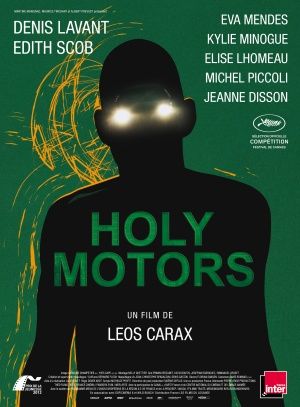
Holy Motors (Carax, 2012)
Continuing my paltry coverage of the Philadelphia Film Festival, I want to take a bit of time to write about one of the craziest theatrical experiences I have had in quite some time. Specifically, it all happened when I sat down to watch Holy Motors, the audacious new (mostly French) film from Leos Carax. Much like Beyond The Hills this one generated heaps of positive buzz at Cannes earlier in the year despite not coming away with any of the major awards. But unlike the relatively straightforward, though still complex, Beyond The Hills, one cannot as easily describe all the intricacies and surprises on display in Holy Motors, and I wouldn't want it any other way.
Tuesday, October 23, 2012
The Hounds Are Baying, I Don't Remember There Being Any Hounds Around Here
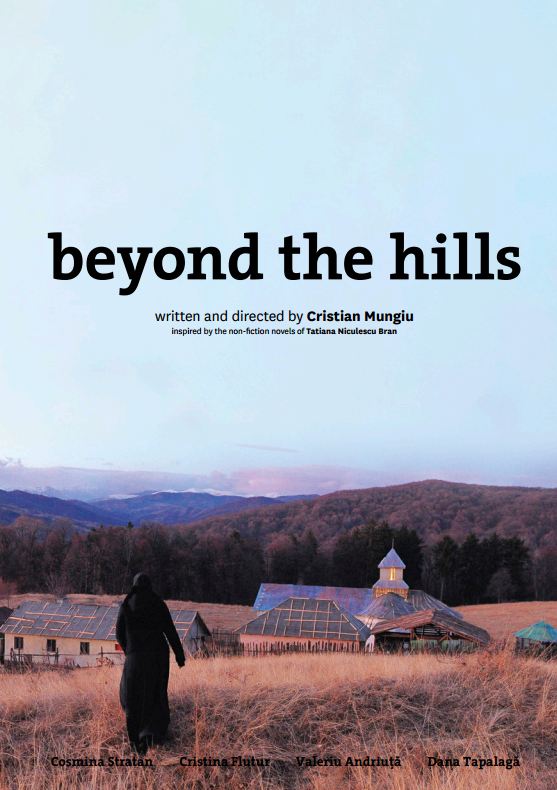
Beyond The Hills (Mungiu, 2012)
On Saturday I was able to have my first ever experience at the Philadelphia Film Festival, and even though I only saw two films out of the many offered I definitely picked two high quality movies that I can't wait to write about. The first film on my docket was Beyond The Hills, the latest from Romanian filmmaker Cristian Mungiu (4 Months, 3 Weeks, 2 Days). I knew relatively little about this film going in aside from its director, but after poking around the internet after the screening I noticed that it actually took home the Best Screenplay prize at Cannes this year along with a shared Best Actress award for its two leads. But aside from that I had little idea of what to expect, and as usual that tends to be a strength.
Monday, August 29, 2011
They've Got Him In A Trance
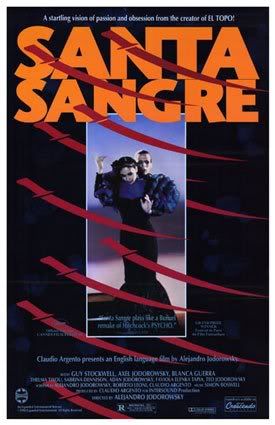
Santa Sangre (Jodorowsky, 1989)
Wednesday, August 3, 2011
She Was Born In Spring, But I Was Born Too Late

Three Colors: Red (Kieslowski, 1994)
I entered Krzysztof Kieslowski's final entry in his Three Colors Trilogy, Three Colors: Red, with a great deal of uncertainty tinged with a splash of hopefulness. I had little frame of reference for this film, knowing little about the actual plot that would be explored and having never seen another film from the Polish director, but the reputation these films have built up since their release in the early 1990's is astounding. However, outside of the reputation I did not know the plot of this film or its exact connections to the previous two films in the trilogy. So after sitting down to confront this film would it have been better to build context with the other two films or will I have to already begin revising my Top 97?Tuesday, July 12, 2011
Oblivion's Been Knocking Since I Gave It My Address

The Illusionist (Chomet, 2010)
The previous year was an incredibly strong year for animated films the world over. Japan delivered the strongest showing with Summer Wars, Ireland brought the fantastic The Secret of Kells, and France yielded the joyous display of absurdity known as A Town Called Panic. And once again we find ourselves in France for Sylvain Chomet's adaptation of Jaques Tati's script for The Illusionist. While Chomet plays his comedy in a broad sense, likely a departure from Tati's signature style, the pull of the film is located in its ability to balance strong emotional scenes with the tension of an ever changing world.
Thursday, July 1, 2010
Generals Gathered In Their Masses Just Like Witches At Black Masses
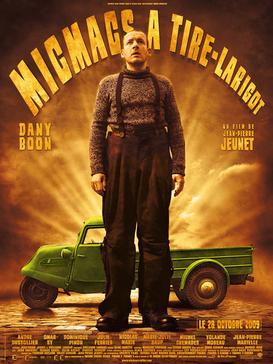
Micmacs (Jeunet, 2010)
The French are a people filled to the brim with whimsy. At least what I know of Jean-Pierre Jeunet's filmography gives me grounds with which I formed this notion. I have never seen Juenet's most famous film, Amelie, but if Micmacs is any indication of what I can expect from that film, I suppose I ought to spend some time watching the other film. What struck me so much about Micmacs was the way that the scenes simply flow into one another, capturing perfectly the a range of emotions that each scene demands. While the film is, by nature, an incredibly light hearted event, what surprised me was not how well the comedy on display is handled, but rather how suspenseful and dramatic the film became during the 'heist' sequences. These scenes blend comedy with delightfully dark moments to create such an engaging mood.
The film also never takes itself incredibly seriously, which adds to the mood created by the blending of reality with surreality. The film opens with a shockingly jarring few sequences involving a few bouts with death that, for me, came completely out of left field. These scenes were completely necessary though, as well as very enjoyable, as they provide set up for the rest of the film. Actually, this film narratively bears a remarkable amount of resemblance to one of my favorite films of last year, Fantastic Mr. Fox. Our protagonist attempts to take down two big businesses in a decidedly whimsical manner. But the difference is found in the much more overt social commentary that comes along with Jeunet's film. While Fox reaches greater understanding by serving as a critique of classicism, Jeunet is more concerned with the directly 'human' troubles that companies, specifically companies designed to create war, cause in the world. Early on in the film one of the company heads boasts that his weapons are designed to maximize on collateral damage to cost the enemy more money than dead soldiers would require.
One aspect that I particularly loved was the inclusion of billboards throughout the film that boasted the film's title and were direct mirrors of the scene that was currently playing out. Given the film's introduction this aspect added another layer of intrigue, causing me to wonder exactly how much of the world on display is 'real.' The entire film builds to a climax that is immensely rewarding, tying the film up wonderfully and solidifying the generally fantastic pacing on display. While Jeunet's work does occasionally feel a bit too topical in its approach, and despite a number of scenes occasionally carrying on to the point where the whimsy became slightly overwhelming, Micmacs is an enjoyable and self aware romp through a just barely surreal France.
The film also never takes itself incredibly seriously, which adds to the mood created by the blending of reality with surreality. The film opens with a shockingly jarring few sequences involving a few bouts with death that, for me, came completely out of left field. These scenes were completely necessary though, as well as very enjoyable, as they provide set up for the rest of the film. Actually, this film narratively bears a remarkable amount of resemblance to one of my favorite films of last year, Fantastic Mr. Fox. Our protagonist attempts to take down two big businesses in a decidedly whimsical manner. But the difference is found in the much more overt social commentary that comes along with Jeunet's film. While Fox reaches greater understanding by serving as a critique of classicism, Jeunet is more concerned with the directly 'human' troubles that companies, specifically companies designed to create war, cause in the world. Early on in the film one of the company heads boasts that his weapons are designed to maximize on collateral damage to cost the enemy more money than dead soldiers would require.
One aspect that I particularly loved was the inclusion of billboards throughout the film that boasted the film's title and were direct mirrors of the scene that was currently playing out. Given the film's introduction this aspect added another layer of intrigue, causing me to wonder exactly how much of the world on display is 'real.' The entire film builds to a climax that is immensely rewarding, tying the film up wonderfully and solidifying the generally fantastic pacing on display. While Jeunet's work does occasionally feel a bit too topical in its approach, and despite a number of scenes occasionally carrying on to the point where the whimsy became slightly overwhelming, Micmacs is an enjoyable and self aware romp through a just barely surreal France.
Wednesday, May 12, 2010
Pause And Reflect With The Blade At Your Wrist
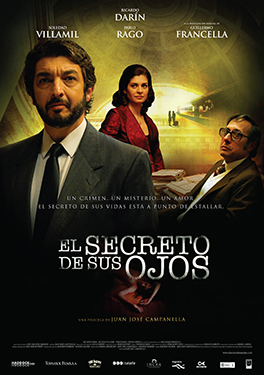
The Secret in Their Eyes (Campanella, 2009)
I walked into The Secret in Their Eyes with a number of reservations. I knew little about the film, but apparently it's a man's recollection, and eventual compilation into a novel, of a murder case that his law firm handled years back. Esposito is haunted by memories of this time in his life, seemingly without explanation, but he knows he has a story to tell and these recurring dreams only further compel him to write. Along the way we learn about lost love, the strength of friendship, and the power of memory in an individual's life. The Argentine film won 2009's Best Foreign Language Film Oscar, besting Michael Haneke's brilliant The White Ribbon and the sleek French prison drama Un Prophete. I love the former and consider the latter to be one of this year's most enjoyable films, so saying this film would need to do a ton of things right in order to convince me that it deserved the victory over the two big name films. But I am getting ahead of myself, I suppose, as the film needs to first and foremost be examined by its own merit and then look at in a broader context. So let's get on with the reflection.
The Secret in Their Eyes is a perfect film. Well, not perfect in a traditional sense, but certainly at a technical level the film is in the upper echelon of movie making. Each and every angle, each cut, every frame. They are all so well timed, so fully realized, so exact and calculated, so beautiful. The film kind of stumbles a bit in the pacing, but that problem is more found in the script rather than in the way the camera is used or how the film is edited together. I suppose the score could have been a bit less imposing, but even that aspect is used fairly well without ever being too distracting. Actually, much like the film itself, the movie never knocks you over on a technical level with sweeping shots of majesty, but taken as a whole it washes over you and prides itself on consistency and precision, producing a wonderful blend that adds to the tension and helps establish more of an investment in the characters on screen.
Despite the script dragging on a bit, The Secret in Their Eyes does a spectacular job of combining comedy with drama, a task that many films have failed at in the past. What this film does is not keep the two worlds separated, in its attempt to capture the reality of life, a trait that is crucial to the overall impact of the film's themes, it lets these two worlds intermingle naturally. The comedy plays off the drama, the jokes don't always land, the characters don't just talk, they actually speak. While the film does tend to stray into the realm of unbelievability with one character in particular, his larger role in the film, as explained by the movie's protagonist, makes these earlier lapses much easier to forgive and adds a layer to this supporting character. The movie actually employs this device a number of times, adding minor details to develop smaller characters slowly in order to make them more complete. But where the script truly succeeds, aside from the thematic material that I will get to shortly, is in the framing device used. As the film plays out it becomes more and more clear that the film is using a framing device within a framing device. The novel frames the murder, the story frames the exploration of Esposito's life, Esposito's life serves as a microcosm for humanity on a grand scale. But how, you may ask. He's just a damn lawman. I'm a rebel!
Well, so is Esposito. He doesn't have time for regulations, these rules, he needs to know the truth behind this murder. And in this examination of obsession and memory the film hits a stride that
As I walked out of the film I still was not sure if this was the best foreign language film from the previous year, but I found myself considering the way life is lived, by myself and the world around me. I am obsessed, obsessed with so many different aspects, and these obsessions, whether great or small, do govern my life. Or perhaps not, perhaps obsessed is not the correct word. Interested works better most of the time, I suppose, but what this film does is examine the point where interest becomes obsession, and what we as people lose when we obsess. But the film never completely paints this quality as negative either; instead we see self fulfillment, therapy, human connection, and justice achieved, partially, through this obsession.
At least until the end of the film when the movie becomes a bit generic, and slightly plodding, as it springs twists, mostly masterfully handled, on the viewer in order to reach a more upbeat ending than I would have expected. But in this ending time is lost, life has gone on, and obsession yields consequence alongside the self fulfillment. For the most part The Secret in Their Eyes is a beautiful and enjoyable film. It blends comedy wonderfully into the drama and is told in a remarkably interesting manner that allows the larger ideas on display to be engaged with by the audience. Is this the best foreign language film of 2009? I would doubt it, and I doubt I will ever truly know, but this film is fantastic.
Oh yes, and as a disclaimer, scores are finished. I'm not using them any more, nor am I using grades. I'll let the words do the talking in order to better focus my thoughts. So yeah, that's that, no more of this stuff. I'll probably keep them, somewhere, for my personal records and year end lists (I should make a 2009 one of these), but otherwise they are gone.
Additionally, I find joy in this title as the connection is not as direct as lyrics I have used to title a few of the more previous entries, so if you get the connection you kick ass, I suppose.
Comments are welcome and, for anyone with a literary mind, I encourage checking out my poetry blog filled with all original works for your reading pleasure.
Also I am on the old Twitter thing so I guess you can follow me at twitter.com/FLYmeatwad.
Monday, October 12, 2009
There's A Place In The Buried West, In A Cave, With A House In It
Back to a quick entry of short paragraph reviews, though this time I have a theme to work with sort of as each film chronicles a tale taking place in a different country. Also, these films are all 2009 films, as my count on the year quickly approaches the 60 film mark. I was going to toss in a Trick 'r Treat review in here as well, but I think that one will get its own entry, especially since it works its way into my incredibly generic Keep the Lights On! October mini-marathon of horror films. Additionally, readers here may or may not know that I have been writing two weekly articles for The Reelists, so you can keep up with regular posts from me there as well as Processed Grass has taken a bit of a back seat to that one. Either way, on to the four films.

I know enough about metal to know that, the majority of modern, inaudible, loud music is crap. I know enough about Canada to know that it kicks a good deal of ass, at least the parts in which I've traveled thus far. That said, I knew nothing about the band Anvil prior to entering this film, so like any good documentary I was prepared to get learned on the subject. The hook here is that Anvil is like a real life Spinal Tap~esque doc, and as far as humor goes it mostly delivers. The laughs are plentiful, especially early on since the film begins to tackle a few more deeper emotions as the narrative progresses, though humor can only carry a film so far. Luckily, Anvil! does not put a huge emphasis on the music, though the small snippets that were played were nice enough to listen to since Anvil apparently plays the 80's hair metal stuff rather than that new age grunt and yell. It's not Black Sabbath, Hell it's not even any Megadeth...well okay maybe it's comparable to Megadeth, which means it's still pretty decent. Still, the focus here is on the lead singer, Lips, and his constant determination, his drive to succeed. The man's passion and determination are admirable, two qualities the film captures nicely, but I suppose the notion that one can take away is that Lips is just a nice guy. And maybe nice guys do finish last, but why is money important when you are doing something you love? These concepts are a little too general for my liking, but the film makes them compelling. Plus the pacing helps make the viewing enjoyable and less of a chore. I had expected this year's Man on Wire or King of Kong, what I go was a doc that is slightly better than Soul Power, but not quite up to the level of a Food, Inc. How's that for arbitrary?
B/B+ or 3.7648972146234623085435

Traveling from Canada to Brazil, or Mexico, or someplace weird like that, we get the directorial debut from Cary Joji Fukunaga who has one of the coolest names I've ever seen given that he was apparently born and raised in Oakland. Simply by looking at the film one would not guess that it is a director's first effort, everything about the movie is visually beautiful, but when we start looking at the narrative the film's flaws are slowly exposed. Character motivation is not always there, some of the situations are a bit too convenient, and the relationship between the two leads does not really generate enough interest to feature it as the main focus of the story. Thankfully the film has enough depth that the glimpses into gang life, the journey Mexico to the United States, and the development of a young mind are all incredibly fascinating and handled with incredible mastery. Fukunaga makes the world and the characters come alive despite not getting much from his leads, so for that I would be willing to call the film at least pretty good, but add in the fact that the cinematography is spectacular and the film showcases some of the greatest costumes all year and I am very confident in calling Sin Nombre a successful film despite the numerous shortcomings from a narrative perspective.
B-/B or 3.4683245307964952753

Next stop on this entry's world wide (but not really since we are only showcasing two continents) tour we make a quick stop in Kazakhstan to take a look at this year's Kazakh entry for the Best Foreign Film Oscar. Focusing on the exploits of an aspiring goat farmer, Tulpan showcases an interesting filmmaking style and mixes with a great lead performance to make for a touching comedy with more than enough drama and symbolism going on to keep me interested in a cerebral sense. The driving sequences here are really entertaining as well and they help with character juxtaposition and ideological comparison. Overall the film is a little disjointed in the sense that I can remember individual scenes fondly, but as a whole the film does not really stand out until the climax. But oh boy is it some climax. Tension is built, I was left feeling slightly uncomfortable but also compelled to watch, drawn to see how everything would play out. And the payoff is both rewarding and a great conclusion to the film's themes. I was not expecting much from this film and, while it does have its share of flaws, the camera is used in such interesting ways and the performances are so good that I can easily recommend the film to anyone with an interest in Kazakh cinema and, likely more pertinent to any readers, dramadies in general. Plus the film links the majority of its themes with symbols in the movie, and I really had a fun time making these connections, so there is a bit of extraneous detail to chew on during repeat viewings. Tulpan likely will not stand much of a chance at taking home the Foreign Language Picture Oscar because it does not seem like the type of film the Academy gravitates towards, but it seems like as good a place as any to start with Kazakh cinema. Additionally, I have now seen as many goats being born as I have people.
B- or 3.3982348732894537205832

Does that smell like a Big Mac with the buns replaced by Boston Cream Doughnuts? We must be back in America. Fittingly, this cinematic tour concludes with Away We Go, a film that is, at least partially, about traveling. Also continuing the idea of directors dealing with a foreign country, Sam Mendes' follow up to last year's brilliant Revolutionary Road comes in the form of another tale about the American family struggling with a new situation. This time Mendes lets his comedy come out, anchored by a fairly well known cast of actors. Jim Gaffigan, John Krasinski, Maya Rudolph, Maggie Gyllenhaal, and Catherine O'Hara are just a few of the faces that make appearances during the film's mostly lean run time. As a comedy I am not sure how successful the film is because, well, the film did not make me laugh all that often or all that audibly. And in retrospect I am not sure how well the Rudolph/Krasinski relationship worked for me either since I recall very few specific details about the two aside from the fact that she was pregnant and they were attempting to find 'home.' The whole point here is the journey though, and Mendes packs the film with enough heightened realism to make each stop at least interesting in some regard. The real strength of the film though is, without a doubt, the direction paired with the cinematography. Mendes sure has a way with a camera, a brilliant sophistication that makes for an ocular delight. Sure that is not enough to outweigh all of the narrative's negatives nor does it excuse a lackluster central romance, but damn does the film look fantastic.
C/C+ or 2.9892317438290534805
Comments are welcome and, for anyone with a literary mind, I encourage checking out my poetry blog filled with all original works for your reading pleasure.
Also I am on the old Twitter thing so I guess you can follow me at twitter.com/FLYmeatwad.
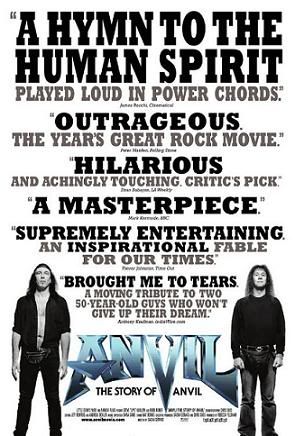
Anvil! The Story of Anvil (Gervasi, 2009)
I know enough about metal to know that, the majority of modern, inaudible, loud music is crap. I know enough about Canada to know that it kicks a good deal of ass, at least the parts in which I've traveled thus far. That said, I knew nothing about the band Anvil prior to entering this film, so like any good documentary I was prepared to get learned on the subject. The hook here is that Anvil is like a real life Spinal Tap~esque doc, and as far as humor goes it mostly delivers. The laughs are plentiful, especially early on since the film begins to tackle a few more deeper emotions as the narrative progresses, though humor can only carry a film so far. Luckily, Anvil! does not put a huge emphasis on the music, though the small snippets that were played were nice enough to listen to since Anvil apparently plays the 80's hair metal stuff rather than that new age grunt and yell. It's not Black Sabbath, Hell it's not even any Megadeth...well okay maybe it's comparable to Megadeth, which means it's still pretty decent. Still, the focus here is on the lead singer, Lips, and his constant determination, his drive to succeed. The man's passion and determination are admirable, two qualities the film captures nicely, but I suppose the notion that one can take away is that Lips is just a nice guy. And maybe nice guys do finish last, but why is money important when you are doing something you love? These concepts are a little too general for my liking, but the film makes them compelling. Plus the pacing helps make the viewing enjoyable and less of a chore. I had expected this year's Man on Wire or King of Kong, what I go was a doc that is slightly better than Soul Power, but not quite up to the level of a Food, Inc. How's that for arbitrary?
B/B+ or 3.7648972146234623085435
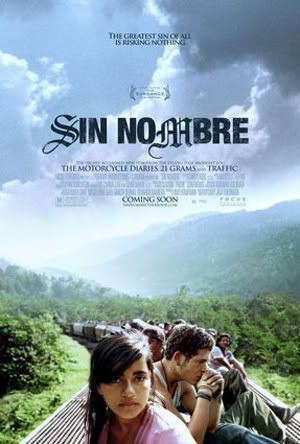
Sin Nombre (Fukunaga, 2009)
Traveling from Canada to Brazil, or Mexico, or someplace weird like that, we get the directorial debut from Cary Joji Fukunaga who has one of the coolest names I've ever seen given that he was apparently born and raised in Oakland. Simply by looking at the film one would not guess that it is a director's first effort, everything about the movie is visually beautiful, but when we start looking at the narrative the film's flaws are slowly exposed. Character motivation is not always there, some of the situations are a bit too convenient, and the relationship between the two leads does not really generate enough interest to feature it as the main focus of the story. Thankfully the film has enough depth that the glimpses into gang life, the journey Mexico to the United States, and the development of a young mind are all incredibly fascinating and handled with incredible mastery. Fukunaga makes the world and the characters come alive despite not getting much from his leads, so for that I would be willing to call the film at least pretty good, but add in the fact that the cinematography is spectacular and the film showcases some of the greatest costumes all year and I am very confident in calling Sin Nombre a successful film despite the numerous shortcomings from a narrative perspective.
B-/B or 3.4683245307964952753
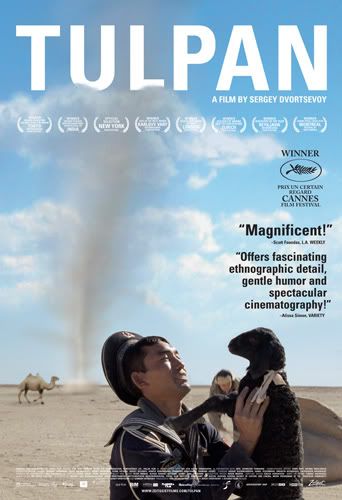
Tulpan (Dvortsevoy, 2009)
Next stop on this entry's world wide (but not really since we are only showcasing two continents) tour we make a quick stop in Kazakhstan to take a look at this year's Kazakh entry for the Best Foreign Film Oscar. Focusing on the exploits of an aspiring goat farmer, Tulpan showcases an interesting filmmaking style and mixes with a great lead performance to make for a touching comedy with more than enough drama and symbolism going on to keep me interested in a cerebral sense. The driving sequences here are really entertaining as well and they help with character juxtaposition and ideological comparison. Overall the film is a little disjointed in the sense that I can remember individual scenes fondly, but as a whole the film does not really stand out until the climax. But oh boy is it some climax. Tension is built, I was left feeling slightly uncomfortable but also compelled to watch, drawn to see how everything would play out. And the payoff is both rewarding and a great conclusion to the film's themes. I was not expecting much from this film and, while it does have its share of flaws, the camera is used in such interesting ways and the performances are so good that I can easily recommend the film to anyone with an interest in Kazakh cinema and, likely more pertinent to any readers, dramadies in general. Plus the film links the majority of its themes with symbols in the movie, and I really had a fun time making these connections, so there is a bit of extraneous detail to chew on during repeat viewings. Tulpan likely will not stand much of a chance at taking home the Foreign Language Picture Oscar because it does not seem like the type of film the Academy gravitates towards, but it seems like as good a place as any to start with Kazakh cinema. Additionally, I have now seen as many goats being born as I have people.
B- or 3.3982348732894537205832
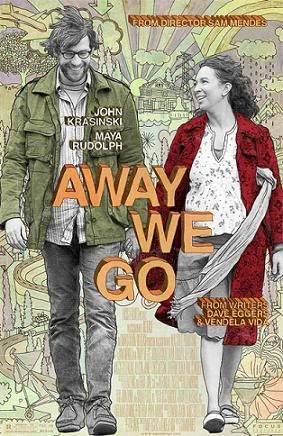
Away We Go (Mendes, 2009)
Does that smell like a Big Mac with the buns replaced by Boston Cream Doughnuts? We must be back in America. Fittingly, this cinematic tour concludes with Away We Go, a film that is, at least partially, about traveling. Also continuing the idea of directors dealing with a foreign country, Sam Mendes' follow up to last year's brilliant Revolutionary Road comes in the form of another tale about the American family struggling with a new situation. This time Mendes lets his comedy come out, anchored by a fairly well known cast of actors. Jim Gaffigan, John Krasinski, Maya Rudolph, Maggie Gyllenhaal, and Catherine O'Hara are just a few of the faces that make appearances during the film's mostly lean run time. As a comedy I am not sure how successful the film is because, well, the film did not make me laugh all that often or all that audibly. And in retrospect I am not sure how well the Rudolph/Krasinski relationship worked for me either since I recall very few specific details about the two aside from the fact that she was pregnant and they were attempting to find 'home.' The whole point here is the journey though, and Mendes packs the film with enough heightened realism to make each stop at least interesting in some regard. The real strength of the film though is, without a doubt, the direction paired with the cinematography. Mendes sure has a way with a camera, a brilliant sophistication that makes for an ocular delight. Sure that is not enough to outweigh all of the narrative's negatives nor does it excuse a lackluster central romance, but damn does the film look fantastic.
C/C+ or 2.9892317438290534805
Comments are welcome and, for anyone with a literary mind, I encourage checking out my poetry blog filled with all original works for your reading pleasure.
Also I am on the old Twitter thing so I guess you can follow me at twitter.com/FLYmeatwad.
Sunday, September 20, 2009
I Hear What You're Not Saying...
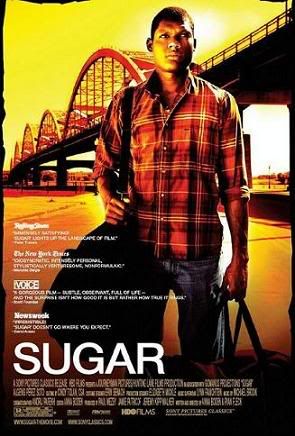
Sugar (Boden and Fleck, 2009)
While I missed the theatrical run of Sugar, I had heard nothing but good things about the baseball biopic focusing on a young Dominican player as he makes the journey over to America for a chance to play in the majors. From the opening preparations to the first minor league game, Sugar chronicles the progression of the titular character wonderfully and humanly, always respecting the game and the player. The rise and (spoilers coming) eventual fall of Sugar is portrayed without embellishment or splendor, the tale is simply told. The film is deceptive in nature though, as one may expect the film to mostly center on Sugar, but a good amount of time is given to the politics of baseball and how these imported players are mostly left by the wayside from the next prospect. The film is marked with a fairly distinctive visual style courtesy of the two directors, and the film is obviously helped by a stunningly strong turn from lead actor Algenis Soto.
 The film does, admittedly drag on a bit in the middle portion, as the story drifts over to New York City for a seemingly meaningless portion. The politics of the game are left out, the language barrier complications that made the start of the film so endearing was mostly forgotten, and Sugar simply did not develop much more as a character. However, the film sets up a devastatingly beautiful ending that packs the viewer so full of hope but forces the audience to also look at reality. Sugar has a number of high points, and as far as entertainment is concerned the film certainly delivers, but as a whole the film does not feel like much more than a fairly standard story mixed with enough interesting concepts to add up to a worthwhile way to spend about two hours.
B/B+ or 3.98927483274083271583275

Big Man Japan (Matsumoto, 2009)
Easily presenting one of the most exciting trailers of the year, I have had the desire to watch Big Man Japan for quite a while, so stumbling across the title on Netflix Instant Watch was a welcome discovery. My expectations entering the film were for a rag tag, tongue-in-cheek Power Rangers~esque romp. Perhaps a Japanese take on The Host where the genre is poked fun at while a nice story is told. Well, that did not happen. Through a very diligent documentary look, Big Man Japan follows writer, director, and lead actor Hitoshi Matsumoto's character Daisato through the mundane life of Japan's protector from the numerous monsters that plague Japan. Matsumoto gives a wonderfully straight performance, capturing the run down depression of a man who has seemingly outlived his use both in the eyes of the public and his family. Mix that with near perfect comedic timing, and Matsumoto turns in one of the year's best performances.
 The film also does mix in a few bigger fights, making use of CGI as best it could and making up for the less than perfect images by having an incredibly stylized group of monsters terrorizing Japan. And then there is the whole social commentary/existence struggle themes through run throughout the film, both of which are handled masterfully. And then the film ends, and what a finale Matsumoto presents. Hysterical to the extreme and incredibly poignant, the film's final fight sequence speaks volumes on American culture in Japanese society, media sensationalism, and one's struggle with humanity. The film is far from flawless, though I do think that the pacing is excellent, but Big Man Japan is a unique ride that is open to a plethora of readings. Any film that provides that is great in my book.
B+/A- or 4.172814962146231645923
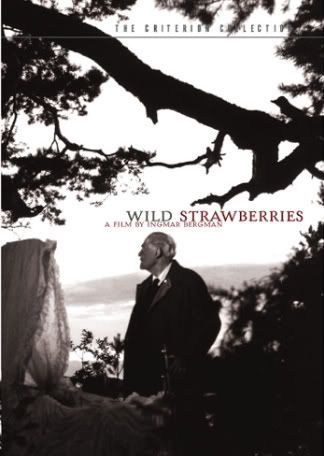
Wild Strawberries (Bergman, 1957)
Speaking of films that are ripe for interpretation, Wild Strawberries is my second Ingmar Bergman film. A meditation on life, looking back upon the existence of a professor who has seemingly alienated his family and friends over the years, Bergman presents a quiet and compelling narrative with an incredibly compelling character at the center of the flash back filled affair. As Dr. Borg revisits his memories, the viewer is presented with a brilliantly structured film flowing to the brim with imagery and symbolism. Of course that is a blanket statement that requires a bit more thought. One scene has a cradle placed out in the woods, standing far enough away from the house to give the viewer some hint about something or another. This is all very vague, though with good reason, I was confused. Bergman creates a film here that is rewatchable, I am sure, but for some reason I was never completely hooked either. This film is odd. I should watch it again. Would have not put this entry up, but I love the poster.
B+ or 3.9892374032754235703?
Comments are welcome and, for anyone with a literary mind, I encourage checking out my poetry blog filled with all original works for your reading pleasure.
Also I am on the old Twitter thing so I guess you can follow me at twitter.com/FLYmeatwad.
B+ or 3.9892374032754235703?
Comments are welcome and, for anyone with a literary mind, I encourage checking out my poetry blog filled with all original works for your reading pleasure.
Also I am on the old Twitter thing so I guess you can follow me at twitter.com/FLYmeatwad.
Monday, September 14, 2009
I Pour Myself A Tall Glass Of Milk, It Was Deep And Cold
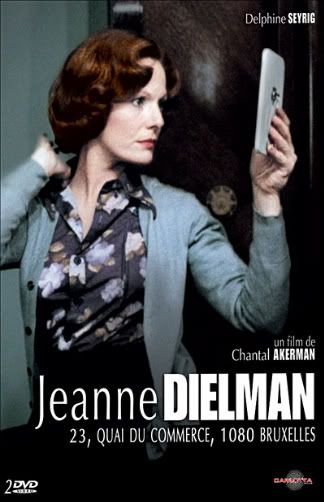
Jeanne Dielman 23, Quai du Commerce, 1080 Bruxelles (Akerman, 1975)
I had, for much of the month of August, avoided watching Jeanne Dielman. Part of the reasoning behind this avoidance was due to the Criterion release not being issued until the end of the month, so I clearly could not have Netflix send me a film that has yet to be released, but the other reason, the incredibly obvious one, is that the film is three and a half hours long of a Belgian woman doing stuff. At the time I was not sure what that stuff was, all I knew what that she cooked potatoes. Now I can get behind watching a Belgian woman cook potatoes in silence for about two hours, but you nearly double that and I just do not know if I am on board. As I opened up the Netflix case to see the new release sitting there, I figured I'd read the short description on the case and check out the Criterion website. Apparently the film was not only a feminist yarn, but also one of the earliest films from a 25 year old director, Chantal Akerman. Obviously, this behemoth draws immediate comparisons to the American classic Citizen Kane. My excitement for this film had effectively gone from mild to incredible. And so the tale of Jeanne Dielman started.
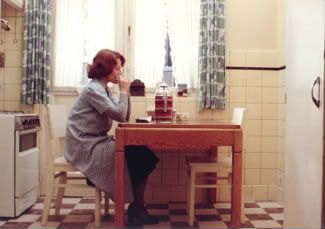 So, minimalist is probably not a good enough word to describe this film, the elongated sequences of Jeanne going through her daily routine in usual silence run throughout the entire film. When Jeanne prepares dinner, she goes through each and every action of preparing the food, never skipping any step. Filmed fantastically, Akerman makes effective use of long shots, congested scenes, and, much to my delight, the constant use of the same exact positioning of the camera outside the kitchen and leading to her bedroom, day in and day out, make for scenes that I shall not forget. The entire film is marked with the visual accomplishment of a seasoned filmmaker, so discovering that she was so young when making the film had me feeling rather shocked. Perhaps equally surprising is that I cannot recall any scene that looked amateurish, or even seemed out of place with the visual look of the rest of the film. Given that the film runs for such a lengthy time, and I'm sure the excess footage was likely staggering as well, Akerman's ability to make the most out of each shot is particularly impressive.
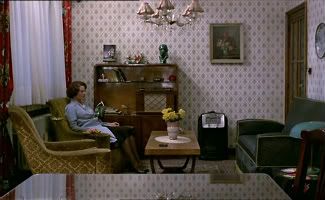 Of course not all of the film's successes are attributed entirely to Akerman; instead, one of the film's greatest strengths comes in the lead performance from Delphine Seyrig. As I have said before, much of the film is mostly dialogue free, yet Seyrig somehow needs no words to completely develop the Dielman character. Perhaps because of the routine like nature of the food preparation, or the detachment shown from the men who pay her for sex, or perhaps even because of the time spent simply sitting with her son at the table, one can understand both her circumstances and specifically why Jeanne is such a compelling central figure. From the trapped sense all the way to Jeanne's perceived independence and awakening, Seyrig is constantly somber and reserved, yet completely full of emotion and believability. Of course the rest of the cast is pretty fantastic as well, and Jan Decorte, in the role of Jeanne's son, makes the most out of his scenes.
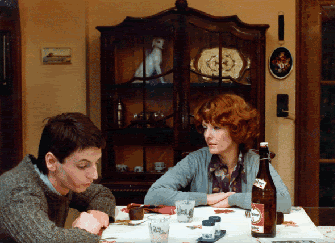 Perhaps I should now talk about the pacing. While I have made slight reference to the repetitive aspects a little earlier, I will take this time to briefly expand on that aspect's impact on the film. Yes, some of the portions of the film are slow because nothing seems to be going on at a surface level, but when sitting down and really watching the film, and specifically watching Seyrig's movements, as she goes through her daily routine, the intensity level is miraculously heightened. Not to mention that when things start slowly unwinding, it hits and it hits hard. During the second portion of the film we see Jeanne encounter a problem with dinner that seems so minute, but the intensity of this event is captured perfectly. The film is so simple on the surface, but even if the viewer misses everything in the film, the ending is a giant clue that some more themes are going on below the surface. While I felt that I had a decent grasp on the film up to that point, the overt symbolism had me re-evaluating some portions of the film up to that point. I am positive that when, in a few years, I sit down with Jeanne Dielman again, I will find much more than I had initially discovered with the film.
 I could probably dissect the film further, but much more capable people already have and they also likely have the advantage of multiple viewings. So as far as an initial reaction is concerned, I feel that I covered enough territory to make it known that Jeanne Dielman is one Hell of a film and certainly something that should not be missed nor should it be dismissed because of it's immense run time. Anchored by a stunningly strong lead performance from Delphine Seyrig, and paired with some fantastically masterful direction from the young Akerman, Jeanne Dielman is worthy of the comparison to Citizen Kane while still existing as one incredibly complex, challenging, rewarding, and strikingly unique examples of film making.
A or 4.728374983215436523145671
Comments are welcome and, for anyone with a literary mind, I encourage checking out my poetry blog filled with all original works for your reading pleasure.
Also I am on the old Twitter thing so I guess you can follow me at twitter.com/FLYmeatwad.
Subscribe to:
Posts (Atom)