Showing posts with label death. Show all posts

Friday, April 15, 2011

You're Keeping Control Of The Knife, But I'm Not Your Darling


Scream 3 (Craven, 2000)

The question I was left with at the end of my Scream 2 review was exactly how Craven was going to continue layering more levels of self referential material on the series without it eventually breaking apart. After watching Scream 3 it seems almost obvious that the best way to handle the world within the world within the world of Woodsboro would be to have the characters meet up with their on screen counter parts. What could be better than Gale Weathers (Courteney Cox) teaming up with fake Gale Weathers (Parker Posey) in an attempt to uncover the mystery revolving around a string of murders in the latest STAB film, STAB 3: Return to Woodsboro?

The answer to that question is rather easy: bring back Randy (Jamie Kennedy) for a video taped cameo where he gets back to what made him most effective in Scream: laying out how exactly these trilogies work. Apparently, as Sidney Prescott (Neve Campbell) is once again hunted down by a new masked Ghost Face, all the bets are off. The killer should become superhuman, capable of taking as many bullets as possible to the chest without dying, becoming a supernatural presence in the film. Craven plays up this bit nicely, showing the Ghost Face figure being shot at, apparently uncaring about any of the bullets that have hit him. He even makes it believable by portraying Sidney as a tad mentally unstable. She hears her dead mother speaking to her throughout the film, which all ties back to the killer's plan to reveal the truth about Maureen Prescott. It would be easy for the film to go off the deep end with the supernatural, odd considering how grounded in reality the rest of the series has been, but perhaps fitting in the way that genre is broken down. I'm glad Craven kept to continuity rather than deconstruction though, as it allows for a much more cohesive viewing experience and a more emotionally engaging film

The central mystery in the film is a compelling point, and Craven gets back to generating scares by blending his steady camera with an occasionally deceptive score. Even the reveal at the end works nicely in the context of this film, and the series up until that point. Still, the main attraction has to be the way that the movie sets itself up as a metacommentary on the industry that has spawned it. Specifically, what works in this entry is how the killer plays with identity in order to create a sense of unstable bonds between a primary core of characters who have twice survived similar situations. It also asks the viewer to question what is happening in the film, a device that plays well with the fabrication of location that serves as the STAB 3 set. In this near perfect recreation of Woodsboro, we explore a world we know, only for something as trivial as the opening of a door to reveal that our sense of place is being completely manipulated. Just looking at the way that Craven crafts these scenes, that he uses artifice to refer to artifice, demonstrates his mastery over his material.

In the previous two films, the series has dabbled in the implications of its characters's actions both in relation to the genre, and simply as characters. The most genuine moments of Scream 3 can be found when Sidney is asked to reflect on herself. Does fear ultimately control Sidney, the cipher through which the audience is meant to experience this world? Where does the line between blameless killing and deplorable murder exist? The film probes at these questions, I think I may have to give up hoping that anything of substance will be reached by watching the series, but I still cannot help feeling at least slightly unfulfilled even if the entertainment value was back up in this movie.

Still, when Scream 3 works, it works overtime for double pay.The highlight of the film that I come back to is found early on when one of the actresses in STAB 3 is asked to read the lines of the script over the phone. The moment is played perfectly, with enough sinister undertones that you know at some point the scene will go wrong, but also asking the audience to know to make this association by reworking the initial dialogue from the first film. The second movie in the series also attempted to do this as well, but we had a screen separating us, here the results were going to be real. The Scream series has gone from deconstructing cinema to deconstructing reality, and in doing so asking each viewer to ask how much of a difference is found between the two. It goes as far as having Jay and Silent Bob make baffling cameo appearances, characters within characters. Perhaps even within characters. When do they stop becoming characters?

As the series evolves we see technology evolving with it. The cell phones become slightly smaller. Caller ID is replaced by *69. It is hard, at times, to ever make these characters feel truly alone. When this happens, Craven examines vulnerability. Does Scream 3 always generate fears? No. But it does manage ambition, to capture a changing world in a world that is completely fabricated. Craven taps in to the basest of human fears and juxtaposes it with the modern context where no one is alone. As I prepare to enter Scre4m, the developments between the turn of the millennium and the present day are ripe for examination and exploitation in a way that, I hope, only Scream can tackle.

Netflix Rating: ****/*****

Rich

Comments are welcome and, for anyone with a literary mind, I encourage checking out my poetry blog filled with all original works for your reading pleasure.

Also I am on the old Twitter thing so I guess you can follow me at twitter.com/FLYmeatwad.

Thursday, April 14, 2011

You're All Alone, Friend? Pick Up The Phone Then


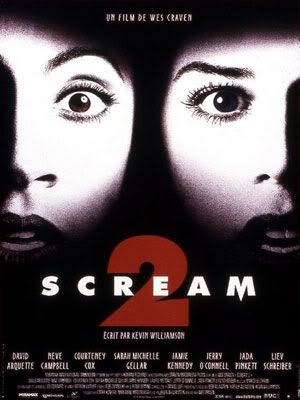
Scream 2 (Craven, 1997)

Sequels are inferior films by nature. This claim is posited early on in Scream 2 by Randy (Jamie Kennedy) in his film studies college class. Unless conceived before as part of a trilogy - Star Wars: The Empire Strikes Back is used as one counterexample in the movie - sequels are bogged down with characters and scenarios that are shadows of the original's glory. When you are making a sequel that is as self aware as Scream 2 you have to be confident in your craft to directly call out the inferiority of sequels, to essentially ask the audience to to laugh at, not with, you. So the question facing the follow up to Craven's 1996 slasher is not 'how do you make it work' but rather: why do we need to see these people, this world, again?

Craven's answer is to continue to layer on the self referential aspects of this universe. Opening the film with an elongated sequence that ushers in the return of Ghost Face is enhanced by the droves of people dressed up like the killer watching STAB, a film within the film that is based on a book written about the events of the first movie by Gale Weathers (Courteney Cox). The killer then goes about recreating the victims of the original Woodsboro murders in an attempt to, once again, end the life of Sidney Prescott (Neve Campbell). As a narrative device the layers of artifice on top of one another serve to answer the how, and through that begin to hint at an answer to the why.

Unfortunately, the second movie in the Scream series is still bogged down with many of the problems that Randy outlines in that early classroom scene. The college years introduce a cast of characters that seem so overtly meant to counteract the original cast it becomes overbearing. How many times do I need to hear Sidney's new boyfriend say that he is not like Billy? Probably just once, certainly not the three times afterward. Having Dewey and Gale back was a nice touch, mostly because the characters were each fleshed out a good deal more than they were in the first film, but it's also odd that Sidney and Dewey made no mention of his dead sister in the year since the murders. But ultimately the plot is so by the numbers that any filmmaker, even with the wonderful camera work that Craven puts forth, would have a difficult time turning this story in to a compelling narrative.

What I think this film lacks, and what made the film movie so compelling, is that deconstruction element. When thinking about how to approach my review of the first Scream I was drawn to the way that Randy broke down horror conventions to make even the uninitiated viewer familiar with what this specific film was attempting to accomplish. Sure the first call to Sidney early on when she uses Caller ID to identify who is calling her is a fantastic touch, and the inclusion of cell phones adds more suspense to the final product, but Randy never makes mention of any of these aspects, the film just lets them occur and then never mentions them again. Despite Jamie Kennedy stealing each and every scene that features Randy, we never get that deconstruction. In the classroom scene I keep referencing, truly a beautiful way to set the tone of the film, he simply dismisses sequels outright. Later on Randy goes about breaking down conventions with Dewey, commenting on how copycat killers and horror sequels are set to up the body count, gore, and elaborateness of the traps, but instead of questioning this absurdity Craven later revels in it. There are surprises along the way, and one tremendous loss, but the feeling of Craven restructuring the genre is rarely apparent, even in the final reveal of the actual Ghost Face killers.

Despite this movie being considerably less entertaining than its predecessor, my biggest problem with Scream, the lack of theme and higher purpose, is handled wonderfully with the sequel. I go back, once again, to the first scene in Randy's film class. The discussion is anchored by a conversation about the connection between violence and film. The idea is carried throughout the film and works wonderfully with the metatextual aspects of the series. Even the way it wraps up, laughing at the absurdity of such claims and the way they are manipulated and abused in a modern context, strikes a resonant chord more than ten years after the film's release.

Scream 2 does have its share of moral debases as well though, most notably in the way that the roles are reversed in the final scene. Just as in the first movie, this one becomes notably silent on the implications of Sidney and her crew ultimately becoming killers at the end of the movies. She loudly proclaims how she killed Billy, a notable sense of pride in her voice. She then goes on to murder the two killers, with Craven's camera even looking up toward the three remaining people as Sidney, vindictively, puts a final cap in one of the killers's blood soaked heads. Now I do not expect her to be Batman, but the movie presents Sidney as hardly phased by ending the lives of others. In this is the implication that few aspects separate the sane from the insane in these movies, we are all capable of murder, but this idea is dropped as quickly as it is raised, which, for a film that is as long as Scream 2, is a grave misstep.

Craven does not make many other thematic missteps though, which helps Scream 2 rise above the fairly generic plot. Sure the film has high moments, the most notable coming from a Danny Elfman scored play scene where Sidney is chased around stage by Ghost Face and a number of her peers. But aside from a few jump scares early on, the sense of dread and excitement that Craven so perfectly captured in the first film is all but absent from the sequel. Still, I cannot help but coming back to the meta aspects as the definitive element of the series. Even without the deconstruction, the elements of artifice and simulation speaks to the English major in me, so pressing forward with the series I hope to see how Craven refines the balance between creating so many worlds within worlds with making appealing horror movies.

Netflix Rating: ***/*****

Rich

Comments are welcome and, for anyone with a literary mind, I encourage checking out my poetry blog filled with all original works for your reading pleasure.

Also I am on the old Twitter thing so I guess you can follow me at twitter.com/FLYmeatwad.
Monday, October 19, 2009

There's More Like Me Where I Come From, So Mark Our Shapes. Go Down To The Netherworld, Plant Grapes


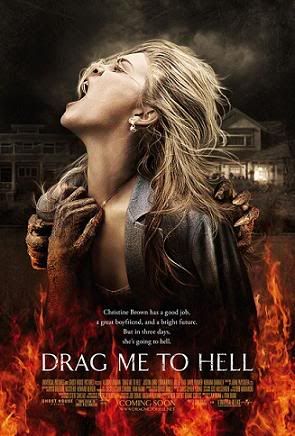
Drag Me To Hell (Raimi, 2009)

You may notice that this entry jumps around a lot. We can say that, like Raimi, I like to make your mind jump, but that doesn't really work. Essentially, I need a post because this is for the marathon, but I am devoting most of my writing tonight to my Where the Wild Things Are review.

I have not seen the Evil Dead films, I really do not know what other non-Spiderman stuff Raimi has done, but after seeing how terrible Spider Man 2 was I had some reservations going into this film, As this little horror marathon continues I veer away slightly from the fun times found in Trick 'r Treat and actually sit down with a horror film that seems to be designed to scare. Raimi creates tension wonderfully and effectively delivers just about every jump scare he sets out to offer the audience, though that is not to say that the film is engaging simply because it can make the viewer jump. The tale is quite compelling, centering around Alison Lohman's character attempting to rid herself of a curse, and the camera work is damn near top notch. Not to mention that the visual effects are both rather stylized and great at setting the film's tone.

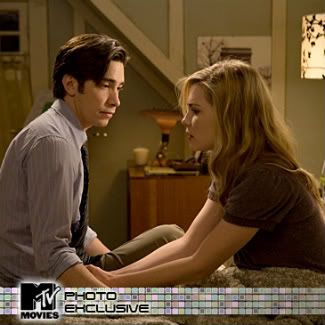
Lohman gives one Hell of a performance in the lead role, in fact I would probably list her as my second favorite actress of the year behind Charlotte in Antichrist and just ahead of Emma Roberts in Hotel for Dogs. As much as I like Justin Long, and that is a good deal, he does not really do all that much with his role. I suppose if there is a surprise it would come in the form of Dileep Rao, but I do not consider him among my favorite supporting performances of the year so it does not appear that he is worth mentioning in any detail. Really the film is Lohman's story and she does everything in her power to make sure that she keeps the viewer engaged.

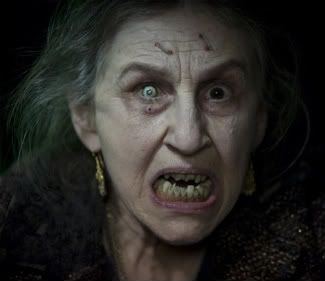
While I am very inexperienced when it comes to horror films, it is also apparent during the film that Raimi is playing with genre convention, which adds a nice layer of underlying humor to the whole affair. There are some scenes that remind me of my time with Poltergeist 3 (no, I don't know why, of all the Poltergeist films, I watched the third one, but whatever), while a number of other scenes had me thinking of what I have heard about other genre staples. The whole dual horror/comedy thing comes to a bursting point when the seance scene occurs though, and what a fantastic scene Raimi has constructed. Without giving away too much information, a goat is involved, as is an old woman and a man servant. The humor is there, but the film never lets the viewer forget the severity of the situation. It's really genius construction, and similar scenes are found scattered throughout the film.

I do not know if I can all Drag Me To Hell one of the best films of the year, and I do not think I can say that it is better than Trick 'r Treat, but Raimi presents me with a film that does get significantly more frightening than Trick 'r Treat while still being at least as entertaining to watch. In hindsight I probably respect the film more than I enjoyed it, but maybe it is the other way around. I'm still not entirely sure. That will likely be a theme tonight as I get to my Wild Things review. I likely would have benefited from knowing more about the genre, but the genius of the film is that is can be enjoyed without all the viewer needing to get all the winks and nods to past films that Raimi has, I believe, inserted here. Anchored by a stellar performance from Lohman, some excellent camera work from Raimi, and a story that is as frightening as it is entertaining, Drag Me To Hell is a blast. I should probably buckle down and watch The Orphanage now though to prepare me for potentially seeing Paranormal Activity in a theater. Maybe.

Result: Lights Off!

B+ or 3.97848237480932753829065

Comments are welcome and, for anyone with a literary mind, I encourage checking out my poetry blog filled with all original works for your reading pleasure.

Also I am on the old Twitter thing so I guess you can follow me at twitter.com/FLYmeatwad.

Sunday, October 18, 2009

Is It Much Too Much To Ask, Not To Hide Behind The Mask?


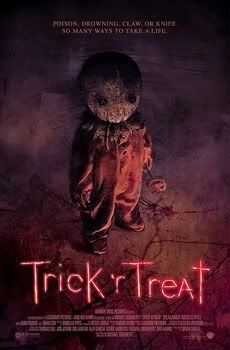
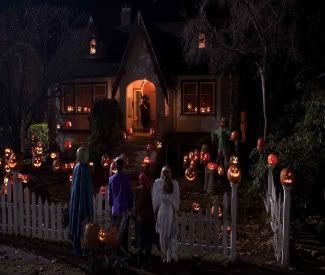
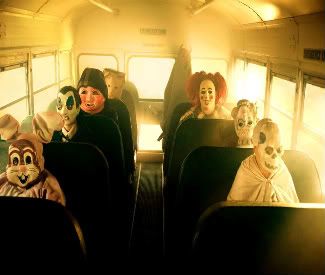
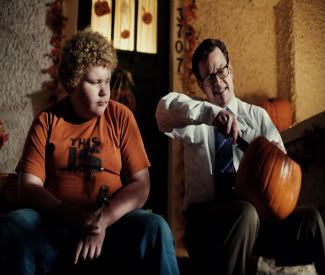
Trick 'r Treat (Dougherty, 2009)

I do not take well to horror films, a problem I hope to rectify this month with my "Keep the Lights On! (Generic Horror Marathon Extravaganza!) Marathon of Monsters, Mayhem, and Mental Provocation Marathon." Unofficially this started with Antichrist, so I guess we can say it has a 2009 theme for now given this entry and the forthcoming Drag Me To Hell one. I'm not into labels...man. And in many ways neither is Trick 'r Treat (boom! What a lead in!), walking a fine line between horror and comedy that few films in recent memory have tread so capably. But let us not confuse this for a film like Shaun of the Dead or a Scary Movie, Trick 'r Treat is definitely a horror film, it just has a good deal more fun with the genre than what I imagine many more recent serious scary movies do, which is probably what makes it such a gateway film for this marathon. It is not necessary scary, it gets slightly formulaic and predictable, but it's still a consistently enjoyable and interesting ride.

A uniform narrative, at least in the sense that it all does occur in one area on a single night, the film follows four different groups of people on Halloween night. All of the stories flow normally, the cuts are not awkward or anything like that, and they are strung together by the ominous Sam character, a young child with a burlap sack or something similar covering his head. Visually it works wonders and keeps a mysterious figure at the center of what is already a collective of incredibly compelling tales. The performances are nothing incredibly special, I suppose Anna Paquin is the big name but she has never done much for me and she only continues to underwhelm in this film, and the direction did not have me stunned, but the film is edited excellently and really wonderfully paced and constructed, so I have no qualms about the technical aspects of the film at all. In fact, the film has a visual style that practically drips the essence of Halloween. Unlike any film I have ever seen before, and admittedly they are few and far between, no movie conveys all the atmosphere that comes with this time of year. It's absolutely intoxicating in a way that the all time great holiday movies are, and in many ways this film has the substance to exist as a great film even outside of the Halloween time frame. I suppose anyway since it just released and I will have to revisit it in a few months to verify this claim.

Many aspects of this film really reminded me of some childhood memories magnified and readjusted for a person who, like myself, grew up with these television programs and has missed similar thrills that cater to a more mature demographic. The film captures the thrill of a show like Are You Afraid of the Dark?, the excitement of a movie like Hocus Pocus, and the twists and turns that R.L. Stein delivered in his Goosebumps books and television series. Having the film tap into all of these different entertainment forms, while still making everything modern, occasionally bloody, usually frightening, and R rated in terms of language and what not, makes for a film that not only hits all the right notes in regard to nostalgic purposes, but also acts as a great thrill ride that does not let up at all during the 90 minute or so run. I am honestly stunned that such a high quality film was kept out of theaters and saved for a direct to DVD release, it truly is impressive that such a film could slip through the cracks because it seems to be able to appeal to anyone at all, even a non horror fan like myself. Who does not like to have a little fun?

So, unlike Antichrist, Trick 'r Treat is a much more traditional horror film, or at least that is what I have gathered. Plus the way it embraces Halloween is absolutely stunning, though I have probably fawned over that enough over the course of this review. Sure the film is not flawless in the sense that it has insane thematic depth, character development, or even interesting direction, but it also does little to nothing wrong aside from getting a little predictable toward the end. The film is a good time, it's a unique tale, it has a central symbol and idea that are both advanced incredibly well, and it really is a film that should enter the holiday cannon. The film is not scary, so those looking to be frightened should probably look elsewhere, but everyone really should go out of their way to check out this film, preferably before or on Halloween, because it truly is one Hell of a ride.

Result: Lights Off!

B+/A- or 4.182397214723104723

Comments are welcome and, for anyone with a literary mind, I encourage checking out my poetry blog filled with all original works for your reading pleasure.

Also I am on the old Twitter thing so I guess you can follow me at twitter.com/FLYmeatwad.
Monday, September 14, 2009

I Pour Myself A Tall Glass Of Milk, It Was Deep And Cold


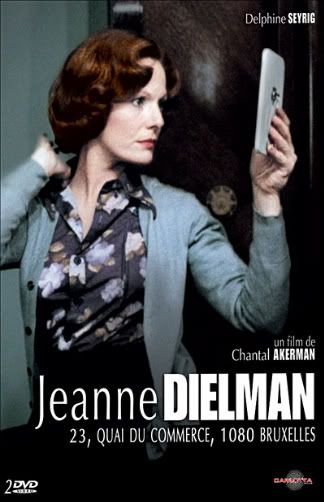
Jeanne Dielman 23, Quai du Commerce, 1080 Bruxelles (Akerman, 1975)

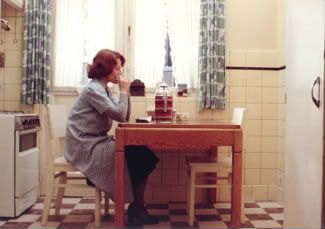
I had, for much of the month of August, avoided watching Jeanne Dielman. Part of the reasoning behind this avoidance was due to the Criterion release not being issued until the end of the month, so I clearly could not have Netflix send me a film that has yet to be released, but the other reason, the incredibly obvious one, is that the film is three and a half hours long of a Belgian woman doing stuff. At the time I was not sure what that stuff was, all I knew what that she cooked potatoes. Now I can get behind watching a Belgian woman cook potatoes in silence for about two hours, but you nearly double that and I just do not know if I am on board. As I opened up the Netflix case to see the new release sitting there, I figured I'd read the short description on the case and check out the Criterion website. Apparently the film was not only a feminist yarn, but also one of the earliest films from a 25 year old director, Chantal Akerman. Obviously, this behemoth draws immediate comparisons to the American classic Citizen Kane. My excitement for this film had effectively gone from mild to incredible. And so the tale of Jeanne Dielman started.

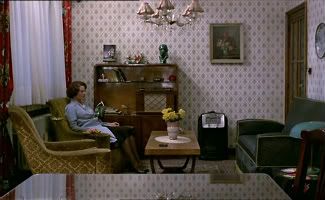
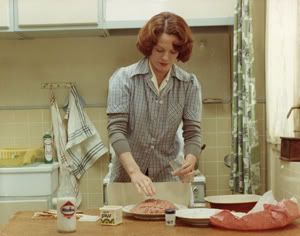
So, minimalist is probably not a good enough word to describe this film, the elongated sequences of Jeanne going through her daily routine in usual silence run throughout the entire film. When Jeanne prepares dinner, she goes through each and every action of preparing the food, never skipping any step. Filmed fantastically, Akerman makes effective use of long shots, congested scenes, and, much to my delight, the constant use of the same exact positioning of the camera outside the kitchen and leading to her bedroom, day in and day out, make for scenes that I shall not forget. The entire film is marked with the visual accomplishment of a seasoned filmmaker, so discovering that she was so young when making the film had me feeling rather shocked. Perhaps equally surprising is that I cannot recall any scene that looked amateurish, or even seemed out of place with the visual look of the rest of the film. Given that the film runs for such a lengthy time, and I'm sure the excess footage was likely staggering as well, Akerman's ability to make the most out of each shot is particularly impressive.

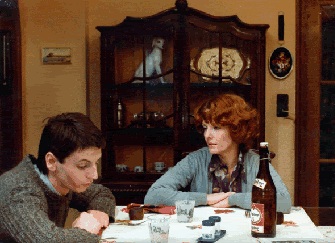
Of course not all of the film's successes are attributed entirely to Akerman; instead, one of the film's greatest strengths comes in the lead performance from Delphine Seyrig. As I have said before, much of the film is mostly dialogue free, yet Seyrig somehow needs no words to completely develop the Dielman character. Perhaps because of the routine like nature of the food preparation, or the detachment shown from the men who pay her for sex, or perhaps even because of the time spent simply sitting with her son at the table, one can understand both her circumstances and specifically why Jeanne is such a compelling central figure. From the trapped sense all the way to Jeanne's perceived independence and awakening, Seyrig is constantly somber and reserved, yet completely full of emotion and believability. Of course the rest of the cast is pretty fantastic as well, and Jan Decorte, in the role of Jeanne's son, makes the most out of his scenes.

Perhaps I should now talk about the pacing. While I have made slight reference to the repetitive aspects a little earlier, I will take this time to briefly expand on that aspect's impact on the film. Yes, some of the portions of the film are slow because nothing seems to be going on at a surface level, but when sitting down and really watching the film, and specifically watching Seyrig's movements, as she goes through her daily routine, the intensity level is miraculously heightened. Not to mention that when things start slowly unwinding, it hits and it hits hard. During the second portion of the film we see Jeanne encounter a problem with dinner that seems so minute, but the intensity of this event is captured perfectly. The film is so simple on the surface, but even if the viewer misses everything in the film, the ending is a giant clue that some more themes are going on below the surface. While I felt that I had a decent grasp on the film up to that point, the overt symbolism had me re-evaluating some portions of the film up to that point. I am positive that when, in a few years, I sit down with Jeanne Dielman again, I will find much more than I had initially discovered with the film.

I could probably dissect the film further, but much more capable people already have and they also likely have the advantage of multiple viewings. So as far as an initial reaction is concerned, I feel that I covered enough territory to make it known that Jeanne Dielman is one Hell of a film and certainly something that should not be missed nor should it be dismissed because of it's immense run time. Anchored by a stunningly strong lead performance from Delphine Seyrig, and paired with some fantastically masterful direction from the young Akerman, Jeanne Dielman is worthy of the comparison to Citizen Kane while still existing as one incredibly complex, challenging, rewarding, and strikingly unique examples of film making.

A or 4.728374983215436523145671

Comments are welcome and, for anyone with a literary mind, I encourage checking out my poetry blog filled with all original works for your reading pleasure.

Also I am on the old Twitter thing so I guess you can follow me at twitter.com/FLYmeatwad.

Monday, August 17, 2009

What A Gas It Was To See Him Walk Her Every Day Into A Shady Place

Planned on doing a double shot review, but I just do not feel that I have much to say about the second film, so I'm just going to tack on a little bit at the end to give it some attention.


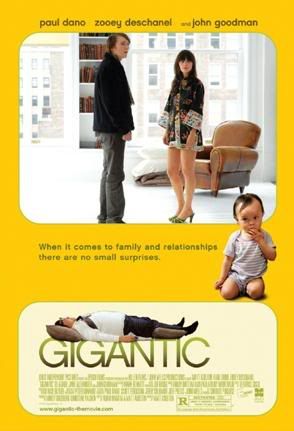
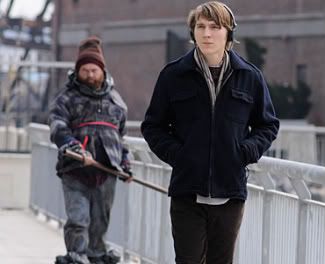
Gigantic (Aselton, 2009)

In many ways, Gigantic is a wonderful experiment that ends up, somehow to its benefit, less than the sum of its parts. Anchored by a wonderful cast, featuring Zooey Deschanel in her second, and more impressive, performance of the year, first time director Matt Aselton comes out firing on all cylinders, but has a good deal of trouble putting everything together for a transcendental film. However, this does not prove to be the detriment that it would immediately seem to imply. Gigantic constantly walks a fine technical line, shifting from beautifully disciplined camera movement, albeit a bit too contained at the film's start, to wonderfully beautiful hand held shots that showcase a striking freedom, such as the scene where the camera drifts in and out of trees in the woods. Unquestionably, the film is a visual powerhouse. The cinematography is some of the best of the year so far and Aselton shows a ton of potential for any future films he will hopefully involve himself in. Whether in the city or out in the forest, he has a way with presenting scenes in visually striking manners. The film is technically brilliant.

The ideas presented in the film are mighty interesting as well, though the movie could have likely used another ten minutes or so to give the viewer a push in some sort of general direction. I am all about ambiguity, and the way the film is constructed the ambiguous nature of the plot lines proves to be crucial to the entire experience, but the idea does not completely pay off at the end. However, I find myself incredibly interested to take a look back and see if I over looked any tiny details that may help give me something more to latch onto and ponder even more in depth. The humor, surprisingly, lands when it is used, but the film is hardly a laugh a minute. Thankfully, the film also crafts some pretty fascinating characters to make up for the fact that that plot is a little lean. But the film is also fairly complex and, much to my delight, only hints instead of coming out and actually revealing things, which I love in films. It makes the audience work, and I can respect the script for taking that chance.

Of course a lot of the writing could easily go to waste with a cast that is not capable of handling the roles. As I said, Deschanel is brilliant, and beautiful, and just about everything the role needs. Of course placing Dano opposite her, and having him turn in a performance that is both human and genuine, capturing the struggles of what appears to be a troubled man attempting to exist in 'normal' society, is a choice that pays off in droves. Goodman is mighty great as well, and Asner turns in a performance that is certainly at least five steps above his voice work in the underwhelming, and incredibly overrated, Pixar film Up from earlier this year. Other highlights of Gigantic include a soundtrack that rivals Adventureland and Lymelife for the year's best, a fantastic supporting cast, and a highly stylized world that all add up to one Hell of a debut for Matt Aselton.


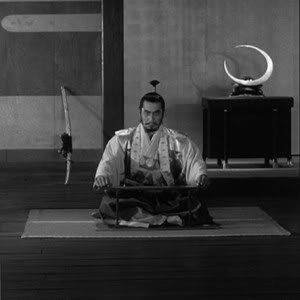
Throne of Blood (Kurosawa, 1957)

The film is visually gorgeous, the score is pretty great, the acting is good, and the film is another great effort from Akira Kurosawa. Sadly, this film felt much slower than the two previous Kurosawa films that I have watched and I really think that the silent portions here, unlike in Rashomon, detracted instead of added to the film. Basically the film is a standard retelling of Macbeth, and I've always been of the mind that Macbeth is much better material to be discussed than to be watched or read. Not surprisingly, that transfers over to Throne of Blood mostly. It's a pretty great adaptation I suppose, despite leaving out a few things from the play, I believe. But he also injects his own themes and visual symbols, which adds more to the film, I reckon. Can't say I was blown away though or that I have much to say about the film. It's really solid and a technically great film, but it just never really grabbed me.

B+ or 3.898213472146702381645823

Comments are welcome and, for anyone with a literary mind, I encourage checking out my poetry blog filled with all original works for your reading pleasure.

Also I am on the old Twitter thing so I guess you can follow me at twitter.com/FLYmeatwad.
Thursday, August 13, 2009

And The Sun's So Hot I Think I'll Catch Fire And Burn Up In The Summer Air So Moist And Sweet


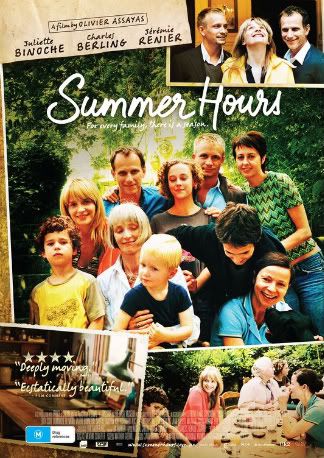
Summer Hours (Assayas, 2009)

So I reckon I should get this out of the way right now, I have not yet seen the French film from last year that is apparently part of this series, The Flight of the Red Balloon. Actually, my exposure to French cinema, both modern and the New Wave movement, is rather limited. However, as of this writing the only other French film I have seen this year, The Class, currently sits as my sixth best film released in 2009, so I found myself fairly excited as I sat down and went into Olivier Assayas' latest film, Summer Hours. Focusing on the surviving family of some French artist, I don't really get into these details because I do not know a damn thing about paintings and sculptures and stuff like that, in about a 100 minute run time, Summer Hours explores different concepts about loss and memory, along with the economic extension of real world circumstances that are important to more affluent families. While I knew little of the film upon entering, the first scene at the estate is a stylistic bang that really cements what proves to be an incredibly visually striking film. The first fifteen minutes or so set up the film and the characters so wonderfully that I found myself mostly swept up in the world being presented.

Being swept up, as I have said, is probably caused by, in no small part, the beautiful cinematography and masterful direction. Assayas does not employ the traditional handheld camera style that would seem like the obvious choice for this type of film, but he also does not make extensive use of a traditional camera style either. At numerous times the scenes feel a little contained, but the idea that these decisions were anything but intentional seems insane simply because the film just looks so professionally constructed. Not to mention that, when using more traditional wide shots, the film looks beautiful. Maybe the way it is shot is supposed to mirror the audience's expectations that these people are supposed to be free because of their social status and money, but in actuality they are just as trapped as 'average' people, yet there is still a noticeable beauty in the human experience. Either way, the film is also anchored by performances that range from really good to great. The standouts are obviously Juliette Binoche and Charles Berling, with Berling really delivering a stellar performance, but all of the supporters are pretty damn fantastic. The younger actors who play the children are also mighty impressive. However, the true mastery is only shown for a very short time, in the form of Edith Scob. She brings an elegant grace and knowledge to her role, despite it mostly being contained to the first portion of the film.

On the whole, Summer Hours is a pretty interesting experience. The film is almost deceptively complex, touching on numerous themes despite presenting them in seemingly simple circumstances. The film is both broad and specific, taking a brush and painting a portrait of both beauty and melancholy, blending the best of emotions at any given time. I should also mention that the final three scenes in the film are some of the most effective of any film so far this year. I find pinpointing a single reason for their success rather difficult, but I almost believe that part of the intention is that nothing in the film is as simple as one would imagine. Summer Hours is a truly touching film that, even for someone with my disposition, works on both an emotional level and actually builds up my faith in the human condition, however minor that construction may seem.

A- or 4.1984892174238015472385320157

Comments are welcome and, for anyone with a literary mind, I encourage checking out my poetry blog filled with all original works for your reading pleasure.

Also I am on the old Twitter thing so I guess you can follow me at twitter.com/FLYmeatwad.
Tuesday, August 4, 2009

There'll Always Be A Few Things, Maybe Several Things, That Your Gonna Find Really Difficult To Forgive


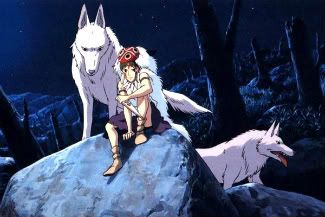
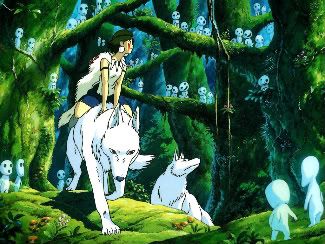
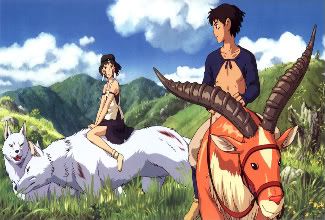
Princess Mononoke (Miyazaki, 1997)

Well, I suppose it is about time that I get to Miyazaki's crown gem, or what I assume is his crown gem considering that Spirited Away is not nearly that great. Going into Princess Mononoke I had only the film's reputation to go on as I did not know anything of the film's plot. Of course as I gazed down at my Netflix sleeve to see that the run time was listed as two hours and fourteen minutes I found myself pretty worried that this film was going to be a bit too long for its own good, after all, the best Miyazaki films are the shorter ones. Oh yes, I was also pretty sure that I heard this film dealt with some environmentalism crap, and since I have made it my mission in life to personally see my own carbon footprint before I die I was pretty sure that any overtly environmentally friendly themes would end up pissing me off. But hey, I'm an open minded kind of guy, so bring on the Mononoke!

The first striking characteristic the film possesses, well aside from the visual aesthetic, is found in the form of the story. Now I do not use the word story in the sense that the word refers to plot, but rather I mean to say in the way the story is told. In many ways Princess Mononoke is a fairy tale, not unlike classic Disney films that focus on Princesses, albeit with much more characterization, as it possesses all the whimsy of a magical world existing in a mostly realistic setting. The world is really well established. The story is simple enough that it feels like it is being told instead of watched, a characteristic that is captured perfectly in the film, but I do not think designating Mononoke as a simple fairy tale completely does the film justice. In many ways Princess Mononoke feels more like a myth, lore passed down from generation to generation and being refined through each progressive telling of the tale. Now I'm sure I got this feeling because of the film's context, it does take place in historical Japan, I think, so the fact that it feels like a myth rather than a fairy tale is expected. However, what I found particularly fascinating was how it felt so culturally specific yet works so well for an audience member who is not a part of this culture. I think part of Miyazaki's ability is to craft and play with this universal magic without sacrificing the Japanese element of the film. In short, the way the story is presented is pretty wonderful.

Of course that is not to say that the film is all whimsy and child friendly. The content is rather mature, limbs fly all over the place and blood plays a hefty part in Mononoke, but it is all handled so gracefully. And there is that little environmental aspect, but the film handles it more as a reverence that is nicely disguised to work with the time instead of being something that hits the viewer over the head. Plus the film does not take the whole 'all technology is terrible' route either, so I can definitely appreciate that given the way Miyazaki openly says that both sides can coexist peacefully. The film works as an allegory alright, but as a straight up film it works as well. The opening sequence is riveting and really all of the action sequences are high energy filled thrill rides. On top of that the film mostly nails all of the sombre moments as well, so I am mostly confident when I say that the run time, despite being a little lengthy, is not a detriment to the film at all, though I did need to take a break during the run time for what that is worth. Actually though it is refreshing to see an animated film willing to stretch out the run to over two hours, as most great animated films I generally want to see more of, so having Mononoke take on a lengthier feel, which also enhances the mythological epic feeling, was a wise choice.

Speaking of animated films, all the technical aspects on display here are top notch. From character animation to the way scenes are drawn, the film is a visual power house. Obviously the imagination in the fantastic characters is going to stand out, Miyazaki has a way with designing these larger creatures that oozes originality, but the real strength is the way that he designs the worlds. The forests, the mountains, and the towns all have a believable beauty to them, not to mention that the traditionally drawn animals are incredible. However, to enhance these creatures, the ones that actually speak are voiced with an insane intensity that makes for numerous great voicing performances. Now I watched the film with subtitles so really all I could go on was how the lines were delivered, but even with this I found myself mostly swept away with the characters. A lot of effort apparently went into the dub as well, so I watched a few scenes with the American voice cast and I can mostly say that the quality of the voice acting there is at least on the level of the Japanese voices. The film, all around, sounds spectacular. Mix that with a brilliant score and the film records high marks in terms of technical quality as well.

So by now it should be pretty obvious that I loved my time with Princess Mononoke. The film is mature, complex, and pretty much a master piece. It avoids the pitfalls that plague some of Miyazaki's lesser works like Spirited Away and Howl's Moving Castle, and I would have to say that it rivals My Neighbor Totoro and possibly even Porco Rosso as the best Miyazaki film that I have seen. Okay, well maybe not Porco Rosso, but I certainly love it as much as Totoro. Any minor problems that I found with Princess Mononoke have quickly been forgotten in one night's time and I am left remembering all of the breath taking positives. On the whole, the film seems to capture what is great about animation, both Eastern and Western, and I think for that alone Princess Mononoke deserves to be championed as an artistic accomplishment. Truly one of the best films ever made.

A+ or 4.83748324623954163596159

Comments are welcome and, for anyone with a literary mind, I encourage checking out my poetry blog filled with all original works for your reading pleasure.

Also I am on the old Twitter thing so I guess you can follow me at twitter.com/FLYmeatwad.
Monday, August 3, 2009

Companionship Is Where You Find It, So I Take What I Can Get


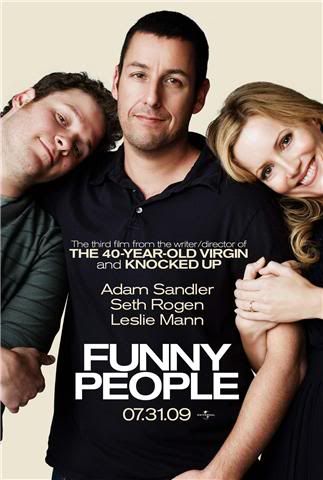
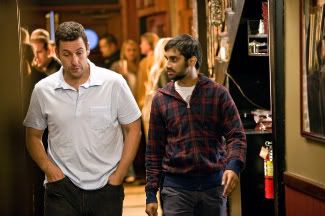
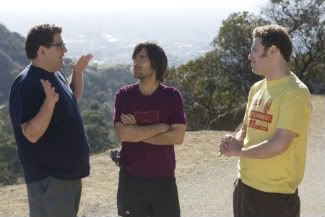
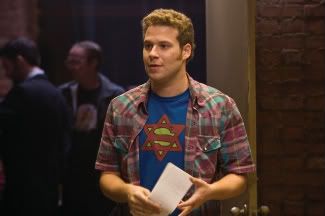
Funny People (Apatow, 2009)

After two major successes where he spent time at the helm, and what seems like a million 'Produced By' attachments to the end of trailers, Judd Apatow returns with the Adam Sandler and Seth Rogen vehicle Funny People. After seeing the trailer it seemed to be another formulaic Apatow film that was going to present the audience with a standard situation, heighten it up a bit, throw in some laughs, make things a little depressing, get a romance going on most of the time, and then wrap up nicely. Well, taking a page out of the Adventureland book to non-success, the trailer does not do the film much justice. The romance aspect of the film is but a footnote to the story of Ira and George, Rogen and Sandler respectively, and how these two men bond during the course of the film. Think I Love You, Man except better. The movie is about characters and comedy, not love and loss.

Clearly the film's greatest strength comes in the form of the lead actors. Both Rogen and Sandler are fantastically funny yet emotionally sound. Sandler has already shown his ability as an actor in Punch Drunk Love, but seeing Rogen be a bit more than what he was in Knocked Up was a nice change of pace. Sandler is the obvious stand out in the film, but Rogen mostly matches him blow for blow, as the comedian mindset the film explores makes necessary. As for the supporting cast, things are a little lack luster. Mann plays her same type of role, which is nice, Bana is pretty damn funny, Hill is mostly good is limited time, but Jason Schwartzman is clearly the best of the supporters. He plays his role of the gloating and arrogant friend realistically and perfectly, capturing what is so disgustingly human about, well, humans. As for Apatow's kids, they have worn out their welcome and really slow the film down when it has already lost steam. The two are not really funny, they are not really cute, and they do not do anything to enhance the film.

Speaking of losing steam, the film is phenomenally strong for the majority of the first hour and a half. Then the narrative decides it wants to take a prolonged stop in romantic comedy territory. For something that is so focused on how Seth and Sandler interact with each other, which is clearly the point of the film as the ending so clearly implies, the amount of time that Sandler spends needlessly wooing Mann is both sloppily integrated and pretty dull. Sure it adds in some laughs, but at the expense of a more complete narrative. The film is dark and comedic early on, it even seems to have the perfect opportunity to end when a line is delivered from an unexpected face, "Then what are you celebrating?" The film would have been a masterpiece if it just stopped. The script could have been altered slightly to tie up the Rogen/Sandler plot line and the film's tone would not have been undercut, but for some reason Apatow cannot do that. The 40 Year Old Virgin has similar problems, and Knocked Up has similar problems. Apatow just cannot write endings.

Thankfully he can work a camera. While the direction is not mind blowing, it does range from solid to really good on numerous occasions. Early on the opening scenes following Sandler are really great, the one wide shot where there are a few pineapple shaped trees on the lawn is pretty great, and the dinner scene is cool as well. Still, Apatow does not prove himself to be one of the best men working with a camera, but at the same time he also never does anything really bad with the camera, so I suppose that means this is mostly a wash. Probably not though because he has some really great parts, right? Sure, let's go with that. Okay, the direction is pretty good, I guess Judd can work a camera. Still, it's not his strong point, but the film still works fine without all that technical flair, mostly because of the first hour and a half. Mostly everything before the rom-com bits.

Damn romantic comedies. Damn advertising. Damn mismarketing. Damn it all. You want to laugh? Well then you're probably better off watching Judd's previous two films, of which The 40 Year Old Virgin is the funniest, but if you want to see Apatow's best film then you should probably see Funny People and just pretend that the bit after the celebration scene doesn't exist. Despite the film's failures, it proves to be the most complex of Apatow's films because it departs most radically from the common Apatow formula that the trailer implies. Funny People examines comedy, it examines humanity, and it tosses in enough penis jokes to appeal to the people who could care less about these two previous explorations. Is the film a transcendental comedy? No. But any film that presses the fourth wall like this while showing the potential to be a masterpiece is good in my book. Plus the bits where Adam Sandler just about openly mocks his career and almost admits that the majority of the films he acts in are shit is pretty great. Keep up the good work Judd, and just learn to write a little less generic.

B+/A- or 4.18213907214746123784691

Comments are welcome and, for anyone with a literary mind, I encourage checking out my poetry blog filled with all original works for your reading pleasure.

Also I am on the old Twitter thing so I guess you can follow me at twitter.com/FLYmeatwad.
To Give Me The Needed Professional Help To Protect Me From The Enemy, Myself


Depart From Me (Cage, 2009)

Second installment of my music reviews takes us to the latest from Definitive Jux rapper Chris Palko, better known as Cage. After radically changing his style from his debut record Movies for the Blind, Cage released his critically praised, but core 'fan' shunned, follow up Hell's Winter. Songs like "Ballad of Worms" and "In Stony Lodge" had prefaced Cage's lyrical shift, and once again the man has evolved as an artist and elevated his musical style with the release of his latest record four years after his previous. Stand outs like "Shoot Frank" and "The Subtle Art of the Break Up Song" paved the way for Cage's growth as a musician as Depart From Me begins to mark the artist's self proclaimed beginning of the end.

Nothing Left To Say - Starting off with a spacey pseudo-techno, pseudo-Radiohead background beat, Cage recites some thought provoking rhymes in a more poetic and subdued style, setting the album's tone perfectly, and then the drums blast in with a booming presence before Cage starts rapping quickly, as per usual. Then he starts singing, apparently dedicating the song to the late Camu Tao, before letting the instruments play wonderfully. Cage finishes with a solid verse and closes by singing the chorus again as the instruments mash up beautifully. A great establishing song to kick the album off.

Best Line: "Awaiting the hand of god knowing I stand to fall
I stared into the pitch black to no hand at all"

Beat Kids - Cage departs slightly from the style of the previous track to let the power chordy beat take centre stage as he slowly spins a chilling yarn before transitioning to a catchy chorus that juxtaposes the subject matter nicely. The mastery of the delivery here is apparent as Cage challenges conventional expectations and asks the listener to question and compromise established beliefs. The use of children in the second chorus backing up Cage is an effective technique too that adds to the song's themes.

Best Line: "And as he forces himself inside her
Her eyes dart around with pain
He says, “You can talk but no one listens to liars.”
But you will surely get yours one day"

Dr Strong - Introducing the song rather quietly and quickly, Cage simply states his former membership of Stony Lodge Hospital before the song picks up a powerful beat that makes great use of more modern industrial metal instrumentals. The song picks up a melodic and trippy semi-piano part about half way through the first as Cage begins exploring the forced drugs of his time in the mental asylum. This aspect is paired beautifully with a tragically moving chorus that Cage belts out impressively. The song ends with the final line of this chorus painfully held to mirror Cage's beaten down state that he describes before completely calming out with a wonderfully diabolical final line.

Best Line: "When you wake up drugged it’s tough to get your thoughts sorted
And you realize you’re tied down about to be drawn and quartered
But there’s no horses about to rip you limb from limb
But the tranquilizer in your blood is what they give to them"

I Found My Mind In CT - The opening minute of guitar here beautifully establishes the song's mood and tone while working to further showcase the album's embrace of more musically oriented tracks. Cage's instrument experimentation is particularly impressive on this track, and he certainly does not skimp on lyrical quality or delivery either. The subject matter is intense and morbid, particularly devoid of hope. The song is beautifully constructed, written, and delivered. Cage even integrates a bit of humor into the dreary lyrics that drip with a distinctive macabre.

Best Line: "My brain left me in PA, departed DC
Then begged me take it back crying in a bar in CT"

I Lost It In Havertown - Continuing the title from the previous song, Cage completely changes gears on this track to make for a fabulous one two punch. The insanely short run time is matched with an up tempo beat with a mash up of instruments that powerfully enhance Cage's lyrics. The distinction here is clearly that the style is more reminiscent of his older and quicker flows of albums past. The track effectively shows that Cage can still rap like he used to, but it also allows room for him to experiment with sound and grow as an artist. The song is great, but the two paired together are incredible artistic triumphs.

Best Lines: "You're tongue in your cheek and you're adorable weeping
Your water can leak in
Fill up the room as soon as I'm stuck in the deep end
I cling to a beacon I was sinking my teeth in
I flew from your region, left you some of my demons
You were some kind of treatment or something else"

Teenage Hands - Cage continues the run of short songs with one of the album's stand out tracks. Telling the story of a sexual deviant on the prowl, targeting high school girls and showing off to relive the apparent glory days, until the second verse when Cage perfectly transitions from the theme of the first verse to a more politically geared tale of a youth enlisting in the army and becoming another cog in the machine. To think that he does all of this in a mere thirty seconds is not only impressive, but a testament to Palko's ability as a master story teller.

Best Line: "Kissing on her neck and squeezing her hand
Like the lungs in your chest trying to breathe in sand
Knife in your stomach and they shut the van door
So you can find out they've got special plans for -

YOUR LITTLE TEENAGE HANDS"

Eating Its Way Out Of Me - The song starts off with a repetitive beat that mirrors a saw, a nice effect that adds an unsettling feeling to what Cage is about to present. The song's lyrical material is probably the most diabolical so far, dealing with a masochist's mentality and detailing a dysfunctional relationship that flips the abuser/abusee role. Cage really shines here as a writer and a musician, establishing his style and perfectly blending the lyrics to the instruments. Clearly one of the record's most successful experiments.

Best Line: "Reopen the scab in my head that never healed right
I can say I’m happy, just don’t know what it feels like"

Kick Rocks - Cage really shows his ability as a story teller here, scripting the song at first before starting off with the chorus. The majority of the song actually plays out more as a dialogue than a song. The song is mighty magical and one of the record's more definitive. Cage really does not rap on the track at all, but the whole track is incredibly catchy and for some inexplicable reason works musically and is certainly one of the record's most fun songs to listen to, despite not being much of a song at all.

Best Line: "Hey, I'm sorry to hear about that mom, but uh look, I'm kinda busy right now
Help you move furniture!?
You're kinda breaking up...
Can you hear me!?
MOM!?!?!"

Captain Bumout - beginning with another spacey/trippy beat, the song quickly becomes very produced and eventually picks up an upbeat guitar as the song leads to the chorus. The song is actually an odd track, but once again shows strides in Cage's ability to adapt his lyrics and delivery to beats that become less and less standard and much more instrumental. Cage breaks a ton of barriers with this song and bridges a lot of gaps between rap and rock, not to mention the semi-tongue in cheek radio-esque chorus. An incredibly interesting track and one of the album's finest.

Best Line: "I'm such a misfit in social situations, I hate it
Depression medicated yet you're insecure and naked
I'm trying to loosen up, you're dying to read my sullen eyes
This intellectual black hole reeks of cologne and lies"

Strain - The record starts to wind down, but the instrumentals certainly do not let up. Cage starts to really nail the beat to delivery thing from here on out, so I am probably going to start cutting down on how much he develops over the run of the album. The song's lyrics are a mish-mash of standard Cage themes, but the lyrical prowess here is mighty impressive and is paired with one of the album's catchiest hooks. Seemingly designed to sing along to, the song is easily one of the highest points of the fourteen tracks.

Best Line: "I won’t let you go if you hate me, just don’t amputate me
I won’t try to kill myself today as long as you save me"

Fat Kids Need An Anthem - Certianly one of the record's strangest tracks, Cage breaks from his beat and delivery experimentation to experiment with sounds. Mimicking the famous rant from Suicidal Tendencies's "Institutionalized" Cage turns in an inspired effort where he begins to have a little fun with the record. While the song is not overly complex, it is a fun listen and touches on a few nice points. The absurdity of it all is what really makes the track stand out though and it provides a nice little bit of breathing room before the heavier final three tracks.

Best Lines: "I remember I was watching Fight Club with my ex-girlfriend and the part came up where he had bitch-tits and she laughed and I had bitch-tits so that means she was really laughing at me."

Look At What You Did - We may have just hit the high water mark. Everything about this track works flawlessly. Cage effectively makes use of instruments while capturing the sound that older fans love without compromising his newer sound or material. Cage weaves a tale, he makes a song, and he puts out an incredibly catchy chorus. The song is standard single stuff, but it is one Hell of a ride and pretty damn thrilling. All of these experiments seem to be paying off as Cage begins perfecting his sound.

Best Line: "Bloodsuckers looking at me stuck with mice
I got the blood of Christ on a cup of ice
She took my eyes and she put em on her somehow
Now I understand why she gets up after sundown"

Depart From Me - The penultimate track is also serves as the record's title, so expectations for the track should be mighty high, especially considering the slew of hits that Cage has been on up to this point. Thankfully, the track does not disappoint. In many ways it elevates even the previous track. The catchy chorus is replaced with one that contains an air of hurt arrogance, meshing with the lyrics wonderfully. The track actually does blend rock and rap perfectly, the experiment seems to mostly be complete and the results are clearly successful. Complex and beautiful, "Depart From Me" is something magical.

Best Lines: "All you need to say
You can share it with the dude in your bed
You did your crying career and started climbing
I thought it could be forever
Now on all my records you're dying"

"You knew it was so hard to see my brother die
so pardon me, you just depart from me
You ruined art for me..."

I Never Knew You - Closing things out with the record's first single is an interesting choice, but it only proves that Cage did make the record he wanted to make and that every song is ordered specifically to enhance the CDs themes. The chorus here showed the flashes of brilliance that would come with the record as the guitars on the chorus elevate with the chorus to flood the song with emotion. The subdued style juxtaposes the loud chorus for a mesmerizing effect. As a song the track works, but as a story it succeeds on more levels than E Harmony uses. A perfect cap to what is truly one Hell of a record. The song ends on a chilling note, the machine that started everything off shutting down. It's so beautiful.

Best Line: "If there was a way out I think you would've taken it
My hands and arms are the only way that you can leave
Face to face for the first time you feel what I'm feeling
Selfishly no longer breathing
Because
Of me "

In just about every way Depart From Me is an upgrade for Cage as a musician. Yes some tracks fall flat, but the record allows him to once again refine a sound form a previous concept he had worked with on a previous album to make something magical. Cage spread his wings with Movies, he refined and perfected his lyrical material on Hell's Winter, and now he has started refining the way instruments work with lyrics in hip hop on Depart From Me. The strength that the final half of the album possesses tells me not only that Cage has carefully constructed the record in such a fashion that the full power it holds can only be experience when one sits down and actually listens to everything from start to finish in one sitting, but it also implies, given his previous track record, that his next record can potentially be one of, if not the, greatest CD ever made.

Personal track rankings below. I should also note that iTunes has a bonus song titled "Hugs and Kisses" which I do not have because I purchased my copy directly from Def Jux; thus, this review does not include that track.

14. Fat Kids Need An Anthem
13. Beat Kids
12. Kick Rocks
11. Captain Bumout
10. I Lost It In Havertown
9. Dr. Strong
8. Teenage Hands
7. I Never Knew You
6. Strain
5. I Found My Mind In CT
4. Nothing Left To Say
3. Eating Its Way Out Of Me
2. Look At What You Did
1. Depart From Me

I shall likely return next Monday, on my birthday, with a review of Chamillionaire's final entry in the Mixtape Messiah series, Mixtape Messiah 7.

Comments are welcome and, for anyone with a literary mind, I encourage checking out my poetry blog filled with all original works for your reading pleasure.

Also I am on the old Twitter thing so I guess you can follow me at twitter.com/FLYmeatwad.
Monday, July 20, 2009

Down Here Where The Heat's So Fine, I'll Drink To Your Health And You Drink To Mine


Ratcatcher (Ramsay, 1999)

My excitement to watch Ratcatcher, a look at a youth's life during the Glasgow Garbage Strike, was enormously high because I had heard it compared to David Gordon Green's wonderful film George Washington. After finishing Ratcatcher I found the film to be a bit more similar to 2006's film This Is England than it was to Green's masterpiece, but unlike This Is England I am positive that I had an overwhelmingly positive response to Lynne Ramsay's film. The film is constructed beautifully and provides an insightful look at the construction of a child's identity without ever hitting the audience over the head with explanations for why James is the way he is, the boy just exists and grows in response to the people he is connected with and the time in which he lives, nothing more, nothing less. It is with this strength that the film carries itself during the hour and a half run time and really establishes itself as one of the greatest films ever made.

The film immediately starts out by showcasing Ramsay's directorial prowess, a trait that never lets up once during the film. The movie overflows with stunning shots and sequences that high light the atmosphere at the time and showcase some of the most spectacular cinematography I have ever witnessed in a film. At the start of the film, for about the first twenty minutes or so, it is actually very fortunate that the camera is used in such a wondrous manner because without such technical prowess I think it may have easy to lose interest in the hurried narrative; however, the reason the interest in the story is not there immediately is likely a result of how Ramsay opens the film and what expectations she works into the viewer's mind. When a film opens with a character we are generally led to believe that this figure will be the central character, and then Ramsay flips that entire notion on its head. It's a really impressive technique that adds to the film's meticulous construction in just about every aspect. Of course the film picks up immensely after the twenty minute mark when James goes on his first bus ride, so the prowess then begins to elevate the film instead of simply sustaining the movie.

Of course all the technical accomplishment a film may possess can easily be undermined by poor acting, but thankfully all of the actors in the film are really great and handle their roles with similar care to how Ramsay handles the script and the camera. In the role of James, William Eadie turns in an incredibly heartfelt performance that completely captures the mentality of a youth both in and out of place. He shows a spectacular range and is pretty phenomenal. Tommy Flanagan is pretty great as the Da, but of the secondary characters the obvious stand out comes in the form of Lynne Ramsay Jr. in the role of Anne Marie. She hits all of her notes pitch perfectly and always makes the audience want to hate her, but she possess some sort of mysterious charm that really prevents that, until the film begins to close and we see just how perfectly she played the part and how much respect she seemingly had for her character. It's mighty impressive that such a young girl can turn in such a powerful performance.

While it seems that this review is a bit shorter than my other looks at films, admittedly it is pretty rushed, I believe the reason for this is because the film covers so much ground that I am fairly sure that I was unable to completely grasp everything on a first viewing so I figured I would just discuss the highlights until I inevitably revisit the movie in a few years. I would also like to discuss, not at length or give any specifics, the fact that I'm pretty sure the film was designed specifically with my interests in mind. Never has another film gotten an ending so right nor with such mastery, beauty, and naturalism. It really is fantastic. Ratcatcher really nails just about everything in terms of quality and value while managing to turn in a compelling and complex film that takes great care to give the viewer just enough information to make the experience unique and rewarding. Sure it's no George Washington, the movies focus on two completely different topics and George Washington really covers much more territory, but who cares? Ratcatcher is still one Hell of a film that I can fully endorse.

A or 4.39239473285716843591263501236508

Comments are welcome and, for anyone with a literary mind, I encourage checking out my poetry blog filled with all original works for your reading pleasure.

Also I am on the old Twitter thing so I guess you can follow me at twitter.com/FLYmeatwad.
Friday, July 17, 2009

Surrenderin' For What? No Wavin' The Bandanna. Tell The Tool Man How I Handle The Damn Hammer


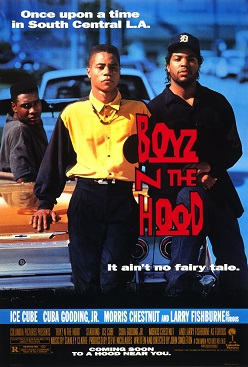
Boyz N the Hood (Singleton, 1991)

I was glancing over my other reviews and I noticed that, with the possible exception of The Adventures of Ichabod and Mr. Toad, I have yet to write a definitively negative review for a film. Going into Boyz N The Hood I was aware that director John Singleton is the only African American to ever be nominated for Best Director and, I learned this later, he is also the youngest nominee for the category. Now add that into the fact that I knew the film had a reputation for being a really great and insightful look at urban violence that neither glorifies or condemns the lifestyle, though that proves to be a misleading notion, while telling a compelling story with believable characters. I usually like films of this nature, the ones that ask questions and expose problems. So mix all of these things together with my fairly high expectations and what result is yielded? My first overtly negative reflection, of course.

Boyz N the Hood starts off wielding a ten ton hammer that is swung around with more violent rage than any act of brutality in the whole film, all in an attempt to hit the viewer over the head with some simplistic parallel that apparently is designed to be deep or insightful or something like that which hardly works. The scene which I refer to is, of course, the one where the children see that blood is turning yellow and one says "that's because of the plasmids separating," or a similar line. Oh boy, it's like the kids are learning the same thing as everyone except in a different way because of their living circumstances. The streets are just as educational as the classroom. Piss off, John Singleton, you think this is anything but a needlessly overt way to start off a film? Mix that in a few scenes later with Trey's arrival at his father's house depicting, after cleaning, a run down lawn shown alongside the neighbor's beautiful green grass. Lovely, everything is always greener on the other side. Good move.

Thankfully, Singleton backs off of these cliched and overly simplistic literary devices when the boys exit childhood and become high school seniors preparing for the end of school. Sadly, what replaces these tired devices proves to be just as detrimental to the film. Singleton essentially trades in his run down Toyota for a tractor with two wheels. The script takes an odd turn to a very cliched Hollywood story telling sense where a love interest is needlessly thrown in, a wife and bastard child are added to set up for more emotional impact later in the film, and the story takes no turn from the first party until the credits. The film just feels like an independent film fighting with a Hollywood film and, much like Doughboy and Ricky earlier, the film just gets dingy and gives up. While there are the occasional sequences that do take a few risks, as a whole the film is so by the numbers that these small probes into meaningful territory are completely undermined.

What seemed so tough whilst watching the film though was not that the film simply kept inserting cliche after cliche, but that it needlessly heightened just about every circumstance and conflict. A scene towards the end where Ricky's SAT scores are revealed proves to be absolutely cringe worthy. Singleton forces stakes into the film and they really stick out as cheap and unnecessary when placed alongside what is supposed to be a tragically brutal and realistic portrayal of impoverished life. On top of that, Singleton's direction, while a few really great shots are used, such as the walk down the rail road tracks, is pretty erratic, ranging from terrible to incredible at any moment in the film. Toss in the score and many times the film started to feel less like an in depth look at urban life and more like an after school special.

Perhaps Singleton's most apparent crime in the film is not inserting needless drama, though that charge is mighty hefty, but rather the most glaring flaw is Singleton's refusal to let the film speak without dialogue. Despite having opportunities, and even using them at times, to imply things instead of directly speaking to the viewer, Singleton feels compelled to give elongated monologues where Larry Fishburne speaks to the audience about his message, and it really comes off as insincere and overly constructed. Then there are parts where someone talks about how things just keep happening "over and over again." It's all pretty painful to listen to and detracts from any impact the film hopes to make on a viewer. The film is not helped by the actors either. Fishburne is decent, but Cuba is pretty bad and Ice Cube is mostly tolerable.

And of course there is the fact that the film is going over territory already explored in much greater depth, in much more detail and with much more sophistication, in other films. The whole concept of being trapped and unable to escape, or the perceived mentality of being contained, is straight out of Charles Burnett's wonderful film Killer of Sheep. Aside from being a much more striking and emotionally engaging film, Killer of Sheep also exists in a much more reserved fashion and does not need to insult the viewer by spoon feeding ideas at each possible opportunity. On top of this, Spike Lee has explored the other territory this film masquerades as exploring in an attempt to appear complex and thought provoking. Despite it not being a tremendous film, Spike Lee's Do The Right Thing provides a more engaging and insightful look at urban life and the injustices of American society without resorting to the theatrics on display in Singleton's film, allowing for a more naturalistic film that enhances the message instead of detracts.

Much like Do The Right Thing, Boys N the Hood becomes incredibly overt at the end. Yet while Spike continues to call on reality, Boyz N the Hood continues to rely on its cheap theatrics to attempt and force a greater emotional impact on the viewer before proving to be an ultimately hollow experience. The follow up 'here's what these characters are doing now' lines that fade in and out, aside from reinforcing the After School Special feeling, continue to draw attention to the fact that everything on screen is artificially heightened and constructed; thus, any attempt to draw parallels between these characters and the reality is, for the umpteenth time, ground into a dust and blown away in the wind.

Ultimately, Boyz N the Hood is nothing more than a jumbled mishmash of ideas that are far too willing to conform to Hollywood convention to discover the sort of effective statement that the film so desperately attempts to find. Even without considering the fact that other films, and older films, have done what Singleton attempts, Boyz N the Hood still proves to be a joke of a film that struggles to ever find ground solid enough to stand on either as a high profile Hollywood film or as a thought provoking call to social action. I honestly would like to know if anyone, after seeing the Burnett film and the Lee film, can still make a case for Boyz N the Hood being worth much at all. Hell, I'd be interested in hearing this case made even from someone who has not seen either the Lee or Burnett films because it baffles me that this film can be considered anything except for glorified garbage. I imagine there is more entertainment and more insight to be gained from watching Don't Be a Menace to South Central While Drinkin' Your Juice in the Hood.

D/D+ or 1.718921742381742835723108

Comments are welcome and, for anyone with a literary mind, I encourage checking out my poetry blog filled with all original works for your reading pleasure.

Also I am on the old Twitter thing so I guess you can follow me at twitter.com/FLYmeatwad.
Wednesday, July 15, 2009

Meet The New Boss, Same As The Old Boss


Ikiru (To Live) (Kurosawa, 1952)

The Kurosawa marathon continues with the 1952 film Ikiru (To Live). Now because I know little about Kurosawa outside of what I saw in Rashomon I have to wonder if this film is any indication of what types of films are to come in the future from the acclaimed director. Sure Rashomon started getting all philosophical at the end, but Ikiru starts things off with a metaphoric bang as we quickly learn the circumstances and are introduced to our protagonist. Given the film's description on the Netflix packet I had little idea of what the film would consist of aside from a man trying to build a park, but little did I know just how deceptive such a description is in the film's larger context.

Speaking of larger context let's start pretty broad and begin narrowing things down from there. Kurosawa turns in another fantastic effort behind the camera and, in some ways even more than Rashomon, makes for a visually compelling film. Seeing how differently he handles shots in a larger and congested city as opposed to the tangled forests was interesting and really gave the film its own stylistic feel while keeping with elements that are quickly becoming Kurosawa trademarks. Once again seeing the influence that the man has had on future films is near unmistakable when watching Ikiru, but in some ways I almost felt that, as far as direction is concerned, Rashomon is just slightly stronger. However, every time I thought this we would get sequences like the playground one or the one in the bar early on. In other words, the film looks pretty damn beautiful.

So now we'll get a little more concise and focus on the acting. While the film is littered with a ton of really good performances throughout, the anchor, as the script demands, must be Watanabe. Thankfully, Takashi Shimura turns in a top notch performance that hits all of the right notes. Even if the script was horrible, the direction terrible, and the other actors particularly dreadful, I am completely confident that Shimura's performance alone would make for compelling cinema. Obviously none of that is the case though and all the surrounding elements only help to enhance his job on screen. He captures the mentality of man perfectly and seeing him develop in the face of certain death and a crumbling family life is handled masterfully, both by Shimura and Kurosawa. The performance is truly incredible and certainly had me impressed throughout the hefty two and a half hour run time.

Now the run time could have easily been a flaw, and there were one or two scenes where things slowed down a noticeable bit, but for the most part the film was paced excellently. It clearly followed a very direct Three Act structure, but age old tales have always been told about how life is, at its core, three different parts all making up a whole. I do not think it is by coincidence that Kurosawa structured the film in such a manner, and taken in context it's a truly remarkable technique. Actually, most of the artistic value of the film is handled wonderfully and just about all of the philosophical stuff is given ample attention.

The one problem I had with the film was in the bureaucratic commentary. The film starts off with a whole round about sequence of going from department to department that is used incredibly, and most of the stuff in the third act, especially the final returning to work portion, is flawlessly executed, but the theme feels a bit underdeveloped during the middle portion. Now I know this theme was not supposed to act as the backbone of this portion, but having a little more there could have really pushed the film over the top for me. When the number of successes in a film are so plentiful, as is the case with Ikiru, the one flaw tends to stand out, but as I evaluate it I am able to realize that it does not hurt the film all that much. The only other potential problem I can think of, as was the case with Rashomon, is how direct the ending is, though thankfully nothing feels rushed or forced here, so the problem here is more personal and less technical, so my supporting evidence is limited.

Ultimately, my second experience with Akira Kurosawa was similar to my first. Things start off fairly simple, but as the film builds it picks up momentum at an astounding rate and makes for an incredibly compelling film. I think the sheer amount of material here, extraneous ideas given to each individual viewer I mean, is so numerous that I need at least one more viewing to process everything, but I can say without a doubt that Ikiru demonstrates Kurosawa's versatility as a storyteller and as a director while still existing wonderfully as a narrative. Ikiru hits every note pitch perfect and has me, once again, excited to see more Kurosawa.
A[/A+?] or 4.672348239143679563159783

Comments are welcome and, for anyone with a literary mind, I encourage checking out my poetry blog filled with all original works for your reading pleasure.

Also I am on the old Twitter thing so I guess you can follow me at twitter.com/FLYmeatwad.