Scre4m (Craven, 2011)
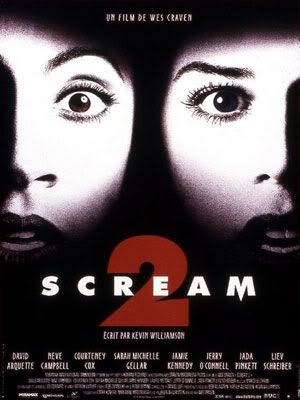
Returning to Woodsboro, quite literally this time rather than the fictional return of STAB, a film series within the series based on the events of the first Scream, found in Scream 3, suggests that the Scream series is making an attempt to return to its roots. Sure the core characters have changed, the disdain between Sidney (Neve Campbell) and Gale (Courteney Cox) has disappeared as the two are now able to reflect on their past mishaps and enjoy a mostly peaceful present, but the cast is still primarily made up of Sidney, Gale, and Dickey (David Arquette) trying to figure out who is responsible for the latest in a string of Ghost Face murders. The problem with a return to Woodsboro after 15 years since the initial events in the story is that the horror genre has changed so much since then that the slasher is an antiquated subgenre. Not to mention that too much of the 'same' storywise could easy get stale.
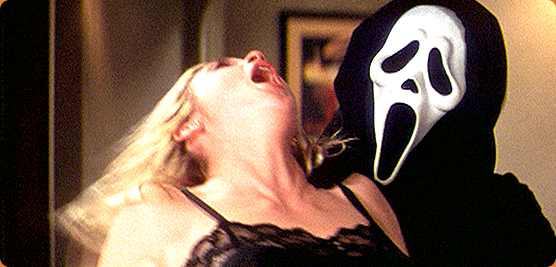
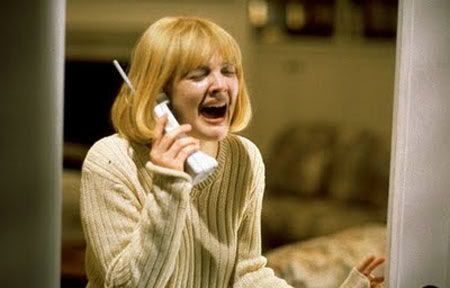
Thankfully, Scre4m, from the very opening sequence, manages to avoid most of the pitfalls by embracing all of the elements that have made the three preceding films successes. Continuing with the appeals to the meta, the Williamson script has the film open with another occurrence of Ghost Face terrorizing on screen victims, but then it pulls out to reveal that it was a part of a STAB film. Nothing new for the franchise, we have seen this done before. However, this event is then recreated one more time, only to pull away in a reveal that the initial scene was the characters in STAB 7 watching the opening of STAB 6. Included are a few comments about the emergence of torture porn in modern horror, the changed rules, and some more banal, but humorous, jabs at the modern genre. These, though, are all mostly abandoned after that second pullout occurs to reveal the actual first two murders in the real town of Woodsboro. This opening sequence perfectly establishes the current perception of Ghost Face, clearly detached and a bit of a joke for the new generation in Woodsboro, while still making the audience aware that this is, in fact, a Scream film where the scares are going to come interspersed with commentary on how and why these events are happening.
 The formula has worked for Craven so far, and Scre4m shows him in what may very well be top form. Craven has succeeded in the past when his camera is allowed to exert a sense of control over the audience. Through this control he is able to make the scares work and to keep the tension building throughout the film. In what may be a first for the franchise, the film actually maintains its tension as it continues closer and closer toward its conclusion. Most notable is a scene on a balcony where the score, the camera, the dialogue makes it almost apparent that one of the characters is going to be killed. A turn is made, a head-like figure is seen, but all is not as it seems. Taking this anticipation and withholding it is what makes the scares work, though none of this is possible without Craven's steady hand orchestrating the camera.
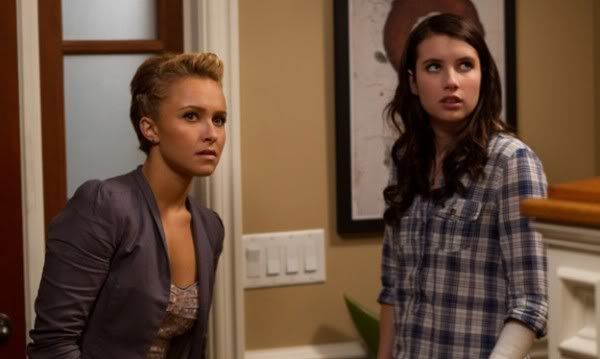
He also coaxes a number of fantastic performances from his entire cast. Most notably, and surprising, was the way that Hayden Panettiere as Kirby, one of the two main horror buffs in the movie. In fact, there is not a weak mark in the entire film, except for, perhaps, my favorite member of the cast: Emma Roberts. I will return to this and correct my misleading statement (I would likely argue that Roberts gives the film's best performance) when I throw up the spoiler tag and get more in depth with what each actor is asked to do throughout the film.
You know what? Now is as good a time as any to put up the SPOILER WARNING. If you haven't seen the film and do not want to know what happens, then you should stop reading. Basically, this film is very good, but below I will explain WHY it is very good!
 What Craven does, and I suppose this is partly Williamson's writing as well since it seems to be a script decision, is find another meta layer that can easily be missed if you are not keeping an eye, and ear, out for it during the film. Emma Roberts plays Jill, Sidney's cousin and, eventually, one of the two killers behind the murders. What I find most interesting is that, I would assert that it is by no coincidence either, her character's full name is Jill Roberts. What seems to be happening throughout is a play on Emma Roberts's traditional roles. This is seen in her performance, where she is a bit subdued, mostly playing a standard teenage character. It lulls you in the entire time, completely diverts suspicion, and then she becomes unhinged in such a brutally natural fashion. It is a testament to her ability as an actress to make this change so quickly and sell it so perfectly. I would argue that the reveal actually makes Emma's performance all the more impressive in retrospect, giving a reason for her choices to play quiet and inconspicuous. And the way she eventually throws herself around and confronts Sidney is another masterwork in what is one Hell of a resume that she has put together. I should end this paragraph with the obligatory mention that seeing her kiss Rory Culkin reminded me of a sicker, inverted version of Lymelife, though I would not assume this was part of the writer's intention in the same way the use of surname is.
The way this revelation is handled, originally seeming quite ridiculous, is actually one of the film's strongest points as well. She attempts to frame ex-boyfriend Trevor (Nico Tortorella) and fellow conspirator Charlie (Rory Culkin) as the two killers, echoing Billy and Stu from the first film, in an attempt to garner the fame that Sidney possesses. The motivation behind Jill's murder actually gives the film something to say. She, quite simply, desires fame. Though it feels as if the film is moralizing a bit too much when she gives her monologue explaining why she joined up with Culkin's Charlie to recreate the Woodsboro murders, it does ask the viewer to think about the way that media has been, and can be, manipulated to completely skew a public image. This idea is further reinforced in the brilliant final scene where, after Jill makes one final attempt to kill Sidney and her crew and is killed in the process, outside of the hospital a number of news reporters are talking about how heroic her actions were. Personally, I think it would have been interesting to see Jill succeed in her attempts, getting rid of Sidney and existing as this successful antagonist, but the current ending is still beautifully poetic, and it does add that extra layer of theme to a film that, up until that point, only hints at the recurring idea of trust to hold it together.
 Despite the Scream film never being about theme, it is nice to see the movie attempt to reach for some kind of commentary beyond the usual genre deconstruction. But that also does not mean that the deconstruction goes by the wayside. While not as fully fleshed out as some of its predecessors, the way that technology has integrated its way into the Scream universe is not shied away from in the film. Charlie and Robbie (Eric Knusden) are wired in youths who know their scary movies. Charlie explains that the killer should, in a modern context, be taping all of the crimes to immortalize his art. We see, at times, Robbie broadcasting his entire life to the world wide web. This strand of the story is never actually fleshed out, which is a shame because it could have been used to further deconstruct the modern horror where killers like Jigsaw play games with their victims, similar to the trivia games that Ghost Face is known for using. I had high hopes for how a world of Twitter and Facebook, where we are always connected, would manifest itself in a series where the killer preys on those who are never alone. Unfortunately this was not explored. The use of caller ID in the film is much more prevalent than it was in the older films though. A sign of the times. What I find interesting is that it is only an advantage to the killer, providing a reason for why, when the killer calls Jill on the way to school at the start of the film, she does not look to see who is calling. It's a nice touch, though I wish these touches, these ideas, were explored more in the film.
Though I suppose after 11 years off from the franchise there are bound to be a couple of missteps. It is a shame that some are so large, so prevalent in a film and series that are all about the meta level; however, not enough to make Scre4m a disappointment by any stretch. In fact, since seeing the film I may even go as far as saying that it is my favorite entry in the franchise. It's the only film where the tension is never let go, where the excitement is always there, and where the ending actually makes the previous parts of the film more interesting (though I guess the first film does this as well, to a lesser extent). Does the plot sometimes harken back to the first Scream film too much? Possibly, but it also subverts that film and takes on an identity all its own. Therein lies the beauty of Scre4m. It expands the world on a both a contained and meta level, the characters, and is one enjoyable ride with a lite bit of thematic depth that the series is not known for. Sometimes that's all I need.
Netflix Rating: ****/*****
Rich
Comments are welcome and, for anyone with a literary mind, I encourage checking out my poetry blog filled with all original works for your reading pleasure.
Also I am on the old Twitter thing so I guess you can follow me at twitter.com/FLYmeatwad.
Thankfully, Scre4m, from the very opening sequence, manages to avoid most of the pitfalls by embracing all of the elements that have made the three preceding films successes. Continuing with the appeals to the meta, the Williamson script has the film open with another occurrence of Ghost Face terrorizing on screen victims, but then it pulls out to reveal that it was a part of a STAB film. Nothing new for the franchise, we have seen this done before. However, this event is then recreated one more time, only to pull away in a reveal that the initial scene was the characters in STAB 7 watching the opening of STAB 6. Included are a few comments about the emergence of torture porn in modern horror, the changed rules, and some more banal, but humorous, jabs at the modern genre. These, though, are all mostly abandoned after that second pullout occurs to reveal the actual first two murders in the real town of Woodsboro. This opening sequence perfectly establishes the current perception of Ghost Face, clearly detached and a bit of a joke for the new generation in Woodsboro, while still making the audience aware that this is, in fact, a Scream film where the scares are going to come interspersed with commentary on how and why these events are happening.
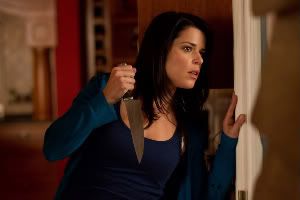 The formula has worked for Craven so far, and Scre4m shows him in what may very well be top form. Craven has succeeded in the past when his camera is allowed to exert a sense of control over the audience. Through this control he is able to make the scares work and to keep the tension building throughout the film. In what may be a first for the franchise, the film actually maintains its tension as it continues closer and closer toward its conclusion. Most notable is a scene on a balcony where the score, the camera, the dialogue makes it almost apparent that one of the characters is going to be killed. A turn is made, a head-like figure is seen, but all is not as it seems. Taking this anticipation and withholding it is what makes the scares work, though none of this is possible without Craven's steady hand orchestrating the camera.
He also coaxes a number of fantastic performances from his entire cast. Most notably, and surprising, was the way that Hayden Panettiere as Kirby, one of the two main horror buffs in the movie. In fact, there is not a weak mark in the entire film, except for, perhaps, my favorite member of the cast: Emma Roberts. I will return to this and correct my misleading statement (I would likely argue that Roberts gives the film's best performance) when I throw up the spoiler tag and get more in depth with what each actor is asked to do throughout the film.
You know what? Now is as good a time as any to put up the SPOILER WARNING. If you haven't seen the film and do not want to know what happens, then you should stop reading. Basically, this film is very good, but below I will explain WHY it is very good!
 What Craven does, and I suppose this is partly Williamson's writing as well since it seems to be a script decision, is find another meta layer that can easily be missed if you are not keeping an eye, and ear, out for it during the film. Emma Roberts plays Jill, Sidney's cousin and, eventually, one of the two killers behind the murders. What I find most interesting is that, I would assert that it is by no coincidence either, her character's full name is Jill Roberts. What seems to be happening throughout is a play on Emma Roberts's traditional roles. This is seen in her performance, where she is a bit subdued, mostly playing a standard teenage character. It lulls you in the entire time, completely diverts suspicion, and then she becomes unhinged in such a brutally natural fashion. It is a testament to her ability as an actress to make this change so quickly and sell it so perfectly. I would argue that the reveal actually makes Emma's performance all the more impressive in retrospect, giving a reason for her choices to play quiet and inconspicuous. And the way she eventually throws herself around and confronts Sidney is another masterwork in what is one Hell of a resume that she has put together. I should end this paragraph with the obligatory mention that seeing her kiss Rory Culkin reminded me of a sicker, inverted version of Lymelife, though I would not assume this was part of the writer's intention in the same way the use of surname is.
The way this revelation is handled, originally seeming quite ridiculous, is actually one of the film's strongest points as well. She attempts to frame ex-boyfriend Trevor (Nico Tortorella) and fellow conspirator Charlie (Rory Culkin) as the two killers, echoing Billy and Stu from the first film, in an attempt to garner the fame that Sidney possesses. The motivation behind Jill's murder actually gives the film something to say. She, quite simply, desires fame. Though it feels as if the film is moralizing a bit too much when she gives her monologue explaining why she joined up with Culkin's Charlie to recreate the Woodsboro murders, it does ask the viewer to think about the way that media has been, and can be, manipulated to completely skew a public image. This idea is further reinforced in the brilliant final scene where, after Jill makes one final attempt to kill Sidney and her crew and is killed in the process, outside of the hospital a number of news reporters are talking about how heroic her actions were. Personally, I think it would have been interesting to see Jill succeed in her attempts, getting rid of Sidney and existing as this successful antagonist, but the current ending is still beautifully poetic, and it does add that extra layer of theme to a film that, up until that point, only hints at the recurring idea of trust to hold it together.
 Despite the Scream film never being about theme, it is nice to see the movie attempt to reach for some kind of commentary beyond the usual genre deconstruction. But that also does not mean that the deconstruction goes by the wayside. While not as fully fleshed out as some of its predecessors, the way that technology has integrated its way into the Scream universe is not shied away from in the film. Charlie and Robbie (Eric Knusden) are wired in youths who know their scary movies. Charlie explains that the killer should, in a modern context, be taping all of the crimes to immortalize his art. We see, at times, Robbie broadcasting his entire life to the world wide web. This strand of the story is never actually fleshed out, which is a shame because it could have been used to further deconstruct the modern horror where killers like Jigsaw play games with their victims, similar to the trivia games that Ghost Face is known for using. I had high hopes for how a world of Twitter and Facebook, where we are always connected, would manifest itself in a series where the killer preys on those who are never alone. Unfortunately this was not explored. The use of caller ID in the film is much more prevalent than it was in the older films though. A sign of the times. What I find interesting is that it is only an advantage to the killer, providing a reason for why, when the killer calls Jill on the way to school at the start of the film, she does not look to see who is calling. It's a nice touch, though I wish these touches, these ideas, were explored more in the film.
Though I suppose after 11 years off from the franchise there are bound to be a couple of missteps. It is a shame that some are so large, so prevalent in a film and series that are all about the meta level; however, not enough to make Scre4m a disappointment by any stretch. In fact, since seeing the film I may even go as far as saying that it is my favorite entry in the franchise. It's the only film where the tension is never let go, where the excitement is always there, and where the ending actually makes the previous parts of the film more interesting (though I guess the first film does this as well, to a lesser extent). Does the plot sometimes harken back to the first Scream film too much? Possibly, but it also subverts that film and takes on an identity all its own. Therein lies the beauty of Scre4m. It expands the world on a both a contained and meta level, the characters, and is one enjoyable ride with a lite bit of thematic depth that the series is not known for. Sometimes that's all I need.
Netflix Rating: ****/*****
Rich
Comments are welcome and, for anyone with a literary mind, I encourage checking out my poetry blog filled with all original works for your reading pleasure.
Also I am on the old Twitter thing so I guess you can follow me at twitter.com/FLYmeatwad.