Showing posts with label horror. Show all posts

Wednesday, February 26, 2025

Taking On 2024 - Top Films

Another long pause between posts, and one I had intended to do earlier but was derailed by having to wait for I'm Still Here (2024) to play locally before I could realistically finalize a list. Such is life, the fragility of permanence. But a list thankfully was finalized, and this year I broke with a Top Ten to include a bonus film, or perhaps it's the New Normal(tm) since it's the second year running where the list has expanded. Kind of in line with the year though, as it had a number of notable strong titles, some of the best would have contended for last year's list had they played the local festival in October. One can only speculate on the battles that were never fought.

This battle, however, is one that will be conquered. We have, as usual, a list of every film I considered eligible for the year, if you want to see what missed the cut in no real order. Nothing else really to plug, and perhaps one day I will return more regularly to blogging. There's always something fun about getting back to sit with and think through the year that was in film. But, as they say, fuck all that, let's get to it.

Wednesday, March 6, 2024

Taking On 2023: Top Films

Back for my annual tradition of writing about the films that most resonated with me from the previous year as we either turn the page to the new year and/or lead up to the Oscars. In this case it's more the latter, though given the way some releases have gone part of the reason this list is being posted so late has more to do with the way distributors have opted to trickle out some heavy hitters. It would, of course, be a fool's errand to try and make a definitive list, and, despite seeing a good number of films in 2023 (easily tracked on my Letterboxd list for those who like to play along), 2023 proved unique in a number of ways.

While I certainly lament my inability to see/Mubi's holding hostage of Do Not Expect Too Much From The End Of The World, a film I am sure would at least reasonably have had the ability to compete for a top spot given the pedigree, I was fortunate enough to see a number of releases that are still considered in some strange limbo state. In the past I have also been resistant to including television on this list, and will continue to not this year, though those limits were pushed with Scott Pilgrim Takes Off, a marvelous work of adaptation that illuminates and repurposes the source material in such a surprising and rich way that it feels like it could stand alongside the best features, and was one of the few TV shows I logged on my Letterboxd. But there will be a slight change this year, as I write about a Top 12 for the first time, though for those who do care or are more sticklers than I am at present I have ordered things so you can opt to still have a definitive Top 10 without having to disqualify certain films that almost certainly should be thought of as 2024 releases based on when they'll actually be more accessible theatrically.

All that to say that things have changed, but not drastically. And it's time to count down.

Wednesday, February 20, 2019

Taking On 2018 - Top Films

Look at that, another year in the books. And that means that films came out, a lot of them, actually, and even though there were plenty I still wanted to check out, I did have a chance to get out to plenty of them. A lot of has changed since the last time I checked in on the world of cinema to name my best of the year so far. Not sure that I'd label it an amazing year for film, but also when I was whittling down this thing to the Top Ten it was pretty difficult, so in the end I guess it was pretty solid. As always, I logged everything that I counted as a 2018 film on Letterboxd in a list that isn't ranked, and some even have words if that's your thing. Just like the ones below the cut, or below these words if you've already clicked in to the post proper. There will be some pictures here too though, just the posters or something. Some numbers as well, ones that aren't even spelled out, so in that sense you ought to call this Mr. Toad because it's about to be closed and never to be heard from again a wild ride.

Saturday, July 7, 2018

Taking On 2018 - Top Films Of The Year So Far

Here we are once again, halfway through 2018, what is undeniably the worst year in existence, marked with nothing but pain, sadness, hopelessness, and a few okay films. Some would say it has #BeenAWhile since I last wrote anything on this blog proper, and it has, especially as I use Letterboxd to get out quick thoughts and then just process and have conversations elsewhere, but I imagine there's still a good amount of value is writing down more extensive thoughts on things that have stood out to me throughout the year. So I'll do that. This time in a list form while I try to figure out which things I liked more than other things. The actual process of putting this together ended up being more difficult than I imagined, mostly figuring out what would compete for the last few slots. So with that, it looks like this is how things shook out at the halfway point.

Saturday, March 23, 2013

And I'm Sick And Tired Of Wondering What Your Presents Mean


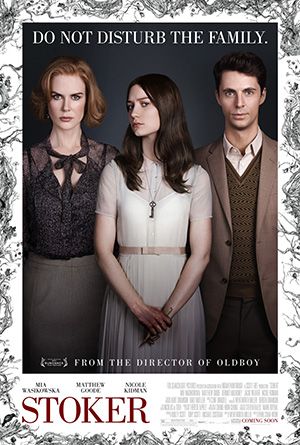
Stoker (Park, 2013)

It's always interesting to see how an artist transitions from one medium to another, whether it be a painter stepping behind a camera or a novelist turning in to a screen writer. Yet with Stoker, director Park Chan-wook is not moving mediums but is actually breaking language barriers. If that isn't already a massive challenge to take on in what is the first English language film from the Korean visionary, then why not add in an extended metaphor of the physical and sexual awakenings that define the adolescent experience? If there's one thing that everyone can universally understand it would definitely the teenage psyche.

Tuesday, December 20, 2011

Don't Stop Imagining. The Day That You Do Is The Day That You Die.

It's Awards season, and the time where year end wrap ups begin to hit hard. As a result, I need to begin writing at a much more rapid pace in an attempt to crystalize my thoughts on all the wonderful (I know, but bear with me) film that are sure to be released in this time. So what we have are an upcoming series of shorter reviews that will rarely delve in to the same type of analysis synthesis that I attempt to craft with my writing. Then there will be a huge onslaught of year end lists. I'll try and sprinkle a few editorials in there as well, and there's probably a major site overhaul coming up. So there's the state of Processed Grass, and now on to the review!


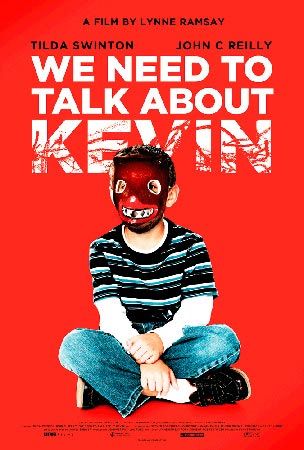
We Need To Talk About Kevin (Ramsay, 2011)

The new film from acclaimed Scottish filmmaker Lynne Ramsay, We Need To Talk About Kevin, recently had a one week limited pre-Oscar qualification run type deal in NYC and I had a chance to see it during that time. Basically what we have is a quasi-horror film that, much like other indie standout Martha Marcy May Marlene, takes many of its cues from psychological horror and Gothic tropes than delving in to new age cinematic scares.

Friday, October 14, 2011

Thinking About Terror: Why Does Horror Scare?

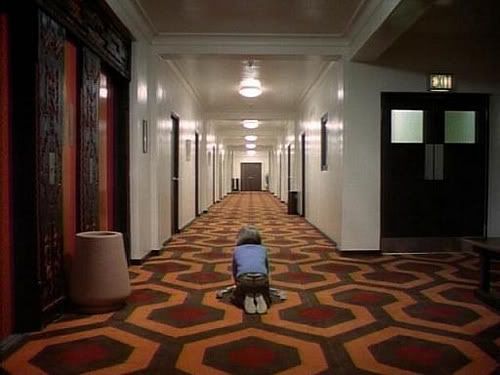
Every October I feel as if the obligated to watch horror films. Like watching It's A Wonderful Life around Christmas it becomes a yearly tradition. Growing up I had a huge aversion to horror, brought on by one too many nights spent staying up past my bed time to watch Ernest: Scared Stupid. Now I go back and look at the films I was terrified of as a child and they seem silly, yet as I grew older and started watching more types of films I have still avoided horror. This is particularly odd to me as one of my favorite writers, Edgar Allan Poe, is always associated with the genre. In an attempt to combat my hesitancy to embrace these films I even decided to watch all four of the Scream movies earlier in the year. I even went to my local theater to see The Shining when it played a week ago. After this brief confrontation with some notable entries in the scary movie oeuvre, I was left with one nagging question in the back of my mind: do horror films need to be scary?


The short answer to this question would be a simple yes. I don't mean to imply that they only are meant to scare, there is a ton of artistic quality in this art form in craft, theme, and pathos. However, most people even use the terms 'horror film' and 'scary movie' interchangeably. But while watching The Shining I did not find myself nearly as scared as I did when I was watching Scream. I may even say that I didn't feel scared at all. Certainly not in the same way. And  that's really where I find horror films incredibly interesting. Much like comedy, horror is such an umbrella term that it can encompass so many different types of movies. Using my limited knowledge of these kinds of movies, I want to take a look at exactly how these movies scare.

Tuesday, September 20, 2011

So How Did You Get Here Under My Skin?


Contagion (Soderbergh, 2011)

At times while watching Steven Soderbergh's latest film, Contagion, I could not help like feeling that it had topically missed its mark. As a member of the United States I have lived through a few biological scares, but the most recent one seems to be so far in the past that I hardly consider the extremity or fear that is bred during a disease scare. I have never been directly affected, and the sensationalist media has always made me think that these bird flu and swine flu scares are simply hyped up contained cases that will be easily controlled by the world's vast medical technology. What Soderbergh is tasked with doing then is not only making me believe that these very real diseases could be...well, real, but he must also turn a vastly biological affair in to a gripping story. So after focusing on a singular individuals in his last three films (Che, The Informant!, and The Girlfriend Experience) can Soderbergh expand, as he has with other films such as Traffic and the Oceans series, once more to encompass a global scare?

Monday, August 29, 2011

They've Got Him In A Trance

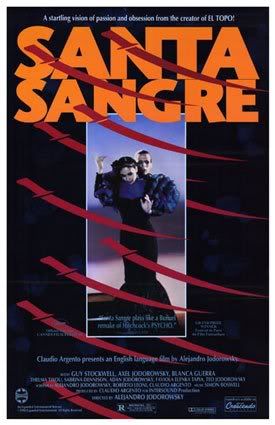
Santa Sangre (Jodorowsky, 1989)

I don't usually do very well with horror films. It is a genre that I do not dismiss, in fact I spent the better half of last semester wrestling with the artistic legitimacy of the horror genre in fiction that was mostly revolutionary to how I now approach these stories. Still, I am easily scared and as a result am not very well versed in the world of scares. Prior to watching Santa Sangre I knew nothing of the film beyond the wikipedia entry that labeled it as "a surreal horror film." Now I did not actually know what that description would entail, but I don't think any amount of wikipedia would have prepared me for what I would find when I actually booted up the old Netflix Instant Stream and dove head first - or perhaps it's more fitting to say arms first - in to my first film from Alejandro Jodorowsky.

Tuesday, April 19, 2011

These, These, These Are The Words - The Words That Maketh Murder


Scre4m (Craven, 2011)

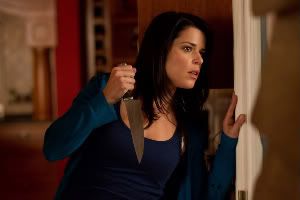
Returning to Woodsboro, quite literally this time rather than the fictional return of STAB, a film series within the series based on the events of the first Scream, found in Scream 3, suggests that the Scream series is making an attempt to return to its roots. Sure the core characters have changed, the disdain between Sidney (Neve Campbell) and Gale (Courteney Cox) has disappeared as the two are now able to reflect on their past mishaps and enjoy a mostly peaceful present, but the cast is still primarily made up of Sidney, Gale, and Dickey (David Arquette) trying to figure out who is responsible for the latest in a string of Ghost Face murders. The problem with a return to Woodsboro after 15 years since the initial events in the story is that the horror genre has changed so much since then that the slasher is an antiquated subgenre. Not to mention that too much of the 'same' storywise could easy get stale.

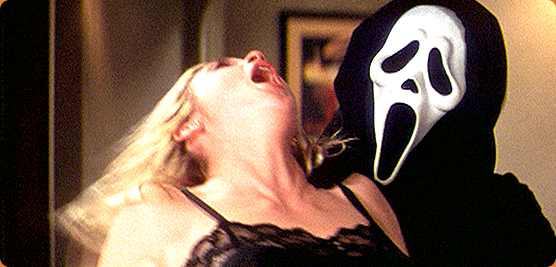
Thankfully, Scre4m, from the very opening sequence, manages to avoid most of the pitfalls by embracing all of the elements that have made the three preceding films successes. Continuing with the appeals to the meta, the Williamson script has the film open with another occurrence of Ghost Face terrorizing on screen victims, but then it pulls out to reveal that it was a part of a STAB film. Nothing new for the franchise, we have seen this done before. However, this event is then recreated one more time, only to pull away in a reveal that the initial scene was the characters in STAB 7 watching the opening of STAB 6. Included are a few comments about the emergence of torture porn in modern horror, the changed rules, and some more banal, but humorous, jabs at the modern genre. These, though, are all mostly abandoned after that second pullout occurs to reveal the actual first two murders in the real town of Woodsboro. This opening sequence perfectly establishes the current perception of Ghost Face, clearly detached and a bit of a joke for the new generation in Woodsboro, while still making the audience aware that this is, in fact, a Scream film where the scares are going to come interspersed with commentary on how and why these events are happening.

The formula has worked for Craven so far, and Scre4m shows him in what may very well be top form. Craven has succeeded in the past when his camera is allowed to exert a sense of control over the audience. Through this control he is able to make the scares work and to keep the tension building throughout the film. In what may be a first for the franchise, the film actually maintains its tension as it continues closer and closer toward its conclusion. Most notable is a scene on a balcony where the score, the camera, the dialogue makes it almost apparent that one of the characters is going to be killed. A turn is made, a head-like figure is seen, but all is not as it seems. Taking this anticipation and withholding it is what makes the scares work, though none of this is possible without Craven's steady hand orchestrating the camera.

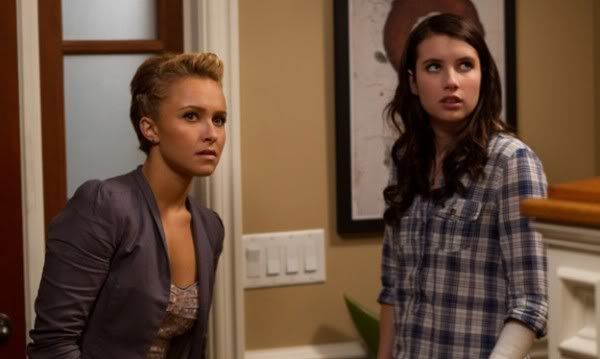
He also coaxes a number of fantastic performances from his entire cast. Most notably, and surprising, was the way that Hayden Panettiere as Kirby, one of the two main horror buffs in the movie. In fact, there is not a weak mark in the entire film, except for, perhaps, my favorite member of the cast: Emma Roberts. I will return to this and correct my misleading statement (I would likely argue that Roberts gives the film's best performance) when I throw up the spoiler tag and get more in depth with what each actor is asked to do throughout the film.

You know what? Now is as good a time as any to put up the SPOILER WARNING. If you haven't seen the film and do not want to know what happens, then you should stop reading. Basically, this film is very good, but below I will explain WHY it is very good!

What Craven does, and I suppose this is partly Williamson's writing as well since it seems to be a script decision, is find another meta layer that can easily be missed if you are not keeping an eye, and ear, out for it during the film. Emma Roberts plays Jill, Sidney's cousin and, eventually, one of the two killers behind the murders. What I find most interesting is that, I would assert that it is by no coincidence either, her character's full name is Jill Roberts. What seems to be happening throughout is a play on Emma Roberts's traditional roles. This is seen in her performance, where she is a bit subdued, mostly playing a standard teenage character. It lulls you in the entire time, completely diverts suspicion, and then she becomes unhinged in such a brutally natural fashion. It is a testament to her ability as an actress to make this change so quickly and sell it so perfectly. I would argue that the reveal actually makes Emma's performance all the more impressive in retrospect, giving a reason for her choices to play quiet and inconspicuous. And the way she eventually throws herself around and confronts Sidney is another masterwork in what is one Hell of a resume that she has put together. I should end this paragraph with the obligatory mention that seeing her kiss Rory Culkin reminded me of a sicker, inverted version of Lymelife, though I would not assume this was part of the writer's intention in the same way the use of surname is.

The way this revelation is handled, originally seeming quite ridiculous, is actually one of the film's strongest points as well. She attempts to frame ex-boyfriend Trevor (Nico Tortorella) and fellow conspirator Charlie (Rory Culkin) as the two killers, echoing Billy and Stu from the first film, in an attempt to garner the fame that Sidney possesses. The motivation behind Jill's murder actually gives the film something to say. She, quite simply, desires fame. Though it feels as if the film is moralizing a bit too much when she gives her monologue explaining why she joined up with Culkin's Charlie to recreate the Woodsboro murders, it does ask the viewer to think about the way that media has been, and can be, manipulated to completely skew a public image. This idea is further reinforced in the brilliant final scene where, after Jill makes one final attempt to kill Sidney and her crew and is killed in the process, outside of the hospital a number of news reporters are talking about how heroic her actions were. Personally, I think it would have been interesting to see Jill succeed in her attempts, getting rid of Sidney and existing as this successful antagonist, but the current ending is still beautifully poetic, and it does add that extra layer of theme to a film that, up until that point, only hints at the recurring idea of trust to hold it together.

Despite the Scream film never being about theme, it is nice to see the movie attempt to reach for some kind of commentary beyond the usual genre deconstruction. But that also does not mean that the deconstruction goes by the wayside. While not as fully fleshed out as some of its predecessors, the way that technology has integrated its way into the Scream universe is not shied away from in the film. Charlie and Robbie (Eric Knusden) are wired in youths who know their scary movies. Charlie explains that the killer should, in a modern context, be taping all of the crimes to immortalize his art. We see, at times, Robbie broadcasting his entire life to the world wide web. This strand of the story is never actually fleshed out, which is a shame because it could have been used to further deconstruct the modern horror where killers like Jigsaw play games with their victims, similar to the trivia games that Ghost Face is known for using. I had high hopes for how a world of Twitter and Facebook, where we are always connected, would manifest itself in a series where the killer preys on those who are never alone. Unfortunately this was not explored. The use of caller ID in the film is much more prevalent than it was in the older films though. A sign of the times. What I find interesting is that it is only an advantage to the killer, providing a reason for why, when the killer calls Jill on the way to school at the start of the film, she does not look to see who is calling. It's a nice touch, though I wish these touches, these ideas, were explored more in the film.

Though I suppose after 11 years off from the franchise there are bound to be a couple of missteps. It is a shame that some are so large, so prevalent in a film and series that are all about the meta level; however, not enough to make Scre4m a disappointment by any stretch. In fact, since seeing the film I may even go as far as saying that it is my favorite entry in the franchise. It's the only film where the tension is never let go, where the excitement is always there, and where the ending actually makes the previous parts of the film more interesting (though I guess the first film does this as well, to a lesser extent). Does the plot sometimes harken back to the first Scream film too much? Possibly, but it also subverts that film and takes on an identity all its own. Therein lies the beauty of Scre4m. It expands the world on a both a contained and meta level, the characters, and is one enjoyable ride with a lite bit of thematic depth that the series is not known for. Sometimes that's all I need.

Netflix Rating: ****/*****

Rich

Comments are welcome and, for anyone with a literary mind, I encourage checking out my poetry blog filled with all original works for your reading pleasure.

Also I am on the old Twitter thing so I guess you can follow me at twitter.com/FLYmeatwad.
Friday, April 15, 2011

You're Keeping Control Of The Knife, But I'm Not Your Darling


Scream 3 (Craven, 2000)

The question I was left with at the end of my Scream 2 review was exactly how Craven was going to continue layering more levels of self referential material on the series without it eventually breaking apart. After watching Scream 3 it seems almost obvious that the best way to handle the world within the world within the world of Woodsboro would be to have the characters meet up with their on screen counter parts. What could be better than Gale Weathers (Courteney Cox) teaming up with fake Gale Weathers (Parker Posey) in an attempt to uncover the mystery revolving around a string of murders in the latest STAB film, STAB 3: Return to Woodsboro?

The answer to that question is rather easy: bring back Randy (Jamie Kennedy) for a video taped cameo where he gets back to what made him most effective in Scream: laying out how exactly these trilogies work. Apparently, as Sidney Prescott (Neve Campbell) is once again hunted down by a new masked Ghost Face, all the bets are off. The killer should become superhuman, capable of taking as many bullets as possible to the chest without dying, becoming a supernatural presence in the film. Craven plays up this bit nicely, showing the Ghost Face figure being shot at, apparently uncaring about any of the bullets that have hit him. He even makes it believable by portraying Sidney as a tad mentally unstable. She hears her dead mother speaking to her throughout the film, which all ties back to the killer's plan to reveal the truth about Maureen Prescott. It would be easy for the film to go off the deep end with the supernatural, odd considering how grounded in reality the rest of the series has been, but perhaps fitting in the way that genre is broken down. I'm glad Craven kept to continuity rather than deconstruction though, as it allows for a much more cohesive viewing experience and a more emotionally engaging film

The central mystery in the film is a compelling point, and Craven gets back to generating scares by blending his steady camera with an occasionally deceptive score. Even the reveal at the end works nicely in the context of this film, and the series up until that point. Still, the main attraction has to be the way that the movie sets itself up as a metacommentary on the industry that has spawned it. Specifically, what works in this entry is how the killer plays with identity in order to create a sense of unstable bonds between a primary core of characters who have twice survived similar situations. It also asks the viewer to question what is happening in the film, a device that plays well with the fabrication of location that serves as the STAB 3 set. In this near perfect recreation of Woodsboro, we explore a world we know, only for something as trivial as the opening of a door to reveal that our sense of place is being completely manipulated. Just looking at the way that Craven crafts these scenes, that he uses artifice to refer to artifice, demonstrates his mastery over his material.

In the previous two films, the series has dabbled in the implications of its characters's actions both in relation to the genre, and simply as characters. The most genuine moments of Scream 3 can be found when Sidney is asked to reflect on herself. Does fear ultimately control Sidney, the cipher through which the audience is meant to experience this world? Where does the line between blameless killing and deplorable murder exist? The film probes at these questions, I think I may have to give up hoping that anything of substance will be reached by watching the series, but I still cannot help feeling at least slightly unfulfilled even if the entertainment value was back up in this movie.

Still, when Scream 3 works, it works overtime for double pay.The highlight of the film that I come back to is found early on when one of the actresses in STAB 3 is asked to read the lines of the script over the phone. The moment is played perfectly, with enough sinister undertones that you know at some point the scene will go wrong, but also asking the audience to know to make this association by reworking the initial dialogue from the first film. The second movie in the series also attempted to do this as well, but we had a screen separating us, here the results were going to be real. The Scream series has gone from deconstructing cinema to deconstructing reality, and in doing so asking each viewer to ask how much of a difference is found between the two. It goes as far as having Jay and Silent Bob make baffling cameo appearances, characters within characters. Perhaps even within characters. When do they stop becoming characters?

As the series evolves we see technology evolving with it. The cell phones become slightly smaller. Caller ID is replaced by *69. It is hard, at times, to ever make these characters feel truly alone. When this happens, Craven examines vulnerability. Does Scream 3 always generate fears? No. But it does manage ambition, to capture a changing world in a world that is completely fabricated. Craven taps in to the basest of human fears and juxtaposes it with the modern context where no one is alone. As I prepare to enter Scre4m, the developments between the turn of the millennium and the present day are ripe for examination and exploitation in a way that, I hope, only Scream can tackle.

Netflix Rating: ****/*****

Rich

Comments are welcome and, for anyone with a literary mind, I encourage checking out my poetry blog filled with all original works for your reading pleasure.

Also I am on the old Twitter thing so I guess you can follow me at twitter.com/FLYmeatwad.
Thursday, April 14, 2011

You're All Alone, Friend? Pick Up The Phone Then


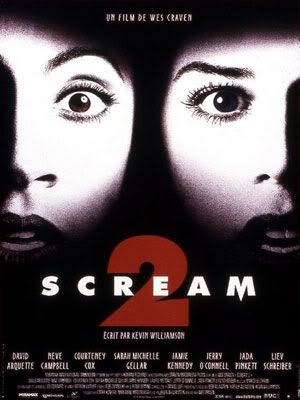
Scream 2 (Craven, 1997)

Sequels are inferior films by nature. This claim is posited early on in Scream 2 by Randy (Jamie Kennedy) in his film studies college class. Unless conceived before as part of a trilogy - Star Wars: The Empire Strikes Back is used as one counterexample in the movie - sequels are bogged down with characters and scenarios that are shadows of the original's glory. When you are making a sequel that is as self aware as Scream 2 you have to be confident in your craft to directly call out the inferiority of sequels, to essentially ask the audience to to laugh at, not with, you. So the question facing the follow up to Craven's 1996 slasher is not 'how do you make it work' but rather: why do we need to see these people, this world, again?

Craven's answer is to continue to layer on the self referential aspects of this universe. Opening the film with an elongated sequence that ushers in the return of Ghost Face is enhanced by the droves of people dressed up like the killer watching STAB, a film within the film that is based on a book written about the events of the first movie by Gale Weathers (Courteney Cox). The killer then goes about recreating the victims of the original Woodsboro murders in an attempt to, once again, end the life of Sidney Prescott (Neve Campbell). As a narrative device the layers of artifice on top of one another serve to answer the how, and through that begin to hint at an answer to the why.

Unfortunately, the second movie in the Scream series is still bogged down with many of the problems that Randy outlines in that early classroom scene. The college years introduce a cast of characters that seem so overtly meant to counteract the original cast it becomes overbearing. How many times do I need to hear Sidney's new boyfriend say that he is not like Billy? Probably just once, certainly not the three times afterward. Having Dewey and Gale back was a nice touch, mostly because the characters were each fleshed out a good deal more than they were in the first film, but it's also odd that Sidney and Dewey made no mention of his dead sister in the year since the murders. But ultimately the plot is so by the numbers that any filmmaker, even with the wonderful camera work that Craven puts forth, would have a difficult time turning this story in to a compelling narrative.

What I think this film lacks, and what made the film movie so compelling, is that deconstruction element. When thinking about how to approach my review of the first Scream I was drawn to the way that Randy broke down horror conventions to make even the uninitiated viewer familiar with what this specific film was attempting to accomplish. Sure the first call to Sidney early on when she uses Caller ID to identify who is calling her is a fantastic touch, and the inclusion of cell phones adds more suspense to the final product, but Randy never makes mention of any of these aspects, the film just lets them occur and then never mentions them again. Despite Jamie Kennedy stealing each and every scene that features Randy, we never get that deconstruction. In the classroom scene I keep referencing, truly a beautiful way to set the tone of the film, he simply dismisses sequels outright. Later on Randy goes about breaking down conventions with Dewey, commenting on how copycat killers and horror sequels are set to up the body count, gore, and elaborateness of the traps, but instead of questioning this absurdity Craven later revels in it. There are surprises along the way, and one tremendous loss, but the feeling of Craven restructuring the genre is rarely apparent, even in the final reveal of the actual Ghost Face killers.

Despite this movie being considerably less entertaining than its predecessor, my biggest problem with Scream, the lack of theme and higher purpose, is handled wonderfully with the sequel. I go back, once again, to the first scene in Randy's film class. The discussion is anchored by a conversation about the connection between violence and film. The idea is carried throughout the film and works wonderfully with the metatextual aspects of the series. Even the way it wraps up, laughing at the absurdity of such claims and the way they are manipulated and abused in a modern context, strikes a resonant chord more than ten years after the film's release.

Scream 2 does have its share of moral debases as well though, most notably in the way that the roles are reversed in the final scene. Just as in the first movie, this one becomes notably silent on the implications of Sidney and her crew ultimately becoming killers at the end of the movies. She loudly proclaims how she killed Billy, a notable sense of pride in her voice. She then goes on to murder the two killers, with Craven's camera even looking up toward the three remaining people as Sidney, vindictively, puts a final cap in one of the killers's blood soaked heads. Now I do not expect her to be Batman, but the movie presents Sidney as hardly phased by ending the lives of others. In this is the implication that few aspects separate the sane from the insane in these movies, we are all capable of murder, but this idea is dropped as quickly as it is raised, which, for a film that is as long as Scream 2, is a grave misstep.

Craven does not make many other thematic missteps though, which helps Scream 2 rise above the fairly generic plot. Sure the film has high moments, the most notable coming from a Danny Elfman scored play scene where Sidney is chased around stage by Ghost Face and a number of her peers. But aside from a few jump scares early on, the sense of dread and excitement that Craven so perfectly captured in the first film is all but absent from the sequel. Still, I cannot help but coming back to the meta aspects as the definitive element of the series. Even without the deconstruction, the elements of artifice and simulation speaks to the English major in me, so pressing forward with the series I hope to see how Craven refines the balance between creating so many worlds within worlds with making appealing horror movies.

Netflix Rating: ***/*****

Rich

Comments are welcome and, for anyone with a literary mind, I encourage checking out my poetry blog filled with all original works for your reading pleasure.

Also I am on the old Twitter thing so I guess you can follow me at twitter.com/FLYmeatwad.
Wednesday, April 13, 2011

In Violent Times, You Shouldn't Have To Sell Your Soul


Scream (Craven, 1996)

"What's your favorite scary movie?"

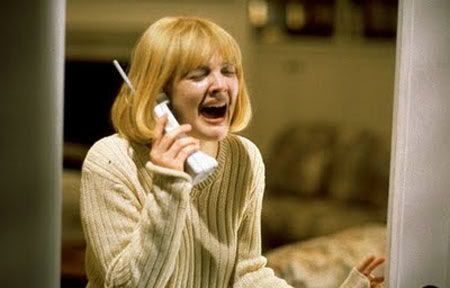
The scene that kicks off Wes Craven's Scream, an excellent exercise in tension building, is also likely the franchise's most iconic. A woman is getting ready to watch a movie, she receives a few phone calls of escalating intensity from a gravely voiced stranger which start with an innocent question and eventually end in a shrieking death threat. What's odd is that this confrontation does not involve the movie's central character, Sidney Prescot (Neve Campbell). It does, however, set up the intensity of the killer that will consume the town of Woodsboro.

Horror is a genre that I do not enjoy, and as I watched Wes Craven construct his 1996 slasher I figured out what most unnerves me about the genre. When a talented hand is controlling the camera, as is the case here, the viewer becomes powerless. Each camera angle, each cut (haha!), is used to withhold, for as long as possible, the release that will come when the threat, in this case Ghost Face, attacks. Craven tells you that it is going to happen, the warnings are there, but in his construction he makes you yearn for the attack, if only to experience the relief of release. He escalates the intensity of each scene, through the use of score and editing, to make the presence of Ghost Face as inviting as it is terrifying.

However, a film cannot exist on scares alone. What makes Scream stand out is the meta-textual components that have characters in the movie questioning the killer's movements throughout. If you've ever watched a movie and wondered if any of the inhabitants had ever seen a movie before, Scream makes you painfully aware that the inhabitants of Woodsboro know their horror films. As someone who is not well versed in the genre it is easy to feel left out, but the way that the script breaks down convention and then turns the screw just a bit further in its own execution (I'm on a roll here) of these tropes is handled to make sure that even the uninitiated will understand how the genre is being deconstructed and reconstructed. Self awareness is easy to mess up, having a film that does not make the self awareness seem pompous, while still noticeably winking at the audience, is a refreshing balance.

This self awareness is partly where the film breaks apart for me though. The end of the film has anchorwoman Gale Weathers (Courtney Cox) staring forward at the screen and recapping the fallout of the Woodsboro murders. Then Craven pulls back the camera as she walks toward the house where the largest bloodbath has taken place only moments earlier, and we see the camera that Gale was actually speaking to exist within this camera. The technique is beautiful and encapsulates what Craven reaches for throughout the film. My only question is, and it's a rather large inquiry: so what? The film is entertaining, it is, at least partially, scary, the performances are solid across the board (with Stu [Matthew Lillard] and Randy [Jamie Kennedy] being the stand outs), and the central mystery is gripping. But in the end the movie fails to say anything, either about the genre, the escapist nature of cinema, or any larger world implications. I watch film to be entertained, but I mostly watch movies to learn. I walked away from Scream pleased, entertained, but vastly unfulfilled.

Though I think, partially, I am selling the artistic merits of the film a bit short. In a film that is so steeped in deconstruction, that thrives on an awareness of convention and the reversal of convention, the 'confessions' of the killers is perhaps the inkling of theme that I seek. Craven builds up to this huge reveal of the killers, and the surprise is there, but when they get around to motive it appears as if the two young men have no reason for their killing. That lack of confession has its roots back in the anti-climax found in Bram Stoker's Dracula, the absence of reason goes back to the most notable horror convention: the lack of a visible explanation is the scariest thing of all. This idea, the way it is handled, is interesting, it's ballsy even. But I need more than balls, I need meat. Wait. Theme. I need theme.

Conceptually I am in love with Scream, much more so than I thought I ever would have been before sitting down and watching the movie, but I don't get married to concepts. No, I'm more likely to settle down with other, more developed, intangible ideas, which Craven's film simply does not take the time to offer. Damn fun, just a tad shallow. I am glad that one of my first tastes of the horror genre was in the form of Scream though because the scares were not so over the top, and it gives me plenty of ways to grapple with the other genre staples that I am going to tackle in the future. And I'm a sucker for metafiction, even aimless meta, so I'm looking forward to see how Craven expands on these concepts in the future franchise films.

Netflix Rating: ****/*****

Rich

Comments are welcome and, for anyone with a literary mind, I encourage checking out my poetry blog filled with all original works for your reading pleasure.

Also I am on the old Twitter thing so I guess you can follow me at twitter.com/FLYmeatwad.

Monday, October 19, 2009

There's More Like Me Where I Come From, So Mark Our Shapes. Go Down To The Netherworld, Plant Grapes


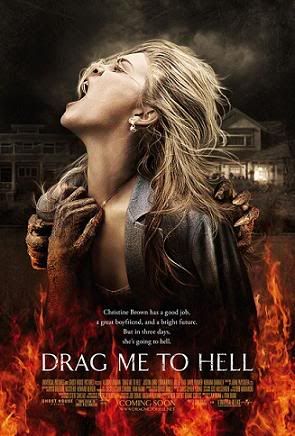
Drag Me To Hell (Raimi, 2009)

You may notice that this entry jumps around a lot. We can say that, like Raimi, I like to make your mind jump, but that doesn't really work. Essentially, I need a post because this is for the marathon, but I am devoting most of my writing tonight to my Where the Wild Things Are review.

I have not seen the Evil Dead films, I really do not know what other non-Spiderman stuff Raimi has done, but after seeing how terrible Spider Man 2 was I had some reservations going into this film, As this little horror marathon continues I veer away slightly from the fun times found in Trick 'r Treat and actually sit down with a horror film that seems to be designed to scare. Raimi creates tension wonderfully and effectively delivers just about every jump scare he sets out to offer the audience, though that is not to say that the film is engaging simply because it can make the viewer jump. The tale is quite compelling, centering around Alison Lohman's character attempting to rid herself of a curse, and the camera work is damn near top notch. Not to mention that the visual effects are both rather stylized and great at setting the film's tone.

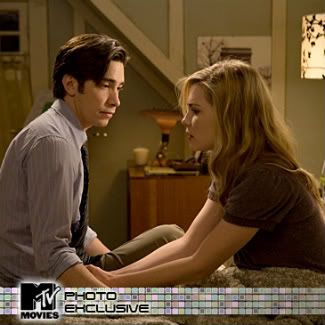
Lohman gives one Hell of a performance in the lead role, in fact I would probably list her as my second favorite actress of the year behind Charlotte in Antichrist and just ahead of Emma Roberts in Hotel for Dogs. As much as I like Justin Long, and that is a good deal, he does not really do all that much with his role. I suppose if there is a surprise it would come in the form of Dileep Rao, but I do not consider him among my favorite supporting performances of the year so it does not appear that he is worth mentioning in any detail. Really the film is Lohman's story and she does everything in her power to make sure that she keeps the viewer engaged.

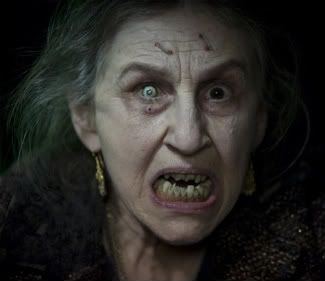
While I am very inexperienced when it comes to horror films, it is also apparent during the film that Raimi is playing with genre convention, which adds a nice layer of underlying humor to the whole affair. There are some scenes that remind me of my time with Poltergeist 3 (no, I don't know why, of all the Poltergeist films, I watched the third one, but whatever), while a number of other scenes had me thinking of what I have heard about other genre staples. The whole dual horror/comedy thing comes to a bursting point when the seance scene occurs though, and what a fantastic scene Raimi has constructed. Without giving away too much information, a goat is involved, as is an old woman and a man servant. The humor is there, but the film never lets the viewer forget the severity of the situation. It's really genius construction, and similar scenes are found scattered throughout the film.

I do not know if I can all Drag Me To Hell one of the best films of the year, and I do not think I can say that it is better than Trick 'r Treat, but Raimi presents me with a film that does get significantly more frightening than Trick 'r Treat while still being at least as entertaining to watch. In hindsight I probably respect the film more than I enjoyed it, but maybe it is the other way around. I'm still not entirely sure. That will likely be a theme tonight as I get to my Wild Things review. I likely would have benefited from knowing more about the genre, but the genius of the film is that is can be enjoyed without all the viewer needing to get all the winks and nods to past films that Raimi has, I believe, inserted here. Anchored by a stellar performance from Lohman, some excellent camera work from Raimi, and a story that is as frightening as it is entertaining, Drag Me To Hell is a blast. I should probably buckle down and watch The Orphanage now though to prepare me for potentially seeing Paranormal Activity in a theater. Maybe.

Result: Lights Off!

B+ or 3.97848237480932753829065

Comments are welcome and, for anyone with a literary mind, I encourage checking out my poetry blog filled with all original works for your reading pleasure.

Also I am on the old Twitter thing so I guess you can follow me at twitter.com/FLYmeatwad.
Sunday, October 18, 2009

Is It Much Too Much To Ask, Not To Hide Behind The Mask?


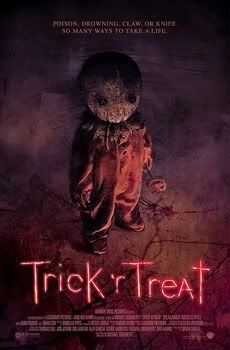
Trick 'r Treat (Dougherty, 2009)

I do not take well to horror films, a problem I hope to rectify this month with my "Keep the Lights On! (Generic Horror Marathon Extravaganza!) Marathon of Monsters, Mayhem, and Mental Provocation Marathon." Unofficially this started with Antichrist, so I guess we can say it has a 2009 theme for now given this entry and the forthcoming Drag Me To Hell one. I'm not into labels...man. And in many ways neither is Trick 'r Treat (boom! What a lead in!), walking a fine line between horror and comedy that few films in recent memory have tread so capably. But let us not confuse this for a film like Shaun of the Dead or a Scary Movie, Trick 'r Treat is definitely a horror film, it just has a good deal more fun with the genre than what I imagine many more recent serious scary movies do, which is probably what makes it such a gateway film for this marathon. It is not necessary scary, it gets slightly formulaic and predictable, but it's still a consistently enjoyable and interesting ride.

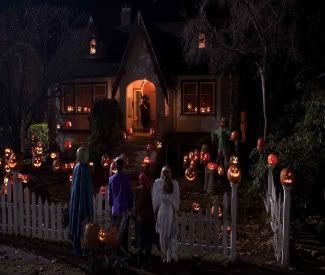
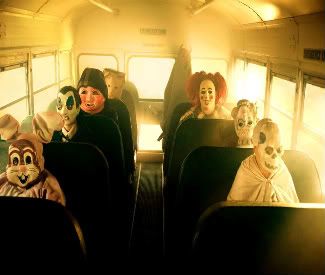
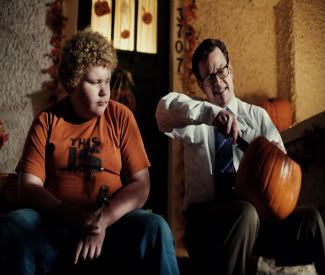
A uniform narrative, at least in the sense that it all does occur in one area on a single night, the film follows four different groups of people on Halloween night. All of the stories flow normally, the cuts are not awkward or anything like that, and they are strung together by the ominous Sam character, a young child with a burlap sack or something similar covering his head. Visually it works wonders and keeps a mysterious figure at the center of what is already a collective of incredibly compelling tales. The performances are nothing incredibly special, I suppose Anna Paquin is the big name but she has never done much for me and she only continues to underwhelm in this film, and the direction did not have me stunned, but the film is edited excellently and really wonderfully paced and constructed, so I have no qualms about the technical aspects of the film at all. In fact, the film has a visual style that practically drips the essence of Halloween. Unlike any film I have ever seen before, and admittedly they are few and far between, no movie conveys all the atmosphere that comes with this time of year. It's absolutely intoxicating in a way that the all time great holiday movies are, and in many ways this film has the substance to exist as a great film even outside of the Halloween time frame. I suppose anyway since it just released and I will have to revisit it in a few months to verify this claim.

Many aspects of this film really reminded me of some childhood memories magnified and readjusted for a person who, like myself, grew up with these television programs and has missed similar thrills that cater to a more mature demographic. The film captures the thrill of a show like Are You Afraid of the Dark?, the excitement of a movie like Hocus Pocus, and the twists and turns that R.L. Stein delivered in his Goosebumps books and television series. Having the film tap into all of these different entertainment forms, while still making everything modern, occasionally bloody, usually frightening, and R rated in terms of language and what not, makes for a film that not only hits all the right notes in regard to nostalgic purposes, but also acts as a great thrill ride that does not let up at all during the 90 minute or so run. I am honestly stunned that such a high quality film was kept out of theaters and saved for a direct to DVD release, it truly is impressive that such a film could slip through the cracks because it seems to be able to appeal to anyone at all, even a non horror fan like myself. Who does not like to have a little fun?

So, unlike Antichrist, Trick 'r Treat is a much more traditional horror film, or at least that is what I have gathered. Plus the way it embraces Halloween is absolutely stunning, though I have probably fawned over that enough over the course of this review. Sure the film is not flawless in the sense that it has insane thematic depth, character development, or even interesting direction, but it also does little to nothing wrong aside from getting a little predictable toward the end. The film is a good time, it's a unique tale, it has a central symbol and idea that are both advanced incredibly well, and it really is a film that should enter the holiday cannon. The film is not scary, so those looking to be frightened should probably look elsewhere, but everyone really should go out of their way to check out this film, preferably before or on Halloween, because it truly is one Hell of a ride.

Result: Lights Off!

B+/A- or 4.182397214723104723

Comments are welcome and, for anyone with a literary mind, I encourage checking out my poetry blog filled with all original works for your reading pleasure.

Also I am on the old Twitter thing so I guess you can follow me at twitter.com/FLYmeatwad.