Showing posts with label thriller. Show all posts

Wednesday, October 26, 2011

I Came In From The Wilderness, A Creature Void Of Form


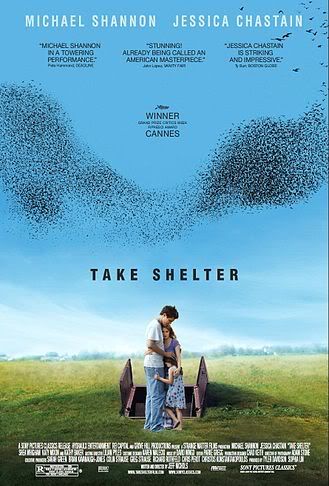
Take Shelter (Nichols, 2011)

It seems after months of waiting, 2011 is starting to get real. Yes, there have been a number of great films released so far this year (specifically I think of The Tree of Life, Drive, and Jane Eyre), but now that I'm looking ahead and making a schedule of films I must see I am almost overwhelmed with options. Take Shelter, the new film from Shotgun Stories director Jeff Nichols, has the type of pedigree that I get all flustered about, so when I saw it was opening at my local theater I became giddy with anticipation to dive in to the film. Knowling little about the movie I was simply hoping to revisit the domestic sphere that Nichols presented so well in his debut feature. Little did I know that I was in for so much more.

Tuesday, September 20, 2011

So How Did You Get Here Under My Skin?


Contagion (Soderbergh, 2011)

At times while watching Steven Soderbergh's latest film, Contagion, I could not help like feeling that it had topically missed its mark. As a member of the United States I have lived through a few biological scares, but the most recent one seems to be so far in the past that I hardly consider the extremity or fear that is bred during a disease scare. I have never been directly affected, and the sensationalist media has always made me think that these bird flu and swine flu scares are simply hyped up contained cases that will be easily controlled by the world's vast medical technology. What Soderbergh is tasked with doing then is not only making me believe that these very real diseases could be...well, real, but he must also turn a vastly biological affair in to a gripping story. So after focusing on a singular individuals in his last three films (Che, The Informant!, and The Girlfriend Experience) can Soderbergh expand, as he has with other films such as Traffic and the Oceans series, once more to encompass a global scare?

Sunday, July 18, 2010

Try This Trick And Spin It, Yeah, Your Head Will Collapse When There's Nothing In It


Inception (Nolan, 2010)

At some point in time every person sleeps, and at some point we all dream, but in this universal trait of humanity do we ever truly experience this sensation with any sort of uniformity? Is this uniformity even necessary in such a personal experience? What happens if our personal experiences, all of our repression, hopes, desires, and fears are not only open for others to witness but to directly manipulate to the point where we do not know if the process is even personal anymore? But, above all else, when we peel back all the layers of our dreams are we left with the purest essence of our thoughts or behind all the twists and turns - the layers and the puzzles - do we find a nothingness? Christopher Nolan's Inception literally delves into the dream world and starts working out these puzzles, taking us along for the ride as we hope to discover something, or rather anything, at the center.

Running throughout the film the script presents two recurring ideas: ideas can act as a cancer that grow and consume us, setting the stage for the titular act to take place, and dreams are elaborately constructed puzzles in which we willingly or unwillingly lose ourselves. And the entire film follows these ideas to their logical conclusions, adding in parlor tricks to cause the audience to further explore the puzzle in hopes of finding the definitive solution. Yet if we - as DiCaprio's Cobb does in the film - become too focused on this mystery, losing sight of the other elements that make up the film. And for much of the film Nolan's use of action and flash make for interesting spectacle to distract from the lack of substance behind the style.

But for each Joseph Gordon Levitt floating through layer two we also have Cobb explaining the previously unmentioned concept of Limbo, and then having Hardy and Levitt talk about it a few minutes later, and then Page doing so near the end of the film. The film is so loaded with exposition that the world and story have about as much breathing room as a man dangling from a noose constructed from the labyrinth the film displays.

And the deeper I venture into this maze I am able to find a few more conclusions, brief glimpses of answer and satisfaction amidst the entire transformation of cities and case scenes, but the farther in I go the more this creeping notion at the back of my mind becomes more and more prevalent: I am not watching people. By the end of the film we are, quite intentionally, left wondering just how much of the film is reality and how much is fabrication, but in this wonder compassion is absent no matter what conclusion is reached. I can understand the need to purposefully make many of the secondary characters two dimensional in order to make one specific interpretation work, but even if I overlook the lack of humanity on display from any of the secondary players then I should be able to feel incredible compassion, or at least understand the motivation, for Cobb.

Unfortunately Cobb is written in such a way that makes him neither sympathetic nor interesting, despite DiCaprio's best efforts to bring a level of humanity to the character. Cobb needs to get back to his children, to reconcile his past, by any means necessary, but we are never meant to know how honest he is in any of his actions (past, present, or future) until the film's conclusion, and for a specific interpretation to work even then we cannot be completely sure of what motivates the character.

Which reveals the film's most notable flaws. Nolan constructs a film that is so concerned with working as a maze that he fails to present any sort of overarching theme that ties the entire film together. Because the ending poses a very simple dualistic question to the viewer I am led to believe that the film is concerned with the nature of reality and perception, but even when considering if it connections to the meaning of perception the film does not necessarily relate it to any greater purpose. The film strives so hard to be a puzzle, to plant ideas in the viewer's head, that at some point each viewer is going to reach a satisfying conclusion, and then the film stops. I am not sure if I am finished with this film, if I have reached a comfortable conclusion, but I know that if I see it another time, or a few more times, eventually I will reach a point where I will have gotten to the end of the maze.

When I watch a film, when I enjoy a film, I am hooked by the theme, the promise that no matter how much I watch it I will continue to learn more about myself and my place to the world, that even when I reach a conclusion in a year, five years, fifty years I should be able to take what I have learned and discover more from the text. When I call a film, or any work of art, great I do so because it reveals a part of humanity, the film can never end. With Inception a promise of finality exists, found each time Cobb or one of his cronies gave a monologue explaining the intricacies of the world, or the repetition of these same rules time and time again in the film, in the most simplistic manner imaginable. Not only did I feel unfulfilled walking out of the theater, but as I draw closer to the end of the puzzle my sense of completeness will only lessen, and that thought depresses me.

Depressed. Unfulfilled. Hollow. Ultimately meaningless. These are the conclusions that I found in Inception; when the layers of dreams are peeled away, when the smoke has faded, when the mirrors have broken, the core of the film attempts to stand naked and nothing more than a shell remains. I have other problems with the film as well, such as an inconsistent use of shaky-cam mixed with fixed and quick cuts, and an imposing score that acts far too obviously and overtly in every scene. Yet the film has its share of positives including a phenomenal performance from Tom Hardy and some immensely intricate and engaging action sequences. But positives and negatives not only break down along with the film, they seem meaningless in comparison to the lack of any shred of humanity, any real theme or purpose. Like our dreams Inception is an escape that occasionally proves to be exciting and compelling, but eventually we are going to hit a kick, bringing back all the stark, harshly depressing realities.

Comments are encouraged and, for anyone with a literary mind, I encourage checking out my poetry blog filled with all original works for your reading pleasure.

Also I am on the old Twitter thing so I guess you can follow me at twitter.com/FLYmeatwad.
Thursday, July 23, 2009

Honey, What Reveals You Is What You Try And Hide Away


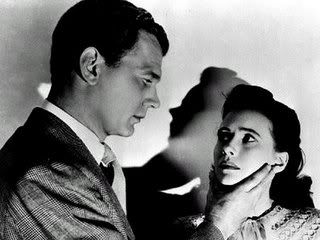
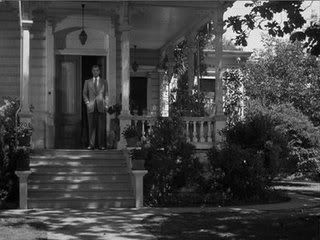
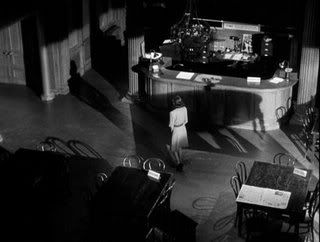
Shadow of a Doubt (Hitchcock, 1943)

Prior to going into this film I had known two little facts that had me pretty excited. The first, and most notable, is that Hitchcock has stated that he considers Shadow of a Doubt to be his favorite of his American films. The second, and more interesting to me personally, is the involvement of esteemed American playwright Thornton Wilder in the script writing process. Obviously these two elements had me pretty excited to see how everything came together and, while I was not sure why I was skeptical, everything blended together seamlessly to craft a compelling and incredibly tense film. While I can say right now that my underexposure to the rest of Hitchcock's work, I have only seen Psycho, results in my unable to informatively agree or disagree with Hitchcock's endearment, but I am going to attempt to make out what makes this particular film so compelling.

I could go on about the direction, but the film is from Hitchcock so it is to be expected that a certain level of pedigree can be found in just about every scene. Instead, I shall start with the acting that is on display during the film's nearly two hour run. Anchored by Teresa Wright and Joseph Cotten as the two Charlies, the two have perfect chemistry and offer an engaging back and forth dynamic that covers, and nails, just about every emotion in the book. Cotten obviously gives a chilling performance as Uncle Charlie and the way he constantly changes his mannerisms depending on the situation is mighty fantastic, but I would have to say that Wright is easily the stand out. Every scene she is in she brings human elements to instead of simply acting to emotion. She displays innocence and the shattering of this innocence and she handles it with such magnificence that I could not help but be bowled over by her performance.

Of course a lot of this has to do with the script. Early on sequences with Ann drip of Wilder's writing, but as things continue to move forward and the film offers up scenes like the one between both Charlies in the bar and the final scene with Wright in the church the film starts to take on a theatrical quality and the dialogue becomes almost poetic. The script is so carefully constructed, or more specifically the dialogue, that the film's themes and the ideas presented are almost immediately heightened to such a high level that the film, even if all the other elements were terrible, would be a fine example of film construction simply for the writing. Factor in how well humor is blended in with the plot and how intense Hitchcock makes the suspenseful sequences and the film takes on a quality of brilliance. Perhaps though the film's second greatest strength is how the viewer is always kept guessing and one can never be sure which direction the film will take in the future.

Sadly the film has somewhat of a turning point toward the end where things begin to fall apart. I personally think that everything would have been great if the film has simply stopped when Uncle Charlie makes an ascent up the stairs and we are treated to a beautiful long shot of Charlie holding her hat and standing in the doorway looking upward. But for some unknown reason the film makes one of what quickly become a stream of awkward cuts between scenes and the film starts to show its hand and strip away the ambiguity and suspense in favor of explaining everything to the viewer. A semi romance is tossed in, though mostly handled wonderfully, a few more scenes of visual action instead of the guessing game previously used, and slightly puzzling dinner and train scenes feel incredibly out of place. Now Wilder or Hitchcock attempt to salvage things by having Wright seemingly abandoned by her love interest, keeping the audience on their toes and wondering if Mr. Graham was just leading her along to help with the case, but then he is simply thrown back in at the end to allow for the final monologue to cap off the film. Sure this scene is brilliant and reestablishes the theatrical and poetic aspects of the film, but I must wonder if the film was better off undercutting most of what comes before just to finish on this philosophical note.

However, in the end the film is still a near masterwork and certainly a cut above the other Hitchcock film I have watched. When everything that has come before is so near flawless I can hardly fault a jarring finale, especially when the film actively makes an attempt to atone for these mistakes even in the way the final few scenes are handled. Shadow of a Doubt is a complex, compelling, and suspenseful film that showcases why Alfred Hitchcock is one of the best filmmakers of all time, and the inclusion of Wilder in the script writing process adds a philosophical layer to the film that results in far more than a simple genre film. The film is not without its flaws, but it is one Hell of a ride that has me excited to dive deeper into Hitchcock's stable of films.

A or 4.689825738056123576230981

Comments are welcome and, for anyone with a literary mind, I encourage checking out my poetry blog filled with all original works for your reading pleasure.

Also I am on the old Twitter thing so I guess you can follow me at twitter.com/FLYmeatwad.