Showing posts with label family. Show all posts

Saturday, March 17, 2012

People Don't Live Or Die, People Just Float


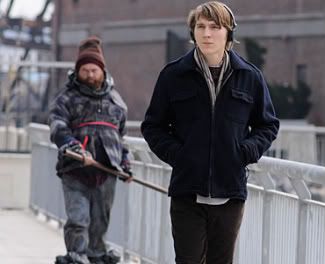
Jeff, Who Lives At Home (Duplass and Duplass, 2012)

Mark and Jay Duplass, brothers behind Cyrus, Baghead, and The Puffy Chair, continue to expand the definition of mumblecore with their latest film Jeff, Who Lives At Home. While it would be easy to describe this movie as a tale of a slacker who attempts to find his place in the world, what the Duplass brothers do with this film is so much more expansive because of the way they build upon the concept of a genre they helped popularize. Existing between the realms of drama and comedy their latest creation is more concerned with the humanity than it is with laughs, but it also willingly paints with the broadest of strokes in order to further reach for the universal. But by doing this I couldn't help but wonder if the shift of focus from the nuanced examination of relationships that have defined previous Duplass brothers films would be needlessly sacrificed for a more sprawling affair.

Wednesday, October 26, 2011

I Came In From The Wilderness, A Creature Void Of Form


Take Shelter (Nichols, 2011)

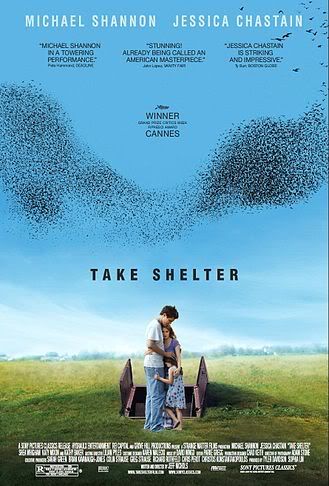
It seems after months of waiting, 2011 is starting to get real. Yes, there have been a number of great films released so far this year (specifically I think of The Tree of Life, Drive, and Jane Eyre), but now that I'm looking ahead and making a schedule of films I must see I am almost overwhelmed with options. Take Shelter, the new film from Shotgun Stories director Jeff Nichols, has the type of pedigree that I get all flustered about, so when I saw it was opening at my local theater I became giddy with anticipation to dive in to the film. Knowling little about the movie I was simply hoping to revisit the domestic sphere that Nichols presented so well in his debut feature. Little did I know that I was in for so much more.

Friday, September 9, 2011

I Wanna Be Like You, I Wanna Walk Like You, Talk Like You, Too


Animal Kingdom (Michod, 2010)

"Every morning in Africa a gazelle awakens knowing it must today run faster than the fastest lion or it will be eaten. Every morning a lion awakens knowing it must outrun the slowest gazelle or it will starve. It matters not whether you are a gazelle or a lion, when the sun rises you had better be running." This African proverb seems to perfectly encapsulates the world of David Michod's Australian crime drama Animal Kingdom. The people in this film, whether cops or criminals, are always running from, or after, one another in an attempt to keep balance in Melbourne, Australia. The world is a bitter struggle for comfort and survival, two ideas the film explores in great depth.

Tuesday, July 27, 2010

But It Grieves My Heart, Love, To See You Tryin' To Be A Part Of A World That Just Don't Exist


Ramona and Beezus (Allen, 2010)

In our world technology moves at a break neck pace, you practically buy the latest gadget and the device has already been outclassed by the next technology on the horizon. I turn on the news and hear the horrors of the world, I see the Datelines, the rehabs, the violence, the predators, and the beaters. So amidst all these horrors is it possible to find solace in a film that acts as a pure artifice, in a world that technology and horror has seemingly left in the past, the America of yesteryear, an America that perhaps has always been idealized but has never purely existed? Standing on the outskirts of these horrors is Ramona and Beezus, a little light of hope, a town where trouble exists, but is veiled by the wonder. I have little knowledge of the source material which has spawned the latest G Rated family film, yet even without this affinity I found it near impossible not to be captivated by this film's charm.

Detailing the journey of titular protagonist Ramona Quimby as she struggles to come to terms with her existence on Klickitat Street. While she confronts standard conflicts such as fitting in at school and dealing with a home life where she also stands out from her seemingly perfect sister, the film adds a compelling layer by having Ramona cope with the loss of loved ones, feelings of isolation, and the conflict of a completely changing home environment. And in this layer is a beautiful sincerity and respect for the audience, regardless of age, that is not afraid to explore the darker side of childhood and stray from the beautiful hand made day-dream sequences for incredibly effective dramatic segments.

These aspects create such a wonderful tone throughout much of the film, and the central performance from Joey King goes a long way in selling these scenes, but it helps that she is surrounding by a surprisingly talented cast. The actors who play the adults in the film all do believable jobs of handling their lines, and as the film continued on I found myself taken by the turn that John Corbett makes as the father; however, the stand out of the adults has to be the repentant egotist Hobart, played by Josh Duhamell. And then, of course, there is the most recognizable face in the film, Selena Gomez portraying the eldest girl in the core family, Beatrice "Beezus" Quimby. Selena possesses such a glowing and infection charm that it seems near impossible not to be taken by her acting, but despite her character being mostly irrelevant considering she is a titular character Selena's big scenes show an impressive range that she has demonstrated before, but not in such a concentrated capacity. One scene has Beezus walking home with her childhood friend Henry, and Selena turns in such an impressive performance in this specific scene that she appears to be set for much future success. King gives the better performance overall, though a good amount of that has to do with the character's role in the film and Selena's wise choice to play Beezus as human rather than an over the top vehicle to showcase her range.

But underlining all of the performances, the conflict, and even the wonder is the portrayal of an idealized America. What struck me while watching the film was the relative absence of technology, especially in relation to one incredibly contemporary problem that plays a large part in the story. This absence creates such a tension in the film by juxtaposing timeless aspects of the narrative and world with the contemporary concerns. And the more I consider the film I also notice an incredible absence of ethnicity, so much so that the only trace of African Americans came in the background in the final scene, and Sandra Oh, but even her role is minimal. Selena is even asked to pass as white. These aspects, perhaps even more than the ideas the film concerns itself with, offer a fascinating look at the Hollywood presentation of the ideal America, one that proves as uncomfortable as appealing. The simplicity of life, the wholesome concerns, and the importance of human bonding is all appealing and beautiful, but much like the wonder and charm in the films plot, a disturbing and dark side lurks underneath the surface.

Still, Ramona and Beezus does offer a celebration of nostalgia that, at the very least, constantly entertains and, at its best, proves to be enlightening. An America that has passed displayed in a genre of film that has apparently been all but forgotten in the wake of CGI extravaganzas and 3-D opuses. The film can likely be faulted for less than stellar comedy, but the film never seems incredibly concerned with generating laughs, just chuckles, the chief concern is the characters and the plot, letting these aspect develop naturally, and in that regard it succeeds. Ramona and Beezus is not a great film, perhaps it may even be mediocre, but is does offer a cinematic gust of fresh air that has only sat better and better with me since leaving the theater.

Comments are encouraged and, for anyone with a literary mind, I encourage checking out my poetry blog filled with all original works for your reading pleasure.

Also I am on the old Twitter thing so I guess you can follow me at twitter.com/FLYmeatwad.

Monday, July 12, 2010

When You Punish A Child For Dreaming His Dream Don't Expect Him To Thank Or Forgive You


Cyrus (Duplass and Duplass, 2010)

In the past couple of years there seems to be one runaway indie comedy that is usually distributed by Fox Searchlight that reaches an unexpected amount of people and is met with surprise financial success. The most notable of these films are Juno and Little Miss Sunshine, both comedies that attempt to combine dramatic elements and complex characters to create genre hybrids offering more meat than the average romantic comedies that inundate theaters on a near weekly basis. In many ways Cyrus follows in the footsteps of these films, but unlike the other Searchlight features the new film from the Duplass Brothers seeks to bring an entirely new genre, mumblecore, to the masses. As a result the two have crafted one of the most interesting cinematic experiments in recent memory, creating a blend the likes of which your local coffee shop can only dream of concocting.

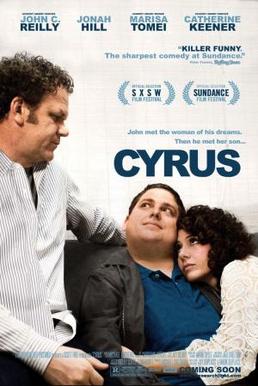
Cyrus takes so many conventions and places them directly at odds with the audience's expectations throughout the film, and from this aspect a portion of the film's genius is found. While I am no expert of mumblecore as a genre, of the films I have seen it appears that certain conventions of that genre are a heavily improvised script, generally lower key actors, and minimal camerawork to create a more 'realistic' film. So how do you do this when you have the queens of the indie scene, Catherine Keener and Marisa Tomei, Seth Rogen 2.0, Jonah Hill, and dramatist turned Tim and Eric vet, John C. Reily, headlining your film? Well you coax a magical performance from each and every one of these actors. In each performance is a brutally honest depiction of humanity, the complexities of love and the need for security. Stripped down to their basic elements we have a man seeking a major change clashing with an individual attempting to hold on not only to a life of security, but hoping to avoid being completely alone in the world around him. What Hill does with the Cyrus character is absolutely breathtaking, but not only is his turn completely stunning, the Duplass brothers have crafted such a wonderful character that he really deserves much more inspection.

The name Cyrus is, in many ways, completely fitting in regard to the film's themes and the character. While the source is questionable, the entomology section of the Wikipedia article states that the name means either "to bestow care" or "humiliator of the enemy in verbal contest," two traits completely attributed to the titular character. He has a need for nurture, and the film establishes his relationship with his mother as being the only fulfilling one in his life, so Cyrus's decision to act out against John is understandable. The stakes are so intense, but because Reily serves as the film's main character we are asked to also sympathize with him, and the character is incredibly easy to sympathize with throughout the film. At the very start of the film a party occurs, and the energy captured during this scene is so intense and well constructed that it absolutely gravitates throughout the rest of the film. This energy, paired with the sympathy that Cyrus does generate for himself, provides a beautifully engaging central conflict.

The construction of the film is also incredibly important when looking at Cyrus as well because the camerawork also plays against so many conventions. The most distinguishing trait of the film is the abundant use of zooms, giving the viewer a more intimate look at these characters, but even above that the zooms act as a way to work with the tension created between all the different aspects of convention playing against one another. The movie is a comedy as much as it is a drama, and because of the type of comedy, a much quieter and serious style, an underlying melancholy is found in the words, which generates an uneasiness throughout the film. The zooms don't allow the viewer much time to breathe or gain a sense of security, not only giving a layer of direct sympathy to our connection with Cyrus's grasp to hold on to what is comfortable at any cost, but also to heighten the uneasiness in each individual scene.

Cyrus is a film that finds complexity in its simplicity, but also does not allow the narrative to carry all the weight. The construction of the film, each zoom, each shot, each quietly creepy look from Hill, they all work simultaneously to enhance both the tone and themes. The film constantly builds to an ultimate clash of enormous forces until it crescendos beautifully as we see ideologies lashing out against each other. And I was left staggering back to my car after the credits started to flash by, and then I broke down in tears, and while I had a feeling during the film, after having a chance to mull it over more and see how perfectly all the elements work together, I knew Cyrus was not only a great film, but one of the year's best.

Comments are encouraged and, for anyone with a literary mind, I encourage checking out my poetry blog filled with all original works for your reading pleasure.

Also I am on the old Twitter thing so I guess you can follow me at twitter.com/FLYmeatwad.

Thursday, July 1, 2010

We Raise Up A Little Roof Against The Cold


Winter's Bone (Granik, 2010)

While I sat in the theater watching Winter's Bone I had memories begin flooding back to me, memories of films of a similar ilk. Shotgun Stories, All the Real Girls, and even the magnificent George Washington all stand as similar films to Granik's first feature length film since 2004. In many ways I half expected to see David Gordon Green's name flash across the screen as a co-director, or at least, as is the case with Shotgun Stories, a producer. But it never did, and when the credits started to roll and Granik's name rolled across the screen I had a throbbing desire to check out the rest of her work because, to be quite honest, Winter's Bone is currently a top contender for my best film from the first half of 2010. Granik brings a harshness to her landscapes and its inhabitants that compliment one another brilliantly, a world that has slowly plodded on simply to keep up with the rest of the country. The barren hills and shacks are populated with televisions, stoves, and machinery, but the film's look is decidedly bleak and causes these marks of modern times to echo the citizens.

Ree Dolly, played brilliantly by the startlingly enticing Jennifer Lawrence, is a seventeen year old woman who works as her house by day, caring for her younger brother and sister, and tracks her father Jesup down by night in order to save her home. I watch her on screen and it becomes apparent that, while she appears to be a modern individual, she is like the land. She continues to move on throughout the film, but ultimately she is stagnant and broken down. Her attempts to join the military are ill placed, her attempts to find her father are constantly met with failure, and she is surrounded by drug dealers, users, and violent posses. Lawrence brings the perfect resolve to this character, unwavering determination and drive the face of adversity, and as the film progressions we as viewers become like Ree; without question we continue and hope because we see that, if she can keep watch over her siblings, there is a chance her brother and sister do not have to be contained. I still do not completely know how Lawrence so masterfully captures this resolve, but her turn as Ree is complex and gripping. She is, of course, surrounded by a terrific supporting cast, but just as Ree is the anchor in this world, Lawrence is the film's ballast (side note: this film also reminds me a bit of Ballast.)

What strikes me so much about this film is not only Granik's ability to create such a well developed mood through the characters and the landscapes, but to also maintain a sense of urgency through the script. Very often films of this nature get so caught up in character development that standard 'action' falls by the wayside, and while the characters here, and certainly in other films, are strong enough to sustain a feature length production, the plot's driving force is genuinely intriguing and engaging. Granik lays out the film's stakes so perfectly that we realize the severity of the situation even before events become violent. If the Dolly house is seized a good chance exists that this family is doomed for at least another generation. But the strength of the script does not stop in its ability to weave character study aspects with traditional plot elements; instead, the script even reaches farther to address basic aspects of humanity. The familial unit, in so many diverse forms, is examined, as is the entire concept of humans as social beings. The building of a society and the construction of values. The film's subtext is not only staggering, but truly astounding.

I knew little of Winter's Bone going in, and what little I did know I had expected to enjoy, but in many ways this film is built for me to love. The film is as meditative as it is tense, as layered as it is simplistic, and a rare film that bleeds atmosphere while hardly ever faltering in any other aspect. Winter's Bone contains all the detail and beauty of a wonderfully painted portrait, knock out cinematography, and such an incredibly strong central performance that I imagine Lawrence will be one of the first names to pop up come December when I am making a year end wrap up list. More films should be as expertly crafted as Winter's Bone.

Sunday, June 20, 2010

And The Ancient Empty Street's Too Dead For Dreaming


Toy Story 3 (Unkrich, 2010)

With Toy Story 3 Pixar has attempted to return to an incredibly successful universe years later and capture the same charm that made the originals so endearing to so many viewers. Flashes of Star Wars. But will Pixar be able to follow in Lucas's footsteps and effectively deepen their world and characters while improving in nearly every way over the original material? With years of mediocre films clogging up their studio in the past decade, yielding only two and a half films of any substantial value, I was skeptical that the studio would have success. While I certainly am not surprised with the results, I found myself a bit surprised at how well specific aspects of the film are handled.

First let us talk about the positives, my friends. We shall strip away all of the fat: throw the shoehorned in jokes away, toss aside the sight gags, forget about all the action and adventure, and focus squarely on the idea of transition. Whether transitioning from life at home to life alone, high school to college, teenager to adult, any change and the gray area between our own prescribed blacks and whites. Early on in the film we see Andy sit back in his chair and peer around his room for what will be one of the last times in his life, and he lets out a sigh. In this sigh the film captures more power than any of the dialogue can hope to ever encompass. Similarly, Woody's pleas with the toys to return to Andy after a mix up has them feeling cast aside, we see both humans and non-humans struggling to reconcile their old life with an unformed future. Later in the film an incredibly touching moment is shared between Andy and his mother. These brief glimpses at honest emotion, conveyed excellently in context, do what successful works of art accomplish: hit on aspects of humanity without feeling artificial. And for the most part, surprisingly, these moments are spread out instead of lumped together to simply 'get' the audience as they were in Up, or far too few as they were in Wall*E. The final scene goes on far too long and becomes a bit too manipulative, but the outline of honest humanity still shines through, at least mostly.

However, Toy Story 3 is hampered by all the fat around the edges, despite the film's attempts to conceal the weaker points that seemingly weave their way in to keep audiences entertained as a standard action/adventure film in the vein of Up and Wall*E's dreadful final 'chase' acts. Essentially, Toy Story 3 is Toy Story 2 except better paced. Remember the not so funny part in Toy Story 2 where the two Buzz Lightyears got mixed up and the one acted like Buzz did in at the start of the first film? That aspect is mostly back again, except now Buzz is back to acting like a 'real' spaceman while speaking Spanish! And dancing! Zany! And the whole lovable, elderly, fat guy who turns out to be controlling, manipulative, and downright despicable, remember that bit? Well that plot line is recycled in the form of Lotso, a bear abandoned by his former owner, making a nice foil for Jesse. Speaking of Jesse, recall how intolerable she was in the previous film? Well she is better in this one because her role is incredibly downsized. Since the film cuts between so many different areas so quickly, and has the characters constantly moving forward, Jesse, and really very few of the toys, ever get to take center stage, which results in some fairly underdeveloped characters. At one point Woody encounters three new toys, all of which seemed interesting, but these characters are on the screen for such a short time they feel more like joke devices than actual characters, resulting in really simplistic interpretations of these individuals. The same can be said of the figures in Lotso's 'family.'

The simplicity is the largest problem that I have with Toy Story. When you have such a complex and layered concept at the center of the film I imagine that the characters would not be so black and white. But with the exception of the giant baby, and I guess Ken, the film is packed with stagnant characters. None of the toys make any major changes, even Woody's supposed realization that they are better together with someone else than separated while he stays with Andy, is complicated by the way Woody essentially becomes a figure comparable to Lotso. But the film pays no attention to this idea, the toys are happy, so Woody is right.This aspect is one of many small bits of logic that break apart when one looks very deeply into the film. How does Lotso know the telephone is in league with Woody and gang? How does that kite get blown so far up in the sky? How can the aliens operate a crane? Why does Lotso need a cane if the spa area can fix even the oldest toys? Why can he run so quickly at the end? They just happen.

A number of the aspects of Toy Story 3 just happen, seemingly because that is what is supposed to happen. So we get an excruciatingly long heist sequence at the end. We have a confrontation with Lotso, an inexplicable grasp of Woody's leg to keep the 'action' sequence going. We also have a Dreamworks~esque back and forth with Barbie and Ken, complete with pitch perfect musical cues and slow motion that would fit right in during the lowest of Shrek films. And a costume changing montage that, if I recall correctly, makes use of "Kung-Fu Fighting." The only thing missing was "Barbie Girl" at some point. The back and forths are not funny, actually there are only a few occasions of legitimate humor in the film. What makes the movie tolerable, and oddly what prevents it from being very good, is how quickly it moves the plot forward and how little time we spend with each group of characters. Barbie and Ken are painful to watch, but these bits are fine because they do not go on incredibly long. Same with any bits involving Jesse. Sadly that means the portions with Andy and Woody are also short, but better these good parts be brief than the bad parts be too long.

As a refinement of Toy Story 2, Toy Story 3 works on just about every level. As a successor to Toy Story, this film falls incredibly short. As an entry in Pixar's catalog, Toy Story 3 is, like many of the studio's films, a middle of the road feature that contains flashes of enjoyment and even brilliance, but is held back by so many paint by numbers story telling techniques, irritating characters, and flat jokes that these features seem lesser by comparison. However, the greatest achievement of Toy Story 3 is the restraint in how emotion is handled. My largest problem with the first ten minutes of Up the obvious manipulation going on in that portion of the film, a trait that only became more apparent as the film tried to integrate emotion further in the run time, and the same can be said of Wall*E and even parts of the masterful Ratatouille. When Toy Story 3 attempts to create a specific mood it works so well, it is just a shame the rest of the film has to exist.

PS: The short before the film was pretty good, and watching Night and Day pal around was enjoyable. The short film genre works for Pixar so well because it allows them to take an incredibly simplistic concept, and the ultimate message of this film certainly is painfully obvious early on and incredibly generic, but through they can play with visuals in such inventive ways and break out that message in an interesting enough way that it makes the simplicity forgivable. I prefer more experimental short films because they allow for much more complex and ambiguous ideas to be explored while engaging me on a cerebral level, but for the opposite end of the spectrum, Day & Night does a pretty great job at being entertaining.

Comments are encouraged and, for anyone with a literary mind, I encourage checking out my poetry blog filled with all original works for your reading pleasure.

Also I am on the old Twitter thing so I guess you can follow me at twitter.com/FLYmeatwad.
Monday, October 19, 2009

Your Head Will Collapse When There's Nothing In It, And You'll Ask Yourself: Where Is My Mind?


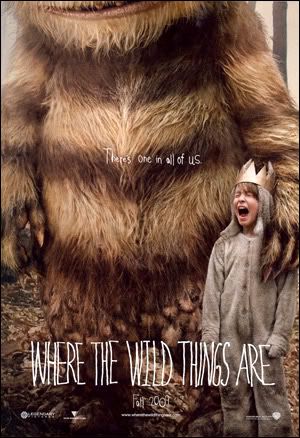
Where The Wild Things Are (Jonze, 2009)

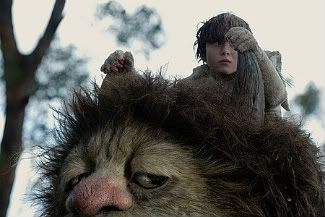
The PG rating tacked on to Spike Jonze's latest film, Where The Wild Things Are, may make you think that this film is intended for children, but I can almost assure you that more adults will enjoy this movie than children will, which is to be expected when you have a director who has only handled adult films focusing on the philosophical plight of man. I am mostly unfamiliar with Jonze's previous work, though I have seen and rather enjoyed Adaptation, and Where The Wild Things Are was set to be my first Jonze film on the big screen. Since I had the pleasure of seeing the film in IMAX the screen certainly was large, perhaps even as large as the Wild Things that young Max encounters. Much like my lack of knowledge about most of Jonze's career with a camera, I have also never read the book this film is based on, so I went in without the years upon years of nostaliga that most viewers will likely enter with. Also, I basically thought the trailers were unimpressive. Still, I was hoping that Jonze could produce one of the year's best films, and I knew if there was a director capable of elevating what could easily have become a simple morality tale for families, Spike Jonze is that man.

In many ways Jonze does deliver a film that is so much more than a simple film made for family friendly audiences, we have a movie that is essentially a trip into the psyche of a vulnerable child as he apparently attempts to come to terms with all of the turmoil in his life. Jonze does, for better and worse, capture the idea of childhood with this film, in each and every regard. Unfortunately, that freedom also shines through in the narrative, or in many cases the lack thereof. The majority of the film when we spend time where the wild things are, the viewer is given only minor references to what portion of Max these creatures are supposed to represent or what the point of him being here is, other than to make things looks pretty for the viewer. But the film is a character study, we don't really need a plot, right? Right. Sadly, the character we are studying is developing constantly, but he is doing it through six or seven lesser portions that simply do not stand alone as compelling enough characters to warrant all the conflict and emotion that Jonze forces on the viewer. In many ways this film is like Antichrist, you know the symbolism is going on because the film pushes the viewer in that direction, but in neither film are we given enough to completely let these symbols exist naturally in the film, but with Antichrist the entire film is overtly allegorical, where as this film is all over the place because we need to believe the reality of the reality as well as the reality of the fantasy in this world. Perhaps I am over-analyzing the film, but I cannot help but I do feel safe in asserting that the film is more rewarding to contemplate afterward than it is to watch during. But that contemplation is the mark of a great film, I am so torn.

You know what else is the mark of a great film? Technical prowess. Jonze has this prowess in spades. Everything about the film up to the point where Max first encounters the wild things is absolutely brilliant. Not only are all of the actors near flawless, a trait that does carry throughout the entire film, but the camera is used so intimately that the intended emotion of each scene practically oozes from the screen. Pair that with the wonderful use soundtrack, the fantastic editing, and the intense art direction and we could have one fantastic film. Actually, all of those things mostly do run throughout the entire film. Why do I not love this film more? Anyhow, Jonze miraculously loses all of this emotion as the film continues, only capturing flashes of the initial greatness about ever 15 minutes or so. Thankfully the film is God damned beautiful, so despite the narrative and character development not being too engaging during the run the visuals are more than enough to keep the film afloat.

Minor spoilers in this next paragraph I suppose, but really it's only the first 15 minutes...

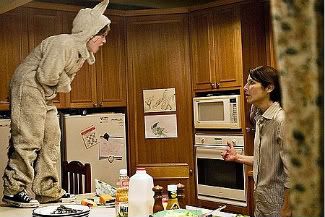
But I think things need to stay more than just afloat, in such a personal yet apparently universal film each and every viewer needs to be able to both sympathize and judge Max all at once. Perhaps that is what is missing in the middle. Early on, when we are still in the real world, everything Max does and each different scene not only reveals more and more about his character, though hardly in overt manners, while conveying different emotions. So much so that I imagine each and every viewer can, to some extent or another, connect with at least one of the things that Max experiences. Rebellion, isolation, joy, freedom, imagination, everything. Jonze displays it all, and he does it wonderfully. Hell, the film nearly had me in tears, which would have easily been a record, about fifteen minutes in when Max is lying on the ground under his mother's desk and she stresses out over work. I spent most of my adolescence in a single parent household and I completely connected with what Jonze had on display, but as a viewer I was also able to see the tragic beauty. And then we get the gut-wrenching scene where Max's mother has her boyfriend over. The way events transpire, it's devastatingly brilliant. But then that emotion disappears and we are given a pretty film to look at for a while.

Much like a child telling a story, the narrative offers basic symbols and moments of genius, but it just does not give enough during the film to truly showcase its brilliance. Yet after the credits rolled it's all mostly there, it just takes looking closer at the subtext. It's so confusing. I really do not know where I stand on the film, whether I love it, dislike it, respect it, admire it, adore it. I do not know. I honestly considered giving the film two ratings, but I can't do that, mostly because scores are meaningless. I'm certain this is not one of my favorite films of the year, yet aside from my top two or three there are no other films I have seen this year that I am more eager to revisit. I'll have to see if I can find someone to go with in the near future and hopefully get a fresh interpretation, maybe that will help me figure things out more. Let's just say it's pretty good, and pretty bad, and pretty fantastic.

B+/A- or 4.23234273847325462371895


We Were Once A Fairytale (Jonze, 2009)

Wow! A double dose of 2009 Spike Jonze! While I am still mostly confused about the Wild Things, I do know this short film is the best Spike Jonze directed film of 2009. Starring Kanye West in a role that is kind of like what I imagine John Malkovich did in the Jonze film about him, we experience a brief night in the club where Kanye struggles with identity, fame, rejection, and perhaps even the human condition. Jonze continues to show why he is magical with a camera, and he even gets a fairly decent performance out of Mr. West, though I have to wonder if Kanye always sounds so odd when he talks/yells. The film is a bit difficult to hear sometimes because it never drops the club atmosphere, so loud music is always playing, but that is nothing more than a minor complaint. While it is probably safe to give away the ending since Jonze has the film up online and it is only 11 minutes long, I will just talk about it in a round about manner. It's a fantastic ending point that, if I am interpreting it anywhere close to correct, and that may not be since the analytical portion of my brain had a good deal of trouble even formulating a decent idea of what was happening, essentially is delightfully bleak yet strikingly lovely. A great effort from Jonze and an excellent follow up to his messy Where The Wild Things Are.

A-/B+ or 4.278721462356239563279

And just like that I have hit 60 2009 films watched so far this year! I have roughly 4 months to hit 100, which I think is completely doable.

Feel free to watch We Were Once A Fairytale right here

Comments are welcome and, for anyone with a literary mind, I encourage checking out my poetry blog filled with all original works for your reading pleasure.

Also I am on the old Twitter thing so I guess you can follow me at twitter.com/FLYmeatwad.

Monday, August 17, 2009

What A Gas It Was To See Him Walk Her Every Day Into A Shady Place

Planned on doing a double shot review, but I just do not feel that I have much to say about the second film, so I'm just going to tack on a little bit at the end to give it some attention.


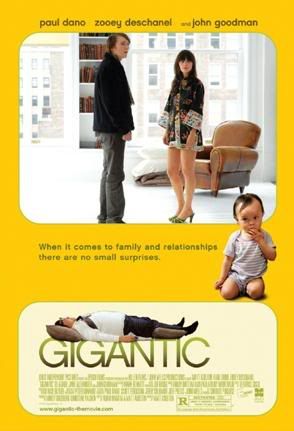
Gigantic (Aselton, 2009)

In many ways, Gigantic is a wonderful experiment that ends up, somehow to its benefit, less than the sum of its parts. Anchored by a wonderful cast, featuring Zooey Deschanel in her second, and more impressive, performance of the year, first time director Matt Aselton comes out firing on all cylinders, but has a good deal of trouble putting everything together for a transcendental film. However, this does not prove to be the detriment that it would immediately seem to imply. Gigantic constantly walks a fine technical line, shifting from beautifully disciplined camera movement, albeit a bit too contained at the film's start, to wonderfully beautiful hand held shots that showcase a striking freedom, such as the scene where the camera drifts in and out of trees in the woods. Unquestionably, the film is a visual powerhouse. The cinematography is some of the best of the year so far and Aselton shows a ton of potential for any future films he will hopefully involve himself in. Whether in the city or out in the forest, he has a way with presenting scenes in visually striking manners. The film is technically brilliant.

The ideas presented in the film are mighty interesting as well, though the movie could have likely used another ten minutes or so to give the viewer a push in some sort of general direction. I am all about ambiguity, and the way the film is constructed the ambiguous nature of the plot lines proves to be crucial to the entire experience, but the idea does not completely pay off at the end. However, I find myself incredibly interested to take a look back and see if I over looked any tiny details that may help give me something more to latch onto and ponder even more in depth. The humor, surprisingly, lands when it is used, but the film is hardly a laugh a minute. Thankfully, the film also crafts some pretty fascinating characters to make up for the fact that that plot is a little lean. But the film is also fairly complex and, much to my delight, only hints instead of coming out and actually revealing things, which I love in films. It makes the audience work, and I can respect the script for taking that chance.

Of course a lot of the writing could easily go to waste with a cast that is not capable of handling the roles. As I said, Deschanel is brilliant, and beautiful, and just about everything the role needs. Of course placing Dano opposite her, and having him turn in a performance that is both human and genuine, capturing the struggles of what appears to be a troubled man attempting to exist in 'normal' society, is a choice that pays off in droves. Goodman is mighty great as well, and Asner turns in a performance that is certainly at least five steps above his voice work in the underwhelming, and incredibly overrated, Pixar film Up from earlier this year. Other highlights of Gigantic include a soundtrack that rivals Adventureland and Lymelife for the year's best, a fantastic supporting cast, and a highly stylized world that all add up to one Hell of a debut for Matt Aselton.


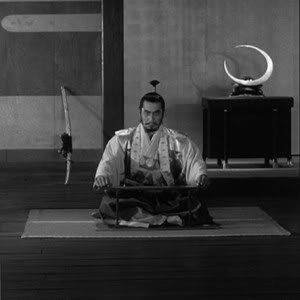
Throne of Blood (Kurosawa, 1957)

The film is visually gorgeous, the score is pretty great, the acting is good, and the film is another great effort from Akira Kurosawa. Sadly, this film felt much slower than the two previous Kurosawa films that I have watched and I really think that the silent portions here, unlike in Rashomon, detracted instead of added to the film. Basically the film is a standard retelling of Macbeth, and I've always been of the mind that Macbeth is much better material to be discussed than to be watched or read. Not surprisingly, that transfers over to Throne of Blood mostly. It's a pretty great adaptation I suppose, despite leaving out a few things from the play, I believe. But he also injects his own themes and visual symbols, which adds more to the film, I reckon. Can't say I was blown away though or that I have much to say about the film. It's really solid and a technically great film, but it just never really grabbed me.

B+ or 3.898213472146702381645823

Comments are welcome and, for anyone with a literary mind, I encourage checking out my poetry blog filled with all original works for your reading pleasure.

Also I am on the old Twitter thing so I guess you can follow me at twitter.com/FLYmeatwad.

Thursday, August 13, 2009

And The Sun's So Hot I Think I'll Catch Fire And Burn Up In The Summer Air So Moist And Sweet


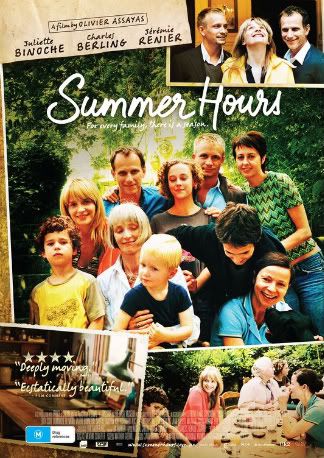
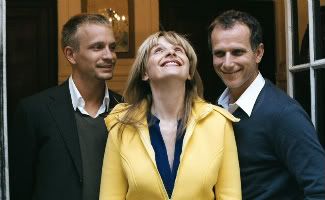
Summer Hours (Assayas, 2009)

So I reckon I should get this out of the way right now, I have not yet seen the French film from last year that is apparently part of this series, The Flight of the Red Balloon. Actually, my exposure to French cinema, both modern and the New Wave movement, is rather limited. However, as of this writing the only other French film I have seen this year, The Class, currently sits as my sixth best film released in 2009, so I found myself fairly excited as I sat down and went into Olivier Assayas' latest film, Summer Hours. Focusing on the surviving family of some French artist, I don't really get into these details because I do not know a damn thing about paintings and sculptures and stuff like that, in about a 100 minute run time, Summer Hours explores different concepts about loss and memory, along with the economic extension of real world circumstances that are important to more affluent families. While I knew little of the film upon entering, the first scene at the estate is a stylistic bang that really cements what proves to be an incredibly visually striking film. The first fifteen minutes or so set up the film and the characters so wonderfully that I found myself mostly swept up in the world being presented.

Being swept up, as I have said, is probably caused by, in no small part, the beautiful cinematography and masterful direction. Assayas does not employ the traditional handheld camera style that would seem like the obvious choice for this type of film, but he also does not make extensive use of a traditional camera style either. At numerous times the scenes feel a little contained, but the idea that these decisions were anything but intentional seems insane simply because the film just looks so professionally constructed. Not to mention that, when using more traditional wide shots, the film looks beautiful. Maybe the way it is shot is supposed to mirror the audience's expectations that these people are supposed to be free because of their social status and money, but in actuality they are just as trapped as 'average' people, yet there is still a noticeable beauty in the human experience. Either way, the film is also anchored by performances that range from really good to great. The standouts are obviously Juliette Binoche and Charles Berling, with Berling really delivering a stellar performance, but all of the supporters are pretty damn fantastic. The younger actors who play the children are also mighty impressive. However, the true mastery is only shown for a very short time, in the form of Edith Scob. She brings an elegant grace and knowledge to her role, despite it mostly being contained to the first portion of the film.

On the whole, Summer Hours is a pretty interesting experience. The film is almost deceptively complex, touching on numerous themes despite presenting them in seemingly simple circumstances. The film is both broad and specific, taking a brush and painting a portrait of both beauty and melancholy, blending the best of emotions at any given time. I should also mention that the final three scenes in the film are some of the most effective of any film so far this year. I find pinpointing a single reason for their success rather difficult, but I almost believe that part of the intention is that nothing in the film is as simple as one would imagine. Summer Hours is a truly touching film that, even for someone with my disposition, works on both an emotional level and actually builds up my faith in the human condition, however minor that construction may seem.

A- or 4.1984892174238015472385320157

Comments are welcome and, for anyone with a literary mind, I encourage checking out my poetry blog filled with all original works for your reading pleasure.

Also I am on the old Twitter thing so I guess you can follow me at twitter.com/FLYmeatwad.
Wednesday, July 22, 2009

I'm Staying In The Hotel, Not The Motel Or The Holi-Day Inn


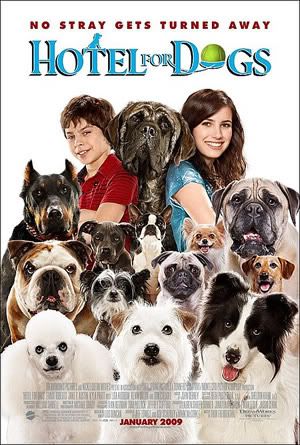
Hotel for Dogs (Freudenthal, 2009)

Coming out of Nickelodeon Movie Studios, I didn't know they were still around, is one of what I like to pretend was one of 2009's most well received blockbusters. That little film, a quiet period piece about the struggles of life, financial strain, and existence in general goes by the seemingly deceptive title Hotel for Dogs. Drawing its influence from the Italian Neo-Realist movement, specifically Umberto D., Hotel for Dogs waxes poetic about all of life's pressing issues and, drawing influence from last year's Wendy and Lucy, makes no sacrifice in regard to emotional power. The fact that the public was able to pick up on such a noticeable masterpiece is pretty much unheard of and quite heartwarming. Or at least that's what I like to pretend.

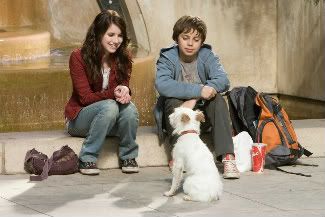
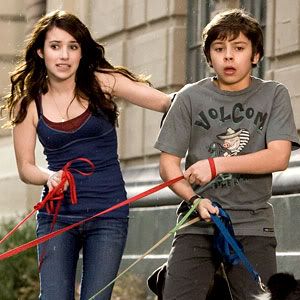
In actuality, Hotel for Dogs is pretty standard stuff at its heart, but the film puts on enough of a show to keep things both fresh and interesting enough to sustain its abnormally lengthy run time of almost two hours. Things start off interestingly enough as the viewer is greeted by a constructed plastic town full of whimsy and the 1950's American Spirit, or something of the sort, before introducing us to Friday as he prowls the streets of some pseudo-city area for some food. Shortly after we are introduced to both Andi and Bruce, Friday's owners and the film's protagonists. Marking these opening sequences is some pretty nice direction, mixing in a few pretty neat shots and sequences, but ultimately nothing of huge interest. All of these things set up nicely for the film as a whole because on the whole the film proves to be a mostly mixed bag of entertainment in spite of the standard technical pieces.

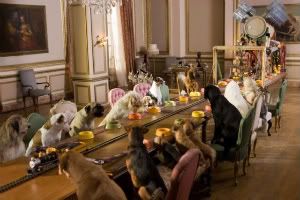
Of course there is one major exception to this, and that is in the design and integration of the devices used inside of the Hotel. Most of the inventions that the film has Bruce come up with are really fun bits of whimsy inserted into the film to give it a nice atmosphere without being too over the top or unrealistic. Sure there is a suspension of belief needed to buy into all of the things that are happening on screen, but the film asks the viewer to do this from the beginning and, for the most part, earns this suspension while still keeping things contained in this world through the whole thing instead of breaking it when it could be convenient for the narrative.

Of course this is not the film's only triumph. While the narrative as a whole is pretty predictable, and when the film takes advantages of connecting plot to larger themes things become pretty obvious, the construction is mostly admirable and the film rarely wastes any time or has any points that feel like stalls in the narrative process. Also the integration of the 'we are orphans and the dogs are like us' metaphor is nice considering that the film is geared toward a younger audience, not to mention that it, mostly, avoids being overly direct or dumbed down to the point where it insults older viewers. There is an extended monologue at the end where things start to get a bit preachy, but it mostly works in context of the film despite almost serving as a literal soapbox. Unfortunately the film does not really integrate humor as well as it could, especially considering that Jake T. Austin has already shown an ability to be incredibly funny when given the correct material. Sure the film has Troy Gentile turn in a strikingly funny performance as Mark, but on the whole the film could have been a good deal funnier than the final product would imply.

Speaking of Jake T. Austin, I was really looking forward to seeing how he would do in a full length film after watching him develop from a slightly tolerable throw away character to one of the most interesting cast members in Disney's Wizards of Waverly Place series, but I was very disappointed with his part in the film. He always felt like he was trying a bit too hard to be the reserved, sheltered, and conflicted younger brother type. He has a few flashes that are really promising, but the role does not offer much and Austin, sadly, does not do much to make it how own, but he is still growing and he shows promise as an actor. Of course it does not help that he is constantly alongside Emma Roberts. I had jokingly said that, after seeing her in Lymelife, that she has potential to top both my Lead and Supporting Actress lists for the year so far, but little did I know that it would turn out to be almost true. In a sea of near mediocrity, Roberts turns in a marvelous performance that must cement her as the most interesting young actress currently working. The range she shows is impressive, but the believability and personality she brings to the Andi character is endearing and inspired. Most of the supporting cast is really good, but Roberts is clearly the standout star and, while I would really need to think of other actresses to know where she falls in my rankings, she certainly is pretty damn impressive here.

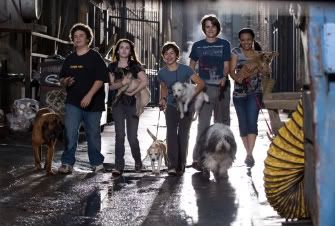
All in all Hotel for Dogs, despite being nothing revolutionary, possesses enough charm, and more than enough dogs, to have kept me both entertained and enjoying my time with the film. Sure, I tend to give most films that involve canines a pass, but here the film is well constructed enough to really succeed and sustain itself without feeling overly cheesy or ever mind numbingly stupid. Highlighted by Emma Roberts' second incredible performance of the year, Hotel for Dogs is a nice bit of escapist cinema with enough earned emotional pull to lift it from decent to good territory. It's a film I would not mind watching again some time in the future and really had my surprised with how much I had eventually enjoyed the film. The film also has a pretty funny Reservoir Dogs homage in it too, which is pictured above.

B/B- or 3.46248136745721357891369576

Comments are welcome and, for anyone with a literary mind, I encourage checking out my poetry blog filled with all original works for your reading pleasure.

Also I am on the old Twitter thing so I guess you can follow me at twitter.com/FLYmeatwad.

Wednesday, July 15, 2009

Meet The New Boss, Same As The Old Boss


Ikiru (To Live) (Kurosawa, 1952)

The Kurosawa marathon continues with the 1952 film Ikiru (To Live). Now because I know little about Kurosawa outside of what I saw in Rashomon I have to wonder if this film is any indication of what types of films are to come in the future from the acclaimed director. Sure Rashomon started getting all philosophical at the end, but Ikiru starts things off with a metaphoric bang as we quickly learn the circumstances and are introduced to our protagonist. Given the film's description on the Netflix packet I had little idea of what the film would consist of aside from a man trying to build a park, but little did I know just how deceptive such a description is in the film's larger context.

Speaking of larger context let's start pretty broad and begin narrowing things down from there. Kurosawa turns in another fantastic effort behind the camera and, in some ways even more than Rashomon, makes for a visually compelling film. Seeing how differently he handles shots in a larger and congested city as opposed to the tangled forests was interesting and really gave the film its own stylistic feel while keeping with elements that are quickly becoming Kurosawa trademarks. Once again seeing the influence that the man has had on future films is near unmistakable when watching Ikiru, but in some ways I almost felt that, as far as direction is concerned, Rashomon is just slightly stronger. However, every time I thought this we would get sequences like the playground one or the one in the bar early on. In other words, the film looks pretty damn beautiful.

So now we'll get a little more concise and focus on the acting. While the film is littered with a ton of really good performances throughout, the anchor, as the script demands, must be Watanabe. Thankfully, Takashi Shimura turns in a top notch performance that hits all of the right notes. Even if the script was horrible, the direction terrible, and the other actors particularly dreadful, I am completely confident that Shimura's performance alone would make for compelling cinema. Obviously none of that is the case though and all the surrounding elements only help to enhance his job on screen. He captures the mentality of man perfectly and seeing him develop in the face of certain death and a crumbling family life is handled masterfully, both by Shimura and Kurosawa. The performance is truly incredible and certainly had me impressed throughout the hefty two and a half hour run time.

Now the run time could have easily been a flaw, and there were one or two scenes where things slowed down a noticeable bit, but for the most part the film was paced excellently. It clearly followed a very direct Three Act structure, but age old tales have always been told about how life is, at its core, three different parts all making up a whole. I do not think it is by coincidence that Kurosawa structured the film in such a manner, and taken in context it's a truly remarkable technique. Actually, most of the artistic value of the film is handled wonderfully and just about all of the philosophical stuff is given ample attention.

The one problem I had with the film was in the bureaucratic commentary. The film starts off with a whole round about sequence of going from department to department that is used incredibly, and most of the stuff in the third act, especially the final returning to work portion, is flawlessly executed, but the theme feels a bit underdeveloped during the middle portion. Now I know this theme was not supposed to act as the backbone of this portion, but having a little more there could have really pushed the film over the top for me. When the number of successes in a film are so plentiful, as is the case with Ikiru, the one flaw tends to stand out, but as I evaluate it I am able to realize that it does not hurt the film all that much. The only other potential problem I can think of, as was the case with Rashomon, is how direct the ending is, though thankfully nothing feels rushed or forced here, so the problem here is more personal and less technical, so my supporting evidence is limited.

Ultimately, my second experience with Akira Kurosawa was similar to my first. Things start off fairly simple, but as the film builds it picks up momentum at an astounding rate and makes for an incredibly compelling film. I think the sheer amount of material here, extraneous ideas given to each individual viewer I mean, is so numerous that I need at least one more viewing to process everything, but I can say without a doubt that Ikiru demonstrates Kurosawa's versatility as a storyteller and as a director while still existing wonderfully as a narrative. Ikiru hits every note pitch perfect and has me, once again, excited to see more Kurosawa.

A[/A+?] or 4.672348239143679563159783

Comments are welcome and, for anyone with a literary mind, I encourage checking out my poetry blog filled with all original works for your reading pleasure.

Also I am on the old Twitter thing so I guess you can follow me at twitter.com/FLYmeatwad.