Showing posts with label Kurosawa. Show all posts

Monday, August 17, 2009

What A Gas It Was To See Him Walk Her Every Day Into A Shady Place

Planned on doing a double shot review, but I just do not feel that I have much to say about the second film, so I'm just going to tack on a little bit at the end to give it some attention.


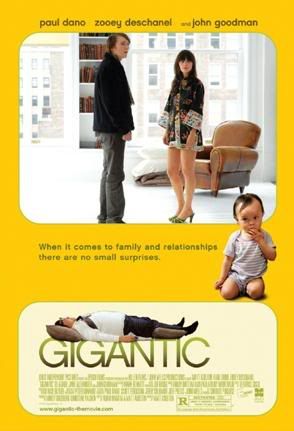
Gigantic (Aselton, 2009)

In many ways, Gigantic is a wonderful experiment that ends up, somehow to its benefit, less than the sum of its parts. Anchored by a wonderful cast, featuring Zooey Deschanel in her second, and more impressive, performance of the year, first time director Matt Aselton comes out firing on all cylinders, but has a good deal of trouble putting everything together for a transcendental film. However, this does not prove to be the detriment that it would immediately seem to imply. Gigantic constantly walks a fine technical line, shifting from beautifully disciplined camera movement, albeit a bit too contained at the film's start, to wonderfully beautiful hand held shots that showcase a striking freedom, such as the scene where the camera drifts in and out of trees in the woods. Unquestionably, the film is a visual powerhouse. The cinematography is some of the best of the year so far and Aselton shows a ton of potential for any future films he will hopefully involve himself in. Whether in the city or out in the forest, he has a way with presenting scenes in visually striking manners. The film is technically brilliant.
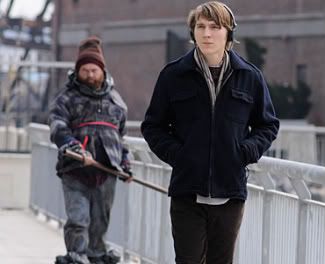
The ideas presented in the film are mighty interesting as well, though the movie could have likely used another ten minutes or so to give the viewer a push in some sort of general direction. I am all about ambiguity, and the way the film is constructed the ambiguous nature of the plot lines proves to be crucial to the entire experience, but the idea does not completely pay off at the end. However, I find myself incredibly interested to take a look back and see if I over looked any tiny details that may help give me something more to latch onto and ponder even more in depth. The humor, surprisingly, lands when it is used, but the film is hardly a laugh a minute. Thankfully, the film also crafts some pretty fascinating characters to make up for the fact that that plot is a little lean. But the film is also fairly complex and, much to my delight, only hints instead of coming out and actually revealing things, which I love in films. It makes the audience work, and I can respect the script for taking that chance.

Of course a lot of the writing could easily go to waste with a cast that is not capable of handling the roles. As I said, Deschanel is brilliant, and beautiful, and just about everything the role needs. Of course placing Dano opposite her, and having him turn in a performance that is both human and genuine, capturing the struggles of what appears to be a troubled man attempting to exist in 'normal' society, is a choice that pays off in droves. Goodman is mighty great as well, and Asner turns in a performance that is certainly at least five steps above his voice work in the underwhelming, and incredibly overrated, Pixar film Up from earlier this year. Other highlights of Gigantic include a soundtrack that rivals Adventureland and Lymelife for the year's best, a fantastic supporting cast, and a highly stylized world that all add up to one Hell of a debut for Matt Aselton.
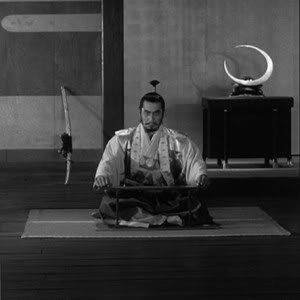

Throne of Blood (Kurosawa, 1957)

The film is visually gorgeous, the score is pretty great, the acting is good, and the film is another great effort from Akira Kurosawa. Sadly, this film felt much slower than the two previous Kurosawa films that I have watched and I really think that the silent portions here, unlike in Rashomon, detracted instead of added to the film. Basically the film is a standard retelling of Macbeth, and I've always been of the mind that Macbeth is much better material to be discussed than to be watched or read. Not surprisingly, that transfers over to Throne of Blood mostly. It's a pretty great adaptation I suppose, despite leaving out a few things from the play, I believe. But he also injects his own themes and visual symbols, which adds more to the film, I reckon. Can't say I was blown away though or that I have much to say about the film. It's really solid and a technically great film, but it just never really grabbed me.

B+ or 3.898213472146702381645823

Comments are welcome and, for anyone with a literary mind, I encourage checking out my poetry blog filled with all original works for your reading pleasure.

Also I am on the old Twitter thing so I guess you can follow me at twitter.com/FLYmeatwad.

Wednesday, July 15, 2009

Meet The New Boss, Same As The Old Boss


Ikiru (To Live) (Kurosawa, 1952)

The Kurosawa marathon continues with the 1952 film Ikiru (To Live). Now because I know little about Kurosawa outside of what I saw in Rashomon I have to wonder if this film is any indication of what types of films are to come in the future from the acclaimed director. Sure Rashomon started getting all philosophical at the end, but Ikiru starts things off with a metaphoric bang as we quickly learn the circumstances and are introduced to our protagonist. Given the film's description on the Netflix packet I had little idea of what the film would consist of aside from a man trying to build a park, but little did I know just how deceptive such a description is in the film's larger context.

Speaking of larger context let's start pretty broad and begin narrowing things down from there. Kurosawa turns in another fantastic effort behind the camera and, in some ways even more than Rashomon, makes for a visually compelling film. Seeing how differently he handles shots in a larger and congested city as opposed to the tangled forests was interesting and really gave the film its own stylistic feel while keeping with elements that are quickly becoming Kurosawa trademarks. Once again seeing the influence that the man has had on future films is near unmistakable when watching Ikiru, but in some ways I almost felt that, as far as direction is concerned, Rashomon is just slightly stronger. However, every time I thought this we would get sequences like the playground one or the one in the bar early on. In other words, the film looks pretty damn beautiful.

So now we'll get a little more concise and focus on the acting. While the film is littered with a ton of really good performances throughout, the anchor, as the script demands, must be Watanabe. Thankfully, Takashi Shimura turns in a top notch performance that hits all of the right notes. Even if the script was horrible, the direction terrible, and the other actors particularly dreadful, I am completely confident that Shimura's performance alone would make for compelling cinema. Obviously none of that is the case though and all the surrounding elements only help to enhance his job on screen. He captures the mentality of man perfectly and seeing him develop in the face of certain death and a crumbling family life is handled masterfully, both by Shimura and Kurosawa. The performance is truly incredible and certainly had me impressed throughout the hefty two and a half hour run time.

Now the run time could have easily been a flaw, and there were one or two scenes where things slowed down a noticeable bit, but for the most part the film was paced excellently. It clearly followed a very direct Three Act structure, but age old tales have always been told about how life is, at its core, three different parts all making up a whole. I do not think it is by coincidence that Kurosawa structured the film in such a manner, and taken in context it's a truly remarkable technique. Actually, most of the artistic value of the film is handled wonderfully and just about all of the philosophical stuff is given ample attention.

The one problem I had with the film was in the bureaucratic commentary. The film starts off with a whole round about sequence of going from department to department that is used incredibly, and most of the stuff in the third act, especially the final returning to work portion, is flawlessly executed, but the theme feels a bit underdeveloped during the middle portion. Now I know this theme was not supposed to act as the backbone of this portion, but having a little more there could have really pushed the film over the top for me. When the number of successes in a film are so plentiful, as is the case with Ikiru, the one flaw tends to stand out, but as I evaluate it I am able to realize that it does not hurt the film all that much. The only other potential problem I can think of, as was the case with Rashomon, is how direct the ending is, though thankfully nothing feels rushed or forced here, so the problem here is more personal and less technical, so my supporting evidence is limited.

Ultimately, my second experience with Akira Kurosawa was similar to my first. Things start off fairly simple, but as the film builds it picks up momentum at an astounding rate and makes for an incredibly compelling film. I think the sheer amount of material here, extraneous ideas given to each individual viewer I mean, is so numerous that I need at least one more viewing to process everything, but I can say without a doubt that Ikiru demonstrates Kurosawa's versatility as a storyteller and as a director while still existing wonderfully as a narrative. Ikiru hits every note pitch perfect and has me, once again, excited to see more Kurosawa.

A[/A+?] or 4.672348239143679563159783

Comments are welcome and, for anyone with a literary mind, I encourage checking out my poetry blog filled with all original works for your reading pleasure.

Also I am on the old Twitter thing so I guess you can follow me at twitter.com/FLYmeatwad.

Friday, July 10, 2009

What I Read Between The Lines: Your Lies

Rashomon (Kurosawa, 1950)

It has taken me needlessly long to get started with Akria Kurosawa's films. Finally, the Filmspotting marathon that Adam and Matty are doing on the podcast has allowed me the chance to really start watching films from a man who is considered to be a master filmmaker. I'm going to skip all of the historical background and things of that nature, not that I would likely be able to offer much insight in the way of correctly placing him in his time period or alongside his contemporaries anyhow, in order to focus on my reaction to my first venture into Kurosawa's robust library of films.

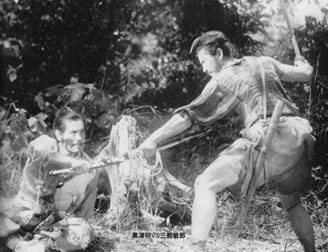
Rashomon has a pretty interesting structure, following a recurring narrative that offers four different occurrences of the same event as a man is put on trial. However, these narrations are narrated by two men at a temple, so really we are hearing a story of a story, and if you take into account the fact that the film is apparently based on another story it adds another fun little layer into the mix. As for the style, it is used much to the film's benefit. Paired with meandering shots through a dreamlike, or perhaps nightmare would be more fitting, forest, the viewer is made to be swept away with each narrative as the idea of fact versus fallacy is constantly in one's mind, but hardly ever able to be discerned in any tangible fashion. Really all we know is what is shown at the Rashomon temple and that the one man is dead, everything else is open to interpretation.

Of course even the way the audience is asked to be engaged and how any individual viewer should interpret the scenario is enhanced by having a faceless inquisitor prod each of the characters to make direct appeals to the camera. The technique is really brilliant and is sure to never give away any details that may place more fact in the hands of a viewer. In a sense, the character that is being told the story by the axeman and the priest is placed in the same situation as a viewer and, towards the end, begins piecing things together on his own as any viewer of the film likely would as well. The film's construction is pretty damn masterful and thought provoking all the way up to a mostly beautiful finale.

Now I have talked all about the construction and have yet to mention the direction and the cinematography. Both are beautifully in the purest sense of the word, Kurosawa's control of the camera paired with Miyagawa's beautifully constructed scenes makes for an experience that is phenomenally striking purely from a visual level, but also one that allows the film to exist almost silently. The dialogue at points is minimal, but none of the tension is ever lost nor does the narrative ever slow down. Dialogue becomes an equal with the images, breaking the barrier between story and painting and doing it wonderfully.

Of course the film's ability to work even in elongated silent sequences, especially when most of the film is so concerned with narrating stories, is also largely thanks to the actors involved. All of the actors give spectacular performances and nothing less than a solid performance can be found. However, mixed in with a slew of really good performances, two particular ones stand out as incredibly impressive. Toshiro Mifune turns in a wonderfully maniacal effort as the bandit Tajomaru, categorized by a signature cackle that embodies the best and the worst of the human experience, while Machiko Kyo is phenomenal as Masako Kanazawa, the wife of the murdered man. Both show an impressive range and turn in riveting performances in their respective roles, but the one scene that really sold it for me is how both act in the axe man's tale. Both interact with each other wonderfully without Mifune or Kyo losing anything to the other.

I have very few gripes with the film. The picture is perfectly paced and sustains its running time nicely, clocking in around 88 minutes. The one part that struck me as odd, though not really a flaw in the film I would say, was the conclusion. I did question the priest's reaction at a pivotal point, and his change actions seemed a little forced, though they worked nicely with what Kurosawa was trying to do, which is the trade off when using characters as representations, as the case appears in the final scene. I am also still wrestling with the film's concluding message, I believe it is rather obvious and if that is true then I suppose I have a bit of a personal problem with what the film is saying rather than a technical problem. To have things end how they do after a wonderfully human and pretty nihilistic speech is delivered seems to undercut what just occurred rather than provide a juxtaposition. Still, I am aware that this problem is purely personal and not a flaw of the film.

Ultimately, I found my first experience with Kurosawa particularly impressive and I cannot wait to delve deeper into the man's body of work. Rashomon takes a seemingly simple tale, shoots it beautifully, tells a story, and then unloads a shotgun shell's worth of philosophy upon the viewer towards the end. The results are hardly painful though, the experience proves mentally stimulating and utterly flooring, capturing the mentality of a lone bowling pin in the ninth frame. I look forward to hearing Adam and Matty discuss the film on the podcast this week and am positive that this marathon is going to be spectacular.

A/A+ or 4.76827914623149236452397856

Comments are welcome and, for anyone with a literary mind, I encourage checking out my poetry blog filled with all original works for your reading pleasure.

Also I am on the old Twitter thing so I guess you can follow me at twitter.com/FLYmeatwad.