Showing posts with label romantic comedy. Show all posts

Monday, July 12, 2010

When You Punish A Child For Dreaming His Dream Don't Expect Him To Thank Or Forgive You


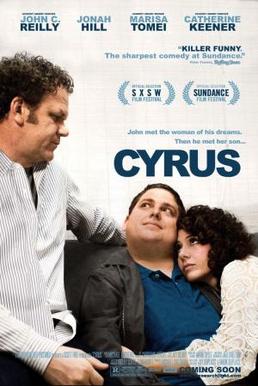
Cyrus (Duplass and Duplass, 2010)

In the past couple of years there seems to be one runaway indie comedy that is usually distributed by Fox Searchlight that reaches an unexpected amount of people and is met with surprise financial success. The most notable of these films are Juno and Little Miss Sunshine, both comedies that attempt to combine dramatic elements and complex characters to create genre hybrids offering more meat than the average romantic comedies that inundate theaters on a near weekly basis. In many ways Cyrus follows in the footsteps of these films, but unlike the other Searchlight features the new film from the Duplass Brothers seeks to bring an entirely new genre, mumblecore, to the masses. As a result the two have crafted one of the most interesting cinematic experiments in recent memory, creating a blend the likes of which your local coffee shop can only dream of concocting.

Cyrus takes so many conventions and places them directly at odds with the audience's expectations throughout the film, and from this aspect a portion of the film's genius is found. While I am no expert of mumblecore as a genre, of the films I have seen it appears that certain conventions of that genre are a heavily improvised script, generally lower key actors, and minimal camerawork to create a more 'realistic' film. So how do you do this when you have the queens of the indie scene, Catherine Keener and Marisa Tomei, Seth Rogen 2.0, Jonah Hill, and dramatist turned Tim and Eric vet, John C. Reily, headlining your film? Well you coax a magical performance from each and every one of these actors. In each performance is a brutally honest depiction of humanity, the complexities of love and the need for security. Stripped down to their basic elements we have a man seeking a major change clashing with an individual attempting to hold on not only to a life of security, but hoping to avoid being completely alone in the world around him. What Hill does with the Cyrus character is absolutely breathtaking, but not only is his turn completely stunning, the Duplass brothers have crafted such a wonderful character that he really deserves much more inspection.

The name Cyrus is, in many ways, completely fitting in regard to the film's themes and the character. While the source is questionable, the entomology section of the Wikipedia article states that the name means either "to bestow care" or "humiliator of the enemy in verbal contest," two traits completely attributed to the titular character. He has a need for nurture, and the film establishes his relationship with his mother as being the only fulfilling one in his life, so Cyrus's decision to act out against John is understandable. The stakes are so intense, but because Reily serves as the film's main character we are asked to also sympathize with him, and the character is incredibly easy to sympathize with throughout the film. At the very start of the film a party occurs, and the energy captured during this scene is so intense and well constructed that it absolutely gravitates throughout the rest of the film. This energy, paired with the sympathy that Cyrus does generate for himself, provides a beautifully engaging central conflict.

The construction of the film is also incredibly important when looking at Cyrus as well because the camerawork also plays against so many conventions. The most distinguishing trait of the film is the abundant use of zooms, giving the viewer a more intimate look at these characters, but even above that the zooms act as a way to work with the tension created between all the different aspects of convention playing against one another. The movie is a comedy as much as it is a drama, and because of the type of comedy, a much quieter and serious style, an underlying melancholy is found in the words, which generates an uneasiness throughout the film. The zooms don't allow the viewer much time to breathe or gain a sense of security, not only giving a layer of direct sympathy to our connection with Cyrus's grasp to hold on to what is comfortable at any cost, but also to heighten the uneasiness in each individual scene.

Cyrus is a film that finds complexity in its simplicity, but also does not allow the narrative to carry all the weight. The construction of the film, each zoom, each shot, each quietly creepy look from Hill, they all work simultaneously to enhance both the tone and themes. The film constantly builds to an ultimate clash of enormous forces until it crescendos beautifully as we see ideologies lashing out against each other. And I was left staggering back to my car after the credits started to flash by, and then I broke down in tears, and while I had a feeling during the film, after having a chance to mull it over more and see how perfectly all the elements work together, I knew Cyrus was not only a great film, but one of the year's best.

Comments are encouraged and, for anyone with a literary mind, I encourage checking out my poetry blog filled with all original works for your reading pleasure.

Also I am on the old Twitter thing so I guess you can follow me at twitter.com/FLYmeatwad.

Monday, August 17, 2009

What A Gas It Was To See Him Walk Her Every Day Into A Shady Place

Planned on doing a double shot review, but I just do not feel that I have much to say about the second film, so I'm just going to tack on a little bit at the end to give it some attention.


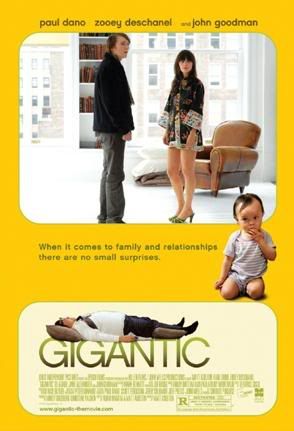
Gigantic (Aselton, 2009)

In many ways, Gigantic is a wonderful experiment that ends up, somehow to its benefit, less than the sum of its parts. Anchored by a wonderful cast, featuring Zooey Deschanel in her second, and more impressive, performance of the year, first time director Matt Aselton comes out firing on all cylinders, but has a good deal of trouble putting everything together for a transcendental film. However, this does not prove to be the detriment that it would immediately seem to imply. Gigantic constantly walks a fine technical line, shifting from beautifully disciplined camera movement, albeit a bit too contained at the film's start, to wonderfully beautiful hand held shots that showcase a striking freedom, such as the scene where the camera drifts in and out of trees in the woods. Unquestionably, the film is a visual powerhouse. The cinematography is some of the best of the year so far and Aselton shows a ton of potential for any future films he will hopefully involve himself in. Whether in the city or out in the forest, he has a way with presenting scenes in visually striking manners. The film is technically brilliant.

The ideas presented in the film are mighty interesting as well, though the movie could have likely used another ten minutes or so to give the viewer a push in some sort of general direction. I am all about ambiguity, and the way the film is constructed the ambiguous nature of the plot lines proves to be crucial to the entire experience, but the idea does not completely pay off at the end. However, I find myself incredibly interested to take a look back and see if I over looked any tiny details that may help give me something more to latch onto and ponder even more in depth. The humor, surprisingly, lands when it is used, but the film is hardly a laugh a minute. Thankfully, the film also crafts some pretty fascinating characters to make up for the fact that that plot is a little lean. But the film is also fairly complex and, much to my delight, only hints instead of coming out and actually revealing things, which I love in films. It makes the audience work, and I can respect the script for taking that chance.

Of course a lot of the writing could easily go to waste with a cast that is not capable of handling the roles. As I said, Deschanel is brilliant, and beautiful, and just about everything the role needs. Of course placing Dano opposite her, and having him turn in a performance that is both human and genuine, capturing the struggles of what appears to be a troubled man attempting to exist in 'normal' society, is a choice that pays off in droves. Goodman is mighty great as well, and Asner turns in a performance that is certainly at least five steps above his voice work in the underwhelming, and incredibly overrated, Pixar film Up from earlier this year. Other highlights of Gigantic include a soundtrack that rivals Adventureland and Lymelife for the year's best, a fantastic supporting cast, and a highly stylized world that all add up to one Hell of a debut for Matt Aselton.


Throne of Blood (Kurosawa, 1957)

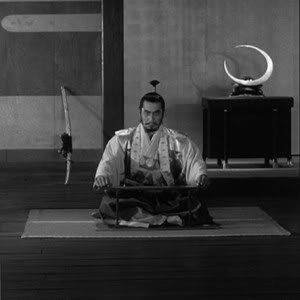
The film is visually gorgeous, the score is pretty great, the acting is good, and the film is another great effort from Akira Kurosawa. Sadly, this film felt much slower than the two previous Kurosawa films that I have watched and I really think that the silent portions here, unlike in Rashomon, detracted instead of added to the film. Basically the film is a standard retelling of Macbeth, and I've always been of the mind that Macbeth is much better material to be discussed than to be watched or read. Not surprisingly, that transfers over to Throne of Blood mostly. It's a pretty great adaptation I suppose, despite leaving out a few things from the play, I believe. But he also injects his own themes and visual symbols, which adds more to the film, I reckon. Can't say I was blown away though or that I have much to say about the film. It's really solid and a technically great film, but it just never really grabbed me.

B+ or 3.898213472146702381645823

Comments are welcome and, for anyone with a literary mind, I encourage checking out my poetry blog filled with all original works for your reading pleasure.

Also I am on the old Twitter thing so I guess you can follow me at twitter.com/FLYmeatwad.
Saturday, August 8, 2009

Take A Look At Eye Full Towers, Never Trust Them Dirty Liars


Paper Heart (Jasenovec, 2009)

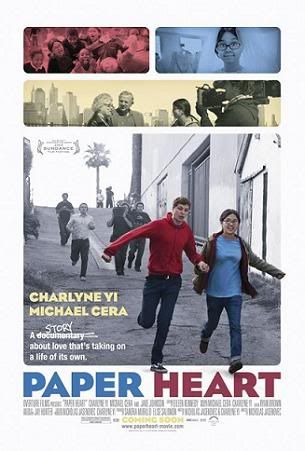
In a year that has seen its fair share of incredible comedies and phenomenal documentaries, Paper Heart pulls both genres together, sits them in a room, and tells them to fight. In many ways this film is likely the physical result of the make up sex of that encounter. Featuring the infectiously endearing Charlene Yi as she travels across the globe in a quest to define love, Paper Heart sits somewhere between film and mockumentary with a noticeable grace. Now after seeing the film I am still not entirely sure what it should be classified as, the actual interviews seem to be genuine, but the film is clearly a fabrication. Regardless, the tactic is mighty interesting and plays with the notions that viewers have both of film and drama while adding to the questions about what is real and what is constructed when deal with the idea of love, so the film certainly succeeds in its assembly.

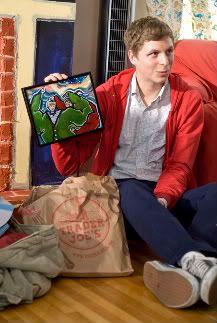
Speaking of constructed, the actors on display here are pretty fantastic. In many ways the only actor in the film is Jake Johnson as he plays the film's director, Nicholas Jasenovec, but I am fairly sure that each cast member in the film, that is the non interviewees, are all performing. Yi is spectacular, and she needs to be for the film to succeed at any level, but her real strength constantly seems to be her reluctance mixed with her curiosity. These traits keep the interviews compelling, but they also help build her character progressively throughout the film. Still, the obvious standout has to be Michael Cera. Cera plays an altered version of himself, seemingly embracing and challenging the notions of him always playing the same character, with tremendous humor and subtlety. Cera is mighty spectacular in the role, slightly reminiscent of his time on the Clark and Michael web series but also a good deal more refined. He does not play himself, Michael Cera plays the public perception of Michael Cera.

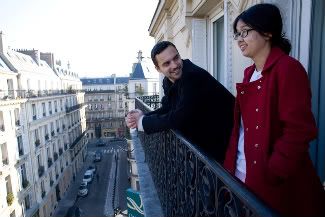
As for the technical aspects, the film is actually impressive as well. Designed to keep the viewer off guard, Paper Heart switches from overly documentary sequences, where the film grain is kicked up to enormous levels, to really beautiful and disciplined shots, like the walk through the forest between Yi and Johnson. However, the sequence that stands out would have to be the scenes in Paris. At the drop of a hat the film takes these entirely constructed sequences and switches the way they are presented almost instantaneously, which is even more impressive the more I look back on the film. However, the direction is not the only striking visual aspect showcased here. The film has numerous charming sequences where interviewees detail their own personal love stories while Yi animates the stories with hand crafted puppets. These scenes are some of the most visually striking of the film and are used to great effect. The film is also enhanced by the score, which is mighty top notch.

In many ways, Paper Heart is probably a comparable film to Bruno, and I would actually be interested in doing a follow up comparison of the two films so someone should make me do that in the near future, in the sense that both subvert a viewer's notions of what a docu/mockumentary should be and how the topics should be covered. Obviously, Paper Heart is more of a film than Bruno, and even more complex as I begin to write more and more about my short time, about an hour and a half, with the film, but they both share some downfalls as well. Not all of the interviews land and the laughs, though clearly there, are not as big as in a straight comedy. However, all of these minor problems are practically irrelevant when looking at the bigger picture. Paper Heart is a layered and complex film that does not only examine love, but examines the entire idea of fabricated realities. At first I was not entirely blown away by the film, but, as is the case with every great film, the more thought I allot to Paper Heart, the better the film appears.

A/A- or 4.389289472308147810234723104


Comments are welcome and, for anyone with a literary mind, I encourage checking out my poetry blog filled with all original works for your reading pleasure.

Also I am on the old Twitter thing so I guess you can follow me at twitter.com/FLYmeatwad.
Monday, August 3, 2009

Companionship Is Where You Find It, So I Take What I Can Get


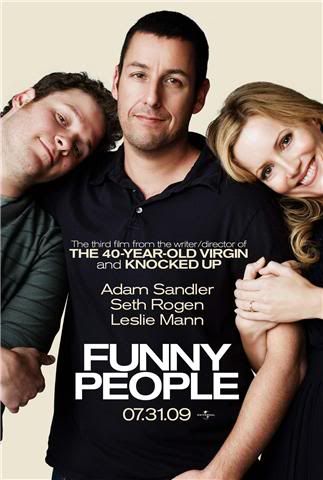
Funny People (Apatow, 2009)

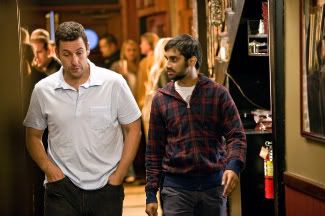
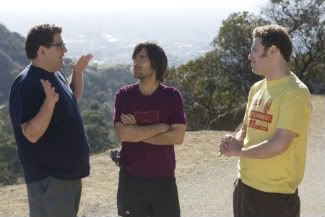
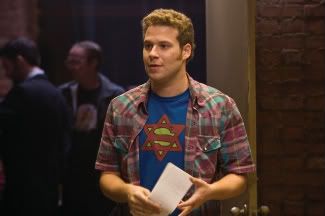
After two major successes where he spent time at the helm, and what seems like a million 'Produced By' attachments to the end of trailers, Judd Apatow returns with the Adam Sandler and Seth Rogen vehicle Funny People. After seeing the trailer it seemed to be another formulaic Apatow film that was going to present the audience with a standard situation, heighten it up a bit, throw in some laughs, make things a little depressing, get a romance going on most of the time, and then wrap up nicely. Well, taking a page out of the Adventureland book to non-success, the trailer does not do the film much justice. The romance aspect of the film is but a footnote to the story of Ira and George, Rogen and Sandler respectively, and how these two men bond during the course of the film. Think I Love You, Man except better. The movie is about characters and comedy, not love and loss.

Clearly the film's greatest strength comes in the form of the lead actors. Both Rogen and Sandler are fantastically funny yet emotionally sound. Sandler has already shown his ability as an actor in Punch Drunk Love, but seeing Rogen be a bit more than what he was in Knocked Up was a nice change of pace. Sandler is the obvious stand out in the film, but Rogen mostly matches him blow for blow, as the comedian mindset the film explores makes necessary. As for the supporting cast, things are a little lack luster. Mann plays her same type of role, which is nice, Bana is pretty damn funny, Hill is mostly good is limited time, but Jason Schwartzman is clearly the best of the supporters. He plays his role of the gloating and arrogant friend realistically and perfectly, capturing what is so disgustingly human about, well, humans. As for Apatow's kids, they have worn out their welcome and really slow the film down when it has already lost steam. The two are not really funny, they are not really cute, and they do not do anything to enhance the film.

Speaking of losing steam, the film is phenomenally strong for the majority of the first hour and a half. Then the narrative decides it wants to take a prolonged stop in romantic comedy territory. For something that is so focused on how Seth and Sandler interact with each other, which is clearly the point of the film as the ending so clearly implies, the amount of time that Sandler spends needlessly wooing Mann is both sloppily integrated and pretty dull. Sure it adds in some laughs, but at the expense of a more complete narrative. The film is dark and comedic early on, it even seems to have the perfect opportunity to end when a line is delivered from an unexpected face, "Then what are you celebrating?" The film would have been a masterpiece if it just stopped. The script could have been altered slightly to tie up the Rogen/Sandler plot line and the film's tone would not have been undercut, but for some reason Apatow cannot do that. The 40 Year Old Virgin has similar problems, and Knocked Up has similar problems. Apatow just cannot write endings.

Thankfully he can work a camera. While the direction is not mind blowing, it does range from solid to really good on numerous occasions. Early on the opening scenes following Sandler are really great, the one wide shot where there are a few pineapple shaped trees on the lawn is pretty great, and the dinner scene is cool as well. Still, Apatow does not prove himself to be one of the best men working with a camera, but at the same time he also never does anything really bad with the camera, so I suppose that means this is mostly a wash. Probably not though because he has some really great parts, right? Sure, let's go with that. Okay, the direction is pretty good, I guess Judd can work a camera. Still, it's not his strong point, but the film still works fine without all that technical flair, mostly because of the first hour and a half. Mostly everything before the rom-com bits.

Damn romantic comedies. Damn advertising. Damn mismarketing. Damn it all. You want to laugh? Well then you're probably better off watching Judd's previous two films, of which The 40 Year Old Virgin is the funniest, but if you want to see Apatow's best film then you should probably see Funny People and just pretend that the bit after the celebration scene doesn't exist. Despite the film's failures, it proves to be the most complex of Apatow's films because it departs most radically from the common Apatow formula that the trailer implies. Funny People examines comedy, it examines humanity, and it tosses in enough penis jokes to appeal to the people who could care less about these two previous explorations. Is the film a transcendental comedy? No. But any film that presses the fourth wall like this while showing the potential to be a masterpiece is good in my book. Plus the bits where Adam Sandler just about openly mocks his career and almost admits that the majority of the films he acts in are shit is pretty great. Keep up the good work Judd, and just learn to write a little less generic.

B+/A- or 4.18213907214746123784691

Comments are welcome and, for anyone with a literary mind, I encourage checking out my poetry blog filled with all original works for your reading pleasure.

Also I am on the old Twitter thing so I guess you can follow me at twitter.com/FLYmeatwad.

Monday, July 27, 2009

And Don't Forget To Give Me Back My Black T-Shirt


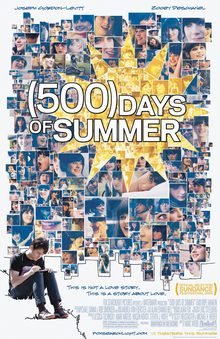
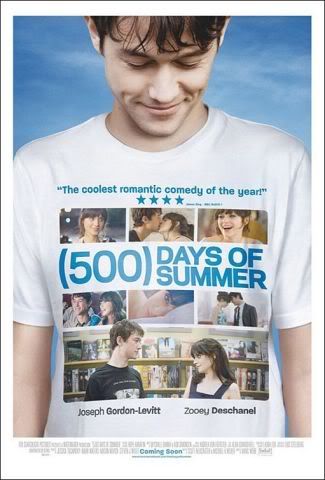
(500) Days of Summer (Webb, 2009)

So I shall preface this review with a piece of information I had not been aware of whilst watching this new picture: (500) Days is Marc Webb's debut feature. Sure that does not change my evaluation of the film, but in relation to that thought I cannot help but be a good deal more impressed with the final result and how everything came together...man. Starring Joseph Gordon-Levitt of Brick fame and Zooey Deschanel of All The Real Girls (both will be referred to as Jo and Zo for the rest of the review), the film sets itself up as the anti-rom-com that plays like a traditional romantic comedy but subverts the genre to unparalleled extremes. It does this, of course, by paying tribute to genre staples that have come before it and adding a good deal of new concepts to the mix. So if you are unable to tell from that remark, I shall state directly that the film does not completely succeed in this ambition. Still, the film has a ton of great moments and some unpolished points, of which I shall now delve into deeper detail.

The film is certainly marked by a distinctive visual style at times, both in the way it looks and the way the camera is used, but the whole thing is pretty erratic throughout. Still, the range of shots Webb uses is impressive and has me excited to see what he works on in the future. The way he uses the camera to call back to other films is mighty impressive as well. Aside from a whole black and white foreign sequence that brilliantly recalls a few Ingmar Bergman films, the hand drawn opening echoes Juno, there's an Annie Hall element to the plot, and then a good deal of others in the between. Sadly these references are not always used to great effect. Unlike the stunning split screen expectations v. reality sequence that heralds Annie Hall, the film's first two acts are mostly genre tributes just for the sake of tribute, including a terrible musical sequence. The film calls attention to use of convention, but like, to quote the severely overrated Dark Knight, a dog chasing a car the film does not know what to do once it catches it. In a sense, (500) Days makes an interesting parallel to Duncan Jones's film Moon, which also subverts genre expectations but to the film's benefit.

Just like Moon, this film showcases some pretty stellar acting as well. Jo and Zo are brilliant, particularly Zo who gives my second favorite performance by an actress this year. She plays her part perfectly, generating an almost inexplicable magical charm that simply draws the viewer toward her character. In fact she is so genuine in her performance that, when the film makes its big reveal, it almost feels like she has betrayed the viewer. Sadly, the supporting cast is nothing to write home about. Sure they all give decent performances, but the film is clearly a vehicle for Jo and Zo, so not showcasing an outstanding supporting talent is pretty obvious, I assume. Still, none of the performances are really terrible, which is a credit to the film.

Ultimately, (500) Days is an interesting idea that does not completely live up to its potential during the fairly standard one hundred minute run time. However, it should be stated that the film has an unbelievably strong third act. Once that expectations v. reality scene starts the film barrels along and never pulls a punch. Unfortunately, getting to this point we have to deal with so many scenes that lack the needed humor or intrigue to keep things fresh, the first two acts are mighty bad. I am a man who values endings though, and the way the film pulls everything together is so damn great that I can easily state that the film is, at its worst, a pretty solid film that deserves a watch. Hell, I'll even tack on the B+.

B/B+ or 3.6789772394823931523915623

Comments are welcome and, for anyone with a literary mind, I encourage checking out my poetry blog filled with all original works for your reading pleasure.

Also I am on the old Twitter thing so I guess you can follow me at twitter.com/FLYmeatwad.