Showing posts with label documentary. Show all posts

Monday, January 2, 2012

In The Courtroom Of Honor, The Judge Pounded His Gavel


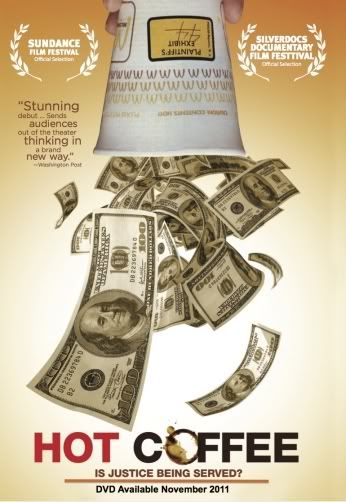
Hot Coffee (Saladroff, 2011)

I was going to give Hot Coffee a full write up, but decided against it because I'm really not sure what I have to say analytically. It's hard to even call this post a review. There's a lot going on in this film, and as such it feels a bit unfocused throughout. The title itself is misleading, which I'm mostly glad about because it meant I didn't need too see a bunch of pictures of an old lady's burnt loins. That was traumatizing, which was the point. So that worked. But the larger point, so it seems, is that the legal system is quickly being framed in a way that ignores the common man in favor of big businesses. This is probably true.

Wednesday, October 12, 2011

Are Notes Not?

So last night I found myself watching a White Stripes concert film/documentary hybrid, The White Stripes: Under Great White Northern Lights, and as I started to type up a reflection on the film I found that the actual substance to the film was not nearly as consequential as the thoughts the film raised. In fact, the film made me realize two very important things, and I keep questioning a few ideas in relation to these revelations.

Monday, September 19, 2011

I Just Want You To Know, I Can See Through Your Masks


Restrepo (Hetherington and Junger, 2010)

Cinema offers viewers the ability to visit different landscapes, different worlds, different universes; however, these journeys are usually kept within the confines of a constructed reality, a world that exists on the reels of film and perhaps in our minds, but not in our 'world.' Documentaries still create this barrier, but the realism of the genre is at worst an examination of a world that many of us are unaware of and are, at best, a portrayal of some truth that all great films can reach. I have not, and likely will not, travel to Afghanistan in my lifetime, nor do I plan on fighting in any literal wars, so Restrepo's portrait in to life during wartime in one of the world's most dangerous conflict zones makes an attempt at capturing the spirit of men tied together by a desire for combat.

Wednesday, September 14, 2011

Don't Give Up Now, Just A Little More Persistence


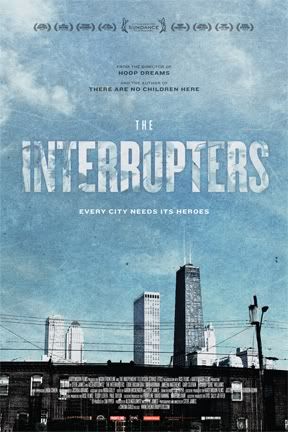
The Interrupters (James, 2011)

Over the summer I visited Chicago for a weekend. While I was aware that I had not actually even scratched the surface of what the city has to offer, after seeing a film like The Interrupters I almost feel as if I should have taken even more precautions as I walked a very standard pass through the city. Actually, as I exited the theater in Philadelphia and I walked back toward the train station to get home I almost felt a bit more paranoid than I should have given the time of day and relatively safe area of the city. But as I continued down the streets, looking all around and moving at a quicker clip than I normally would, I became cognizant of my actions. I was acting this way because of the documentary I had just watched.

Monday, October 12, 2009

There's A Place In The Buried West, In A Cave, With A House In It

Back to a quick entry of short paragraph reviews, though this time I have a theme to work with sort of as each film chronicles a tale taking place in a different country. Also, these films are all 2009 films, as my count on the year quickly approaches the 60 film mark. I was going to toss in a Trick 'r Treat review in here as well, but I think that one will get its own entry, especially since it works its way into my incredibly generic Keep the Lights On! October mini-marathon of horror films. Additionally, readers here may or may not know that I have been writing two weekly articles for The Reelists, so you can keep up with regular posts from me there as well as Processed Grass has taken a bit of a back seat to that one. Either way, on to the four films.

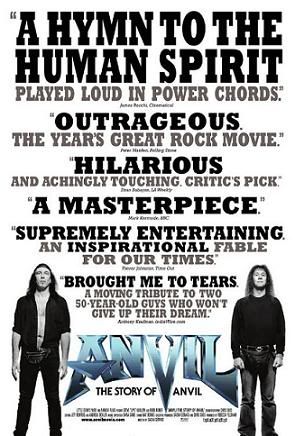
Anvil! The Story of Anvil (Gervasi, 2009)

I know enough about metal to know that, the majority of modern, inaudible, loud music is crap. I know enough about Canada to know that it kicks a good deal of ass, at least the parts in which I've traveled thus far. That said, I knew nothing about the band Anvil prior to entering this film, so like any good documentary I was prepared to get learned on the subject. The hook here is that Anvil is like a real life Spinal Tap~esque doc, and as far as humor goes it mostly delivers. The laughs are plentiful, especially early on since the film begins to tackle a few more deeper emotions as the narrative progresses, though humor can only carry a film so far. Luckily, Anvil! does not put a huge emphasis on the music, though the small snippets that were played were nice enough to listen to since Anvil apparently plays the 80's hair metal stuff rather than that new age grunt and yell. It's not Black Sabbath, Hell it's not even any Megadeth...well okay maybe it's comparable to Megadeth, which means it's still pretty decent. Still, the focus here is on the lead singer, Lips, and his constant determination, his drive to succeed. The man's passion and determination are admirable, two qualities the film captures nicely, but I suppose the notion that one can take away is that Lips is just a nice guy. And maybe nice guys do finish last, but why is money important when you are doing something you love? These concepts are a little too general for my liking, but the film makes them compelling. Plus the pacing helps make the viewing enjoyable and less of a chore. I had expected this year's Man on Wire or King of Kong, what I go was a doc that is slightly better than Soul Power, but not quite up to the level of a Food, Inc. How's that for arbitrary?

B/B+ or 3.7648972146234623085435


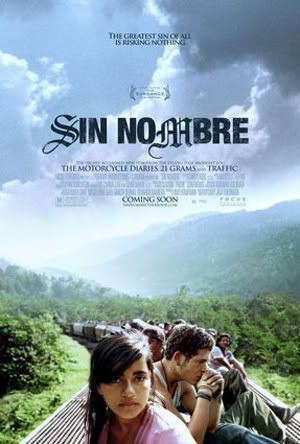
Sin Nombre (Fukunaga, 2009)

Traveling from Canada to Brazil, or Mexico, or someplace weird like that, we get the directorial debut from Cary Joji Fukunaga who has one of the coolest names I've ever seen given that he was apparently born and raised in Oakland. Simply by looking at the film one would not guess that it is a director's first effort, everything about the movie is visually beautiful, but when we start looking at the narrative the film's flaws are slowly exposed. Character motivation is not always there, some of the situations are a bit too convenient, and the relationship between the two leads does not really generate enough interest to feature it as the main focus of the story. Thankfully the film has enough depth that the glimpses into gang life, the journey Mexico to the United States, and the development of a young mind are all incredibly fascinating and handled with incredible mastery. Fukunaga makes the world and the characters come alive despite not getting much from his leads, so for that I would be willing to call the film at least pretty good, but add in the fact that the cinematography is spectacular and the film showcases some of the greatest costumes all year and I am very confident in calling Sin Nombre a successful film despite the numerous shortcomings from a narrative perspective.

B-/B or 3.4683245307964952753


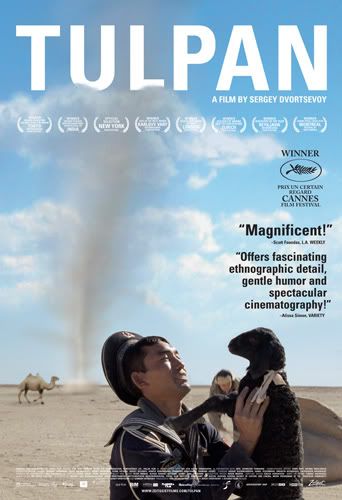
Tulpan (Dvortsevoy, 2009)

Next stop on this entry's world wide (but not really since we are only showcasing two continents) tour we make a quick stop in Kazakhstan to take a look at this year's Kazakh entry for the Best Foreign Film Oscar. Focusing on the exploits of an aspiring goat farmer, Tulpan showcases an interesting filmmaking style and mixes with a great lead performance to make for a touching comedy with more than enough drama and symbolism going on to keep me interested in a cerebral sense. The driving sequences here are really entertaining as well and they help with character juxtaposition and ideological comparison. Overall the film is a little disjointed in the sense that I can remember individual scenes fondly, but as a whole the film does not really stand out until the climax. But oh boy is it some climax. Tension is built, I was left feeling slightly uncomfortable but also compelled to watch, drawn to see how everything would play out. And the payoff is both rewarding and a great conclusion to the film's themes. I was not expecting much from this film and, while it does have its share of flaws, the camera is used in such interesting ways and the performances are so good that I can easily recommend the film to anyone with an interest in Kazakh cinema and, likely more pertinent to any readers, dramadies in general. Plus the film links the majority of its themes with symbols in the movie, and I really had a fun time making these connections, so there is a bit of extraneous detail to chew on during repeat viewings. Tulpan likely will not stand much of a chance at taking home the Foreign Language Picture Oscar because it does not seem like the type of film the Academy gravitates towards, but it seems like as good a place as any to start with Kazakh cinema. Additionally, I have now seen as many goats being born as I have people.

B- or 3.3982348732894537205832


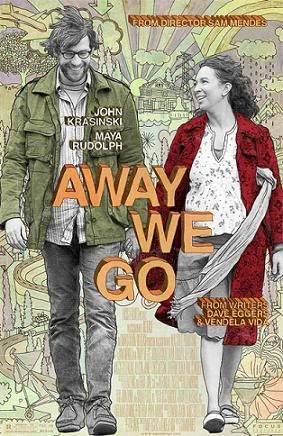
Away We Go (Mendes, 2009)

Does that smell like a Big Mac with the buns replaced by Boston Cream Doughnuts? We must be back in America. Fittingly, this cinematic tour concludes with Away We Go, a film that is, at least partially, about traveling. Also continuing the idea of directors dealing with a foreign country, Sam Mendes' follow up to last year's brilliant Revolutionary Road comes in the form of another tale about the American family struggling with a new situation. This time Mendes lets his comedy come out, anchored by a fairly well known cast of actors. Jim Gaffigan, John Krasinski, Maya Rudolph, Maggie Gyllenhaal, and Catherine O'Hara are just a few of the faces that make appearances during the film's mostly lean run time. As a comedy I am not sure how successful the film is because, well, the film did not make me laugh all that often or all that audibly. And in retrospect I am not sure how well the Rudolph/Krasinski relationship worked for me either since I recall very few specific details about the two aside from the fact that she was pregnant and they were attempting to find 'home.' The whole point here is the journey though, and Mendes packs the film with enough heightened realism to make each stop at least interesting in some regard. The real strength of the film though is, without a doubt, the direction paired with the cinematography. Mendes sure has a way with a camera, a brilliant sophistication that makes for an ocular delight. Sure that is not enough to outweigh all of the narrative's negatives nor does it excuse a lackluster central romance, but damn does the film look fantastic.

C/C+ or 2.9892317438290534805

Comments are welcome and, for anyone with a literary mind, I encourage checking out my poetry blog filled with all original works for your reading pleasure.

Also I am on the old Twitter thing so I guess you can follow me at twitter.com/FLYmeatwad.
Saturday, August 8, 2009

I Wish You Could Swim Like The Dolphins, Like Dolphins Can Swim


The Cove (Psihoyos, 2009)

While I would not consider myself very well versed in documentary film making, I do have an interest in these types of films and, when one builds buzz like The Cove, I feel compelled to do everything in my power to check out these types of films. Luckily, The Cove opened at a local theatre this week and I did not have to go incredibly far out of my way to see the film. The power of a documentary is something that few other films, or even many other artistic mediums, can effectively wield because, quite obviously, a documentary has the advantage of, at least to an extent, presenting life in its purest form. I knew little of the material that would be covered, only that dolphins in Japan were a focus, so I was hardly prepared for what I was about to witness.

About a year after the mesmerizing, and Academy Award Winning, doc, Man on Wire, The Cove begins to set up as a documentary that draws influence from various styles of film, most notably espionage films. While The Cove has far fewer constructed sequences than Man on Wire, the comparisons to these genre films are still incredibly warranted because, even without the construction, the entire film is practically an adrenaline rush of social and political intrigue that had me riveted from beginning until end. The action sequences here, and by action I mean the car tailings, the cop stuff, and the actual infiltration, are all nicely handled and enhanced by one of the best scores of the year. The film is surprisingly suspenseful for the type of film that it is and, quite masterfully, never skips a beat in terms of narrative, which is and of itself an impressive characteristic in any type of film, let alone a documentary.

Of course the film also succeeds as a standard documentary as well. The interviews all serve the film's purpose, the examination is immediately identified and builds throughout, and the whole thing advertises a payoff that, unlike in other docs, hits incredibly hard. For example, the film goes about humanizing the dolphins incredibly effectively. However, to say that the film is simply about dolphins is misleading, as Food, Inc, as well as other older documentaries, has chronicled an abusive industry. No, the tragedy of The Cove is elevated by the dolphin trade, but the actual sadness is in the exposure of government policy, the corruption of power, and the countless victims that will result in the future, all of which the film covers nicely. These aspects are all universal, and I would argue that every individual a part of at least once, usually for extended portions of time. The struggle is tragically heartbreaking and seems to be overlooked in favor of the film's more overt material.

SPOILERS FROM HERE ON OUT...I reckon. I mean the trailer kind of spoils it, and I have made references earlier. Still, spoilers.

Still, I do not mean to lessen the effect of the dolphin killings on screen, as the film serves wonderfully as a call to arms for that particular cause as well. The entire film's intrigue is built on seeing the inside of this cove, and once the film really starts to drive at that things start to pick up immensely. And of course that all leads to the hidden cameras in the cove, and the final fifteen minutes of the film, which also happen to be the best fifteen minutes or so of the year in cinema thus far. Soul shatteringly gruesome, the massacre of these dolphins is shown in full force, capped off by the greatest shot of the year, a cove where the water has gone completely red. The film then starts to wrap things up in grandiose fashion. One interview we have been seeing throughout the entire film is revealed to have taken place after the discovery of the footage, as O'Barry, after just being shot down with "I told you, we are not going to talk about what ifs," pulls out a camera and asks the man to take a look at some footage. Sure it's not very professional, I guess, but it's such a satisfying conclusion, you just want the man to be confronted with this evidence. And his reaction is priceless. Cue the reveal at the IWC, the final monologue, the obligatory call to arms, and then the mesmerizing introduction of David Bowie's "Heroes" as the credits start to roll.

It started during that hidden camera sequence, but by this point I had been effectively bowled over. I recall getting upset over films, I recall weeping after seeing George Washington, but until watching The Cove I had never broken down in tears in a movie theater. The political implications I talked about earlier, mixed with the chilling score and the scenes of the red water left me practically immobile. Does the film have some flaws as a documentary? Probably, as there are one or two points that really do not go very far. Does The Cove present all the facts? I don't really know. However, as I finally worked up the strength to leave the theater and began stumbling my way to the car before breaking down again, I was practically positive that The Cove is nothing short of one of, if not definitively, the best films of the year so far.

A+ or 4.9128934721842374230174

Comments are welcome and, for anyone with a literary mind, I encourage checking out my poetry blog filled with all original works for your reading pleasure.

Also I am on the old Twitter thing so I guess you can follow me at twitter.com/FLYmeatwad.

Take A Look At Eye Full Towers, Never Trust Them Dirty Liars


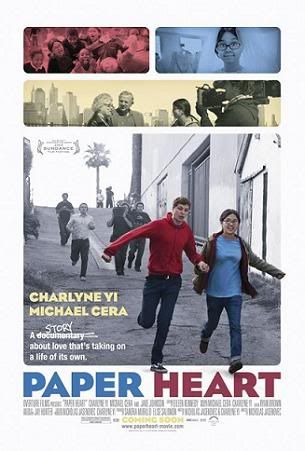
Paper Heart (Jasenovec, 2009)

In a year that has seen its fair share of incredible comedies and phenomenal documentaries, Paper Heart pulls both genres together, sits them in a room, and tells them to fight. In many ways this film is likely the physical result of the make up sex of that encounter. Featuring the infectiously endearing Charlene Yi as she travels across the globe in a quest to define love, Paper Heart sits somewhere between film and mockumentary with a noticeable grace. Now after seeing the film I am still not entirely sure what it should be classified as, the actual interviews seem to be genuine, but the film is clearly a fabrication. Regardless, the tactic is mighty interesting and plays with the notions that viewers have both of film and drama while adding to the questions about what is real and what is constructed when deal with the idea of love, so the film certainly succeeds in its assembly.

Speaking of constructed, the actors on display here are pretty fantastic. In many ways the only actor in the film is Jake Johnson as he plays the film's director, Nicholas Jasenovec, but I am fairly sure that each cast member in the film, that is the non interviewees, are all performing. Yi is spectacular, and she needs to be for the film to succeed at any level, but her real strength constantly seems to be her reluctance mixed with her curiosity. These traits keep the interviews compelling, but they also help build her character progressively throughout the film. Still, the obvious standout has to be Michael Cera. Cera plays an altered version of himself, seemingly embracing and challenging the notions of him always playing the same character, with tremendous humor and subtlety. Cera is mighty spectacular in the role, slightly reminiscent of his time on the Clark and Michael web series but also a good deal more refined. He does not play himself, Michael Cera plays the public perception of Michael Cera.

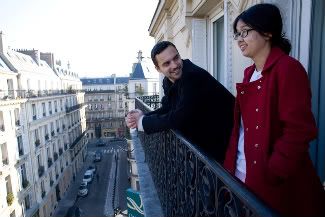
As for the technical aspects, the film is actually impressive as well. Designed to keep the viewer off guard, Paper Heart switches from overly documentary sequences, where the film grain is kicked up to enormous levels, to really beautiful and disciplined shots, like the walk through the forest between Yi and Johnson. However, the sequence that stands out would have to be the scenes in Paris. At the drop of a hat the film takes these entirely constructed sequences and switches the way they are presented almost instantaneously, which is even more impressive the more I look back on the film. However, the direction is not the only striking visual aspect showcased here. The film has numerous charming sequences where interviewees detail their own personal love stories while Yi animates the stories with hand crafted puppets. These scenes are some of the most visually striking of the film and are used to great effect. The film is also enhanced by the score, which is mighty top notch.

In many ways, Paper Heart is probably a comparable film to Bruno, and I would actually be interested in doing a follow up comparison of the two films so someone should make me do that in the near future, in the sense that both subvert a viewer's notions of what a docu/mockumentary should be and how the topics should be covered. Obviously, Paper Heart is more of a film than Bruno, and even more complex as I begin to write more and more about my short time, about an hour and a half, with the film, but they both share some downfalls as well. Not all of the interviews land and the laughs, though clearly there, are not as big as in a straight comedy. However, all of these minor problems are practically irrelevant when looking at the bigger picture. Paper Heart is a layered and complex film that does not only examine love, but examines the entire idea of fabricated realities. At first I was not entirely blown away by the film, but, as is the case with every great film, the more thought I allot to Paper Heart, the better the film appears.

A/A- or 4.389289472308147810234723104


Comments are welcome and, for anyone with a literary mind, I encourage checking out my poetry blog filled with all original works for your reading pleasure.

Also I am on the old Twitter thing so I guess you can follow me at twitter.com/FLYmeatwad.

Monday, August 3, 2009

Bobby! Should I Take 'Em To The Bridge?


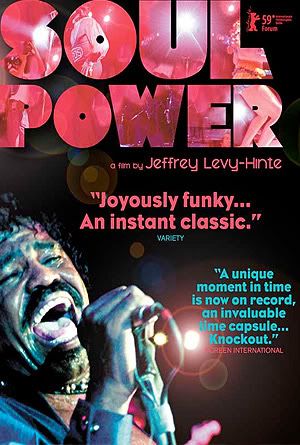
Soul Power (Levy-Hinte, 2009)

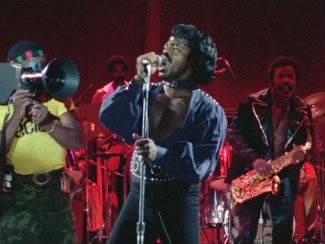
So I basically knew nothing about this film going in to my viewing. I had seen the poster and figured it would be archival footage of James Brown singing songs, and maybe having some interviews about his life. The film pretty much put that thought to rest about five seconds in when the film tells the viewer that the footage was recorded during a concert in Africa during 1974 that was paired with a Muhammad Ali fight. So the film is mostly not about James Brown, well except at the beginning and the end. Still, seeing all of this footage that I have to assume was not released until this point in time is an interesting prospect, so I reckon that the film can sustain itself on the promise that this event, in all its glory, has been captured and preserved over the years. Plus the music is funky, so it is kind of like a concert film that is not in 3-D, which is kind of cool.

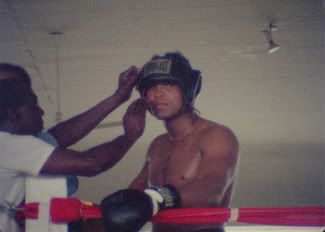
Of course the film does not act as just a concert film. Sure the film documents the whole affair from set up to performance, but it also touches on so many other topics. Ali rants and raves about the injustices of America and American society at numerous points throughout the film, making me understand what people saw in the man as he hits on a ton of truths, while the film also shows us the men organizing everything and how they are basically just pushing the product that Ali talks about. That construction is well handled and could make for a compelling film.

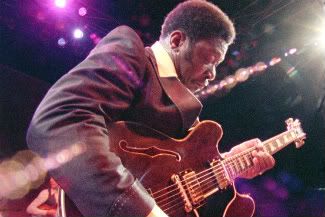
Naturally all the concert footage could make for a compelling documentary as well, placing Brown and B.B. King alongside traditional African acts, all making up mostly the second half of the film. Hell, the film even has a bit about how music is universal. Though I suppose by now it seems pretty obvious what I am driving at: the film does not really seem to know what it wants to be and mostly results in an erratic mix of half way followed through concepts. The whole thing, sadly, lacks the focus that could have tied everything together. Whether or not this is a fault of the documentarian, a lack of footage, or something completely different I cannot say with certainty, but the film is very uneven in its presentation.

If I was to evaluate Soul Power as a time capsule I suppose it would be a perfect film, every idea and benefit tied to the idea of preserving, hiding, and then revealing objects of an older era is present in the film, but as a documentary the whole affair is far too scattered to be worth much more than a watch simply to marvel at the cool footage. I can see people taking ideas away from the film, Hell, I took ideas away from the movie, but no single topic is really fleshed out enough for the film to add up to a meaningful whole. The credit sequence is great though, and be sure to stick around for them to finish completely because the film maker puts a wonderfully effective scene after the screen goes black. Also, the James Brown performance at the end is worked in perfectly to the film and provides for an electric conclusion. Kind of odd that the film did not show the fight though, as that seemed to be a large portion of the film, and it really did little else but cement the idea that the film really is supposed to be about Brown. Still, the time capsule effect is so damn compelling.

B or 3.5483274823512350152370156

Comments are welcome and, for anyone with a literary mind, I encourage checking out my poetry blog filled with all original works for your reading pleasure.

Also I am on the old Twitter thing so I guess you can follow me at twitter.com/FLYmeatwad.