Showing posts with label America. Show all posts

Monday, January 2, 2012

In The Courtroom Of Honor, The Judge Pounded His Gavel


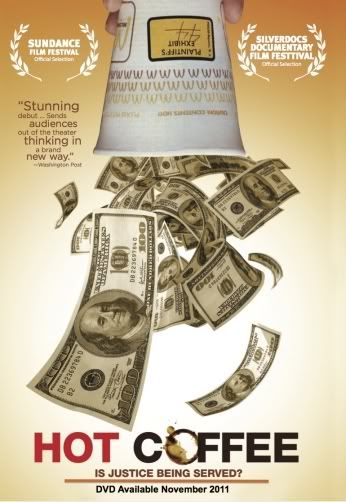
Hot Coffee (Saladroff, 2011)

I was going to give Hot Coffee a full write up, but decided against it because I'm really not sure what I have to say analytically. It's hard to even call this post a review. There's a lot going on in this film, and as such it feels a bit unfocused throughout. The title itself is misleading, which I'm mostly glad about because it meant I didn't need too see a bunch of pictures of an old lady's burnt loins. That was traumatizing, which was the point. So that worked. But the larger point, so it seems, is that the legal system is quickly being framed in a way that ignores the common man in favor of big businesses. This is probably true.

Monday, September 19, 2011

I Just Want You To Know, I Can See Through Your Masks


Restrepo (Hetherington and Junger, 2010)

Cinema offers viewers the ability to visit different landscapes, different worlds, different universes; however, these journeys are usually kept within the confines of a constructed reality, a world that exists on the reels of film and perhaps in our minds, but not in our 'world.' Documentaries still create this barrier, but the realism of the genre is at worst an examination of a world that many of us are unaware of and are, at best, a portrayal of some truth that all great films can reach. I have not, and likely will not, travel to Afghanistan in my lifetime, nor do I plan on fighting in any literal wars, so Restrepo's portrait in to life during wartime in one of the world's most dangerous conflict zones makes an attempt at capturing the spirit of men tied together by a desire for combat.

Friday, July 1, 2011

In The Squares Of The City - In The Shadow Of The Steeple


Transformers: Dark of the Moon (Bay, 2011)

I don't think I've ever really liked NASCAR. I know I enjoy elements of the sport, I know I am intrigued at pondering what it represents and where it finds its popularity, but as hard as I have tried I simply cannot discover the appeal on a large scale. As is the case with most sports the only real purpose is to assert dominance, and specifically in racing the appeal comes from watching the wanton destruction on the track when cars crash. Michael Bay's Transformers: Dark of the Moon - and the series in general - has always struck me as sort of similar to NASCAR. I understand it has a purpose, but I never really understood how this purpose is pragmatic. However, much like the motor sport I have attempted to love, perhaps even genuinely found flashes of excitement, I find myself ready to line up for each new entry that Bay attempts to pump out. So whether he is conscious of it or not (I don't think it matters much one way or the other), Bay has to be doing something right. Right?

Friday, June 17, 2011

The Power In Your Voice. Your Rough Touch. You Keeping Care Of Me, Keeping Watch


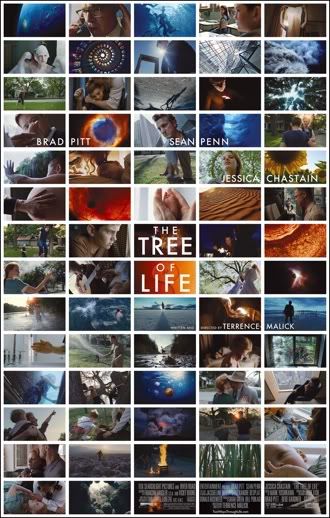
The Tree of Life (Malick, 2011)

"Where wast thou when I laid the foundations of the earth? declare, if thou hast understanding."

And with that brief verse from the Book of Job, Terrence Malick's latest - Palme d'Or winning - film The Tree of Life begins to lay the foundation for a thorough examination of humanity. Moments later we have the primary female voice, via trademark Malickian voice over similar to Badlands and Days of Heaven, posit a thesis that carries throughout the film: during life humans must either walk the path of nature or the path of grace. As we are thrown in to a small 1950's American town the movie makes it blatantly apparent that it casts a wide net, takes on a scope as large as life itself. It really is a beautiful juxtaposition to open the film with, starting as wide and expansive and then keeping those ideas contained to an incredibly specific, focused area. Malick presents the quintessential American life, 1950's USA white, middle class suburbia, and reaches for an understanding of the universal. And from there the film only grows.

Sunday, September 20, 2009

I Hear What You're Not Saying...


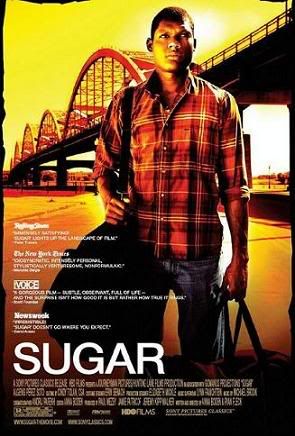
Sugar (Boden and Fleck, 2009)

While I missed the theatrical run of Sugar, I had heard nothing but good things about the baseball biopic focusing on a young Dominican player as he makes the journey over to America for a chance to play in the majors. From the opening preparations to the first minor league game, Sugar chronicles the progression of the titular character wonderfully and humanly, always respecting the game and the player. The rise and (spoilers coming) eventual fall of Sugar is portrayed without embellishment or splendor, the tale is simply told. The film is deceptive in nature though, as one may expect the film to mostly center on Sugar, but a good amount of time is given to the politics of baseball and how these imported players are mostly left by the wayside from the next prospect. The film is marked with a fairly distinctive visual style courtesy of the two directors, and the film is obviously helped by a stunningly strong turn from lead actor Algenis Soto.

The film does, admittedly drag on a bit in the middle portion, as the story drifts over to New York City for a seemingly meaningless portion. The politics of the game are left out, the language barrier complications that made the start of the film so endearing was mostly forgotten, and Sugar simply did not develop much more as a character. However, the film sets up a devastatingly beautiful ending that packs the viewer so full of hope but forces the audience to also look at reality. Sugar has a number of high points, and as far as entertainment is concerned the film certainly delivers, but as a whole the film does not feel like much more than a fairly standard story mixed with enough interesting concepts to add up to a worthwhile way to spend about two hours.

B/B+ or 3.98927483274083271583275


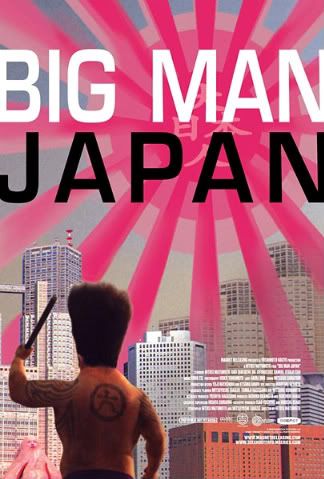
Big Man Japan (Matsumoto, 2009)

Easily presenting one of the most exciting trailers of the year, I have had the desire to watch Big Man Japan for quite a while, so stumbling across the title on Netflix Instant Watch was a welcome discovery. My expectations entering the film were for a rag tag, tongue-in-cheek Power Rangers~esque romp. Perhaps a Japanese take on The Host where the genre is poked fun at while a nice story is told. Well, that did not happen. Through a very diligent documentary look, Big Man Japan follows writer, director, and lead actor Hitoshi Matsumoto's character Daisato through the mundane life of Japan's protector from the numerous monsters that plague Japan. Matsumoto gives a wonderfully straight performance, capturing the run down depression of a man who has seemingly outlived his use both in the eyes of the public and his family. Mix that with near perfect comedic timing, and Matsumoto turns in one of the year's best performances.

The film also does mix in a few bigger fights, making use of CGI as best it could and making up for the less than perfect images by having an incredibly stylized group of monsters terrorizing Japan. And then there is the whole social commentary/existence struggle themes through run throughout the film, both of which are handled masterfully. And then the film ends, and what a finale Matsumoto presents. Hysterical to the extreme and incredibly poignant, the film's final fight sequence speaks volumes on American culture in Japanese society, media sensationalism, and one's struggle with humanity. The film is far from flawless, though I do think that the pacing is excellent, but Big Man Japan is a unique ride that is open to a plethora of readings. Any film that provides that is great in my book.

B+/A- or 4.172814962146231645923


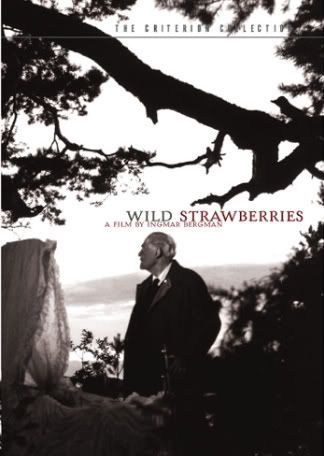
Wild Strawberries (Bergman, 1957)

Speaking of films that are ripe for interpretation, Wild Strawberries is my second Ingmar Bergman film. A meditation on life, looking back upon the existence of a professor who has seemingly alienated his family and friends over the years, Bergman presents a quiet and compelling narrative with an incredibly compelling character at the center of the flash back filled affair. As Dr. Borg revisits his memories, the viewer is presented with a brilliantly structured film flowing to the brim with imagery and symbolism. Of course that is a blanket statement that requires a bit more thought. One scene has a cradle placed out in the woods, standing far enough away from the house to give the viewer some hint about something or another. This is all very vague, though with good reason, I was confused. Bergman creates a film here that is rewatchable, I am sure, but for some reason I was never completely hooked either. This film is odd. I should watch it again. Would have not put this entry up, but I love the poster.

B+ or 3.9892374032754235703?

Comments are welcome and, for anyone with a literary mind, I encourage checking out my poetry blog filled with all original works for your reading pleasure.

Also I am on the old Twitter thing so I guess you can follow me at twitter.com/FLYmeatwad.

Friday, July 17, 2009

Surrenderin' For What? No Wavin' The Bandanna. Tell The Tool Man How I Handle The Damn Hammer


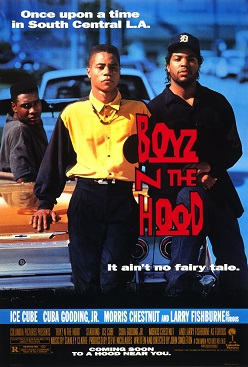
Boyz N the Hood (Singleton, 1991)

I was glancing over my other reviews and I noticed that, with the possible exception of The Adventures of Ichabod and Mr. Toad, I have yet to write a definitively negative review for a film. Going into Boyz N The Hood I was aware that director John Singleton is the only African American to ever be nominated for Best Director and, I learned this later, he is also the youngest nominee for the category. Now add that into the fact that I knew the film had a reputation for being a really great and insightful look at urban violence that neither glorifies or condemns the lifestyle, though that proves to be a misleading notion, while telling a compelling story with believable characters. I usually like films of this nature, the ones that ask questions and expose problems. So mix all of these things together with my fairly high expectations and what result is yielded? My first overtly negative reflection, of course.

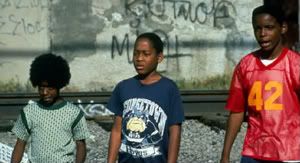
Boyz N the Hood starts off wielding a ten ton hammer that is swung around with more violent rage than any act of brutality in the whole film, all in an attempt to hit the viewer over the head with some simplistic parallel that apparently is designed to be deep or insightful or something like that which hardly works. The scene which I refer to is, of course, the one where the children see that blood is turning yellow and one says "that's because of the plasmids separating," or a similar line. Oh boy, it's like the kids are learning the same thing as everyone except in a different way because of their living circumstances. The streets are just as educational as the classroom. Piss off, John Singleton, you think this is anything but a needlessly overt way to start off a film? Mix that in a few scenes later with Trey's arrival at his father's house depicting, after cleaning, a run down lawn shown alongside the neighbor's beautiful green grass. Lovely, everything is always greener on the other side. Good move.

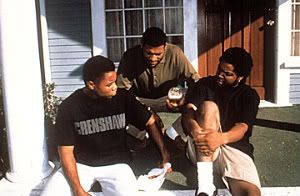
Thankfully, Singleton backs off of these cliched and overly simplistic literary devices when the boys exit childhood and become high school seniors preparing for the end of school. Sadly, what replaces these tired devices proves to be just as detrimental to the film. Singleton essentially trades in his run down Toyota for a tractor with two wheels. The script takes an odd turn to a very cliched Hollywood story telling sense where a love interest is needlessly thrown in, a wife and bastard child are added to set up for more emotional impact later in the film, and the story takes no turn from the first party until the credits. The film just feels like an independent film fighting with a Hollywood film and, much like Doughboy and Ricky earlier, the film just gets dingy and gives up. While there are the occasional sequences that do take a few risks, as a whole the film is so by the numbers that these small probes into meaningful territory are completely undermined.

What seemed so tough whilst watching the film though was not that the film simply kept inserting cliche after cliche, but that it needlessly heightened just about every circumstance and conflict. A scene towards the end where Ricky's SAT scores are revealed proves to be absolutely cringe worthy. Singleton forces stakes into the film and they really stick out as cheap and unnecessary when placed alongside what is supposed to be a tragically brutal and realistic portrayal of impoverished life. On top of that, Singleton's direction, while a few really great shots are used, such as the walk down the rail road tracks, is pretty erratic, ranging from terrible to incredible at any moment in the film. Toss in the score and many times the film started to feel less like an in depth look at urban life and more like an after school special.

Perhaps Singleton's most apparent crime in the film is not inserting needless drama, though that charge is mighty hefty, but rather the most glaring flaw is Singleton's refusal to let the film speak without dialogue. Despite having opportunities, and even using them at times, to imply things instead of directly speaking to the viewer, Singleton feels compelled to give elongated monologues where Larry Fishburne speaks to the audience about his message, and it really comes off as insincere and overly constructed. Then there are parts where someone talks about how things just keep happening "over and over again." It's all pretty painful to listen to and detracts from any impact the film hopes to make on a viewer. The film is not helped by the actors either. Fishburne is decent, but Cuba is pretty bad and Ice Cube is mostly tolerable.

And of course there is the fact that the film is going over territory already explored in much greater depth, in much more detail and with much more sophistication, in other films. The whole concept of being trapped and unable to escape, or the perceived mentality of being contained, is straight out of Charles Burnett's wonderful film Killer of Sheep. Aside from being a much more striking and emotionally engaging film, Killer of Sheep also exists in a much more reserved fashion and does not need to insult the viewer by spoon feeding ideas at each possible opportunity. On top of this, Spike Lee has explored the other territory this film masquerades as exploring in an attempt to appear complex and thought provoking. Despite it not being a tremendous film, Spike Lee's Do The Right Thing provides a more engaging and insightful look at urban life and the injustices of American society without resorting to the theatrics on display in Singleton's film, allowing for a more naturalistic film that enhances the message instead of detracts.

Much like Do The Right Thing, Boys N the Hood becomes incredibly overt at the end. Yet while Spike continues to call on reality, Boyz N the Hood continues to rely on its cheap theatrics to attempt and force a greater emotional impact on the viewer before proving to be an ultimately hollow experience. The follow up 'here's what these characters are doing now' lines that fade in and out, aside from reinforcing the After School Special feeling, continue to draw attention to the fact that everything on screen is artificially heightened and constructed; thus, any attempt to draw parallels between these characters and the reality is, for the umpteenth time, ground into a dust and blown away in the wind.

Ultimately, Boyz N the Hood is nothing more than a jumbled mishmash of ideas that are far too willing to conform to Hollywood convention to discover the sort of effective statement that the film so desperately attempts to find. Even without considering the fact that other films, and older films, have done what Singleton attempts, Boyz N the Hood still proves to be a joke of a film that struggles to ever find ground solid enough to stand on either as a high profile Hollywood film or as a thought provoking call to social action. I honestly would like to know if anyone, after seeing the Burnett film and the Lee film, can still make a case for Boyz N the Hood being worth much at all. Hell, I'd be interested in hearing this case made even from someone who has not seen either the Lee or Burnett films because it baffles me that this film can be considered anything except for glorified garbage. I imagine there is more entertainment and more insight to be gained from watching Don't Be a Menace to South Central While Drinkin' Your Juice in the Hood.

D/D+ or 1.718921742381742835723108

Comments are welcome and, for anyone with a literary mind, I encourage checking out my poetry blog filled with all original works for your reading pleasure.

Also I am on the old Twitter thing so I guess you can follow me at twitter.com/FLYmeatwad.
Monday, July 13, 2009

Two Eyes Took The Aim Behind A Man's Brain, But He Can't Be Blamed


Brüno (Charles, 2009)

Just three years after the release of Sasha Baron Cohen's near legendary film Borat was released to American audiences amidst high critical praise, Cohen is back with a film very similar in nature, Brüno. Given the man's reputation, and even the slew of cameo appearances that Cohen has made in various films since Borat's release, the fact that expectations for the follow up film were sky high was pretty hard to overlook. Perhaps Borat was too big, surely the crew would not be able to find unsuspecting interviewees, let alone ones who are icons in the media, just a slim three years since the release of Borat. Well, these doubts were not without concern, but thankfully Cohen was able to find just enough to make a mostly engaging follow up without going too overboard. Mixed with Cohen's comedic genius, the film proves to be a solid comedy and, as expected, exposes some more of the American mentality and all that comes with such a mind frame.

While I would love to say that there is a ton of substance to Brüno, that is simply not the case. The constructed story is fairly basic and mostly follows the exact same formula that Borat did, except that this film has much more actual story instead of interviews and things of that nature, likely because it was a bit more difficult to find people who did not know that Cohen was once again on the prowl. As a result, Cohen deviates from what was Borat's, and also what is Brüno's, greatest strength: pressing people to expose prevalent attitudes that are usually well concealed. Cohen's ability to see below the surface is truly astounding though and when he is given the chance to sit down and talk the film really shines in a way that mimics some of the greatest documentaries.

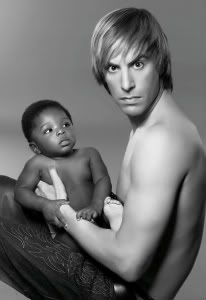
Sadly, these sequences come at a price. Cohen uses various sequences that do not drive at any particular point at all and seem to conform to the notion that these films are designed to shock simply to shock instead of challenging this notion by providing more direct satire. One of the film's lowest points comes in the form of a talk show session when Cohen parades around an adopted child. While even this scene has a few moments of brilliant, the reveal of being a homosexual and seeing how the crowd turns on him is brilliant, the scene is followed up with needless shock and needless theatrics that add little to the film overall. Of course the few scenes like this only make the scenes like the 'gay converters' in Alabama even more rewarding and, with the exception of the song at the end of the peace talks skit, a part that is humorous but does not really bring all that much substance, the humus conversation is genius, plain and simple.

The problem that Brüno could have easily fallen into is that, unlike Borat, focusing on the fashion world as a means of satire is a bit more difficult than the broad brush of politics and America that Borat painted with, but even the scenes that focus on the fashion industry and the entertainment industry, specifically the part with the parents practically willing to whore out their children for the promise of fame, are so sharp and hit so frequently that the film can hardly be faulted for the occasional lulls found in the lesser skits or the underdeveloped plot. Even a seemingly weak skit, the one involving the incredibly intelligent Dr. Ron Paul, that forces so much needless shock for 'plot purposes,' the pay off is a well timed Ru Paul joke, is bearable because of the way Paul seems to be completely willing to spread his message until Baron Cohen pushes too hard.

Honestly, I did not think that I responded this positively to the film, but the more I think back the less I remember the bad things and the more the good parts actually stand out. I mean the Paula Abdul scene where she talks about her compassion for her fellow man as she sits on a 'chair' made of a Mexican laborer, it's not only funny at the visual level, but the idea behind the whole situation is pretty stunning. The film is far from flawless, even at a technical level, but Cohen really gets a lot correct here, like the scene at the Alabama National Guard. Factor in the use of traditional comedy, and the song at the end that likely has Baron Cohen, as well as myself, pissed that the Best Song category at the Oscars is apparently getting the shaft because it really seems like it can be up for consideration.

Perhaps the greatest testament to Cohen's success is found in each individual theatre. Like Borat, Brüno is a film that demands to be seen with a group in a theatre because the comedy on screen is not the only part of interest, how everyone responds to the situations on screen can be just as telling of what Cohen seems to probe with the film. We are all participants in his experiment, just like what Spike Lee does with a film like Bamboozled. The man does not ask us to laugh, he asks us to ask why we laugh. Sasha Baron Cohen cements his genius with the film and solidifies his role as a great social experimenter of modern times. Stanford gave us the Prison Experiment, Milgram challenged the notion of blind obedience, and Cohen as given America both Borat and Brüno. Are either films the most flawless of films? Certainly not, but I believe there is little denying each film's importance.

B[/B+?] or 3.48238476238156327856381975619

Comments are welcome and, for anyone with a literary mind, I encourage checking out my poetry blog filled with all original works for your reading pleasure.

Also I am on the old Twitter thing so I guess you can follow me at twitter.com/FLYmeatwad.