The Dark Knight Rises (Nolan, 2012)
Showing posts with label comic book. Show all posts
Saturday, July 21, 2012
How Many Years Can Some People Exist Before They're Allowed To Be Free?
Labels:
Batman,
batman begins,
Christian Bale,
christopher nolan,
comic book,
comics,
film,
Inception,
Joseph Gordon-Levitt,
Marion Cotillard,
movie,
review,
superhero,
the dark knight,
the dark knight rises,
Tom Hardy
Thursday, December 22, 2011
There's A Cold Wind Coming Off The Ocean
The Adventures of Tintin (Spielberg, 2011)
Labels:
2011,
action,
adventure,
adventures of tintin,
andy serkis,
comic book,
comics,
daniel craig,
dr. who,
Edgar Wright,
film,
indiana jones,
movie,
movie review,
movies,
review,
steven spielberg,
tintin,
uncharted
Saturday, July 9, 2011
CEO, You Don't Have To See ID
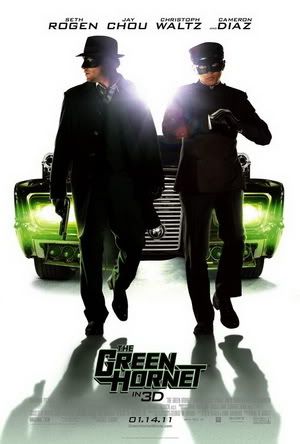
I had a chance to catch an advanced 3-D screening of Michel Gondry's latest film, The Green Hornet, last night, so I am taking a bit of a break from my 2010 coverage to venture in to the present. Never early enough to get a jump on the current year, especially when that jump involves the director of Eternal Sunshine of the Spotless Mind, Be Kind Rewind, and others. Not to mention a script from the men who penned Superbad, an Asian pop star taking up acting, and one of the more compelling comedians working today. So with all this talent involved this cannot possibly go wrong, right?
Thursday, June 9, 2011
I Am Just Different
X-Men: First Class (Vaughn, 2011)
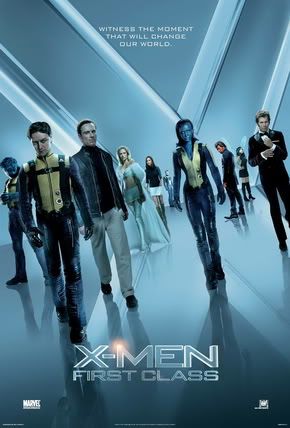
By and large, I think of the first X-Men film to be one of the paramount movies to usher in the recent comic book movie craze, and I have actually enjoyed all of the X-Men films I have seen up to this point. Sure I skipped out on what looked to be an abysmal spin off entry with the recent X-Men Origins: Wolverine, but with a cast that bolsters Michael Fassbender, Nicholas Hoult, James McAvoy, and Jennifer Lawrence, a script from Bryan Singer, and at least an experienced hand orchestrating everything in Matthew Vaughn I was excited to go back in time and really see the characters who set this universe in action. But, given my adverse reaction to Vaughn's previous film, Kick-Ass, I entered with tempered expectations, hoping for more, but expecting little outside of another run of the mill origin story.
Saturday, July 31, 2010
I've Liked You For A Thousand Years. I Can't Wait Until I See You.
Scott Pilgrim vs. the World (Wright, 2010)
In the past few years the Hollywood interest in comic book films has continued to crescendo with huge critical and financial successes such as the Spiderman, Iron Man, and Batman franchises. Aside from being overly saturated by testosterone, such hits have lined summers with blockbuster after blockbuster by sticking to a generic story telling structure of origin stories and world threatening conflict to provide enough action to coerce the adrenaline to come out and frolic. But top tier names are only so plentiful, so the surge in comic book popularity led to various graphic novels getting translations to the silver screen in the form of Watchmen, Sin City, and most recently Kick-Ass. These films focus heavily on action, but the visual flourishes in these films are much more prominent and distinctly separate them form the larger hyped films. So when a director whose claim to fame is his astounding ability to deftly blend genres tackles a film that asks him to combine the entertainment of high action sequences with the charm of a niche graphic novel when I reach a killscreen am I going to want to press continue?
Edgar Wright's follow up to Hot Fuzz details the life of titular protagonist Scott Pilgrim as he literally fights for the love of Ramona Flowers whilst seeking success with his band Sex Bob-Omb. So, naturally, the film is an action film, correct? Well, not exactly. Edgar Wright makes comedies, and Scott Pilgrim vs. the World is stuffed to the brim with more big laughs and subtle touches than I have had the pleasure of seeing since Superbad. But the film, it's certainly not a comedy, as the central relationship is far too much of a driving force. So essentially Scott Pilgrim is a video game meets a graphic novel makes love to a comedy spawns a romance and genetically engineers an action film, donning a musical thong. So I can naturally expect this film to have tonal inconsistencies, but Wright avoids this incredibly common pitfall by keeping the film moving at such a rapid pace, and really packing each and every frame with such a completely realized vision that it never has time to stray from the mood set from the opening Universal logo.
What I notice in this film, and even in Wright's former films, is exactly how much care is placed in every shot. Each use of pixelation, each blur, every censor, all the logos and the outfits, they all establish the world so perfectly. The visual aesthetic works wonderfully with the editing and other visual flairs of the film which include segments that play out at graphic novels and other forms of visual media. But what stands out the most on a visual level is the jaw dropping fight sequences. Each one plays out so differently and allows Wright to showcase a range of film making techniques and styles that synthesize action with comedy and even with music when the script calls for more flashy fights. The more time I have to sit with these sequences and really consider how visually intensive the scenes are, while still maintaining a delightfully charming low budget look.
And of course there's the soundtrack. Anchored by Beck and Broken Social Scene serving a stand ins for Sex Bob-Omb and Crash and the Boys, respectively, the variety of sounds are an absolute delight while still feeling natural and unforced in the context of the film. But not only do the songs serve the overall tone of the film, they also enhance the action, and they enhance the comedy. Rarely have songs ever felt so integrally tied to a film that is not a musical. I suppose the easy comparison to make is to the score in I Am Love, despite the shift in intensity and purpose, the film is elevated incredibly by the use of a very specific type of music employed in a simply masterful manner. But even above the soundtrack is the film's score, a string of wonderful compositions littered with signature video game sounds that play lightly in the background of many scenes. These effect creates such a wonderfully engulfing mood that I found myself completely sucked in every moment of this ride.
However, despite my gushing so far the film is certainly not without its flaws. While the film runs at a neat, and incredibly quick, two hours, I did get the feeling that a complete story is not entirely present. Now I am aware that the film is based on pre-existing source material, so I was able to fill in a few of the holes, but even with this background knowledge I did not find myself incredibly invested in all of the plot lines. Wright juggles so many characters that I was not surprised to see some catch the short end of the stick, but the Kim character is treated as such a removed character that one of the emotional pay offs does not work much at all. Perhaps having her not be important is meant to show the distance between her and Scott though, which does add up but still does not make the plot nearly as satisfying as many of the other threads running throughout the film. The movie needs room to breathe, to completely bring life to all of these characters, and to better reinforce the intensity of the central romance. These aspects are not the strongest, but one of the strengths in O'Malley's series of graphic novels is in the ability to insert quietly beautiful meditations on love amidst the action, and the film does capture the occasionally sickeningly, yet always infectious, feelings of human connection near perfectly.
Another aspect of the comic that is captured in the film, and can stand alone without reading any of the graphic novels, is the character of Scott Pilgrim. Scott is meant to be sympathetic, but we are also asked to realize that Scott is both ignorant to the world around him and as a result kind of a self centered dick. Cera brings this sense to the character wonderfully, combined of course with Wright's inventive way of conveying to the audience how exactly Scott's mind if working. As a viewer I do not always condone Scott's actions, but I can understand them, and the commentary on the illogical human mind is wonderfully woven in to the film, as well as the idea of a society that promotes such behavior. Of course these qualities all rely on the right type of delivery and Michael Cera further cements his status as the best comedic actor of all time by perfectly delivering Scott's lines and conveying his disconnect with his environment. For much of the film Cera does stick with his comfort zone, and the film does really benefit from him doing so, but he does also have big scenes in the action sequences and he further proves his ability to be legitimate 'actor,' depending on one's definition of the art form. Scott is not the drastic change that the Dillinger character is in Youth in Revolt, but not only is he in top form in this film, his ability to work with the fight choreography, both on the ass kicking and ass kicked ends, is simply stunning and further sells what are likely the most enjoyable action sequences I have ever seen.
The film's diverse cast also boasts a ton of other talented actors, but the one that practically steals the show is Kieran Culkin. He impressed me in Lymelife, though I was certainly not prepared for simply how excellent he would be in the role of Wallace Wells, Scott's roommate. He floats through scenes with such poise and precision, delivering his dialogue with such sincerity and charm. His performance is truly a sight to behold. Jason Schwartzman is also excellent doing Jason Schwartzman, and actually all members of the League of Evil Exes play their character uniquely and wonderfully. A few of the secondary character in particular were a huge hit with my audience as well. The females in the film are enjoyable as well, but very few are given very much to do. I wish that more time could have been spent with Envy Adams, not only because Brie Larson is mighty pretty but also because her The Clash at Demonhead performance is one of the best tracks in the film, and the sequence between her and Scott has the potential to be even more emotionally resonant. The stand out of the females is found in the form of Ellen Wong as Knives Chau, a heartbreakingly impressionable Scott super fan girl who exists as a wonderfully satirical spin on Caucasian perspective. Many of the supporting characters play one note roles, but each and every one plays that note pitch perfect.
Coming out of the film I was unsure of exactly how much value I found in Scott Pilgrim vs. the World, but as I started writing about the film I not only learned that I enjoyed the film far more than I had initially imagined (and I am certainly looking forward to seeing it again upon its theatrical release) but the film is also considerably more admirable than I had considered. The startlingly inventive construction and editing are enough to make Wright's latest film a truly uniquely enjoyable experience, but the film's ability to capture such raw moments of beauty in a minefield of laughs cements Wright's status as one of my favorite filmmakers, despite the abysmal Shaun of the Dead, and - finally - left me completely satisfied after seeing a comedy...as much as the label is applicable. At its worst Scott Pilgrim is a masterclass of filmmaking, but this film exists, on practically every level, as a film constructed for me to love. Scott Pilgrim vs. the World is imaginative, inventive, and a film that truly exists as a representation of the time in which it spawned while still holding enough timeless qualities to make it one of the year's finest.
Comments are encouraged and, for anyone with a literary mind, I encourage checking out my poetry blog filled with all original works for your reading pleasure.
Also I am on the old Twitter thing so I guess you can follow me at twitter.com/FLYmeatwad.
Friday, April 16, 2010
All Roads Lead Toward The Same Blocked Intersection
Kick-Ass (Vaughn, 2010)
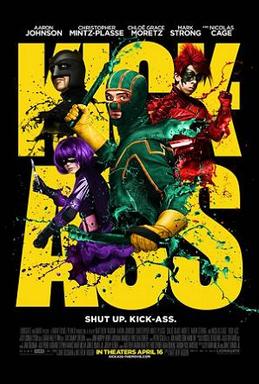
Christopher Nolan. David Fincher. Quentin Tarantino. Zach Snyder. And now, I suppose, Matthew Vaughn is a name to add to the list of directors who can be charged of crafting films that ooze style while skimping on the substance. While I would debate the grounds of many of these claims, as most of the directors have crafted at least one film that would serve as an effective counter point, whether found in the strong subtext present in Fincher's Fight Club, the sprawling narrative in Snyder's take on Watchmen, and just about all of Tarantino's library, (though I suppose that does leave Nolan out in the cold), Vaughn's latest effort (following up his 2007 sophomore film Stardust) may justify such a claim being leveled at the filmmaker. Though I haven't seen either of his two previous pictures, meaning I shall concentrate mostly on my reaction to the man's latest creation, Kick-Ass, an adaptation of Mark Millar's series of graphic novels by the same name, Vaughn has created an interestingly diverse set of films. But sometimes I need more than interesting to keep me going, or maybe I don't, or maybe Vaughn just doesn't want me to know what I want at all.
If the director does, in fact, want to keep me feeling off kilter throughout the entire film he has successfully accomplished his initial mission because, for all intents and purposes, Kick-Ass is a messy and inconsistent film in just about every regard. The score ranges from overbearing to needlessly quiet, yet this pairs with such a delightfully scattershot soundtrack that features a hodgepodge of styles and sounds with each cue seeming almost too perfect for the current scene, practically mirroring the construction of the film as a whole. The three act structure is followed incredibly strictly, so much so that, unlike just about every other successful film based on a graphic novel, no twists or turns at all occur in the narrative. It remains entertaining, but devolves incredibly quickly into predictability, which also mimics the camera tricks that Vaughn employs throughout the film where, during each and every tense scene, we are expected to wait until the a character is placed in a deadly situation before, at the very last second, the tables turn. For a film that is so intent on taking risks with its content the tale is told in a mighty generic manner, and I know I don't go for generic. Even stylized generic, so despite using all those wonderful long shots and top down angles, and starting off by using comic book cues such as text boxes reading "Meanwhile" and other descriptors before eventually abandoning that idea completely, I don't know if the minimal technical flourishes are enough to keep the film afloat by my traditional standards.
But this is an actor's film damn it! Or maybe not. Sure Nicolas Cage follows up one of 2009's best performances in The Bad Lieutenant: Port of Call New Orleans with a smash up performance that succeeds where the film tends to stumble, blending comedy seamlessly with action. And even Chloe Moretz does a decent job of that as well, but I got the feeling while watching her that the character, the disturbingly ruthless preteen Hit-Girl who cares just as much about dropping the C-Nuke as she cares about slicing apart one of the many nameless goons she confronts in the film, is more interesting than her performance. I guess between this and her annoying turn in (500) Days of Summer that means I have even more reason to be concerned about the upcoming remake of Let the Right One In. Anyhow, what seemed so odd was not the actors in the film, but the fact that none of the characters ever seemed fully developed, and nearly all the secondary characters were reduced to caricatures nearly by default. Thankfully the smaller lead roles were anchored by two of the best performances in the film. I do not know if the public as a whole is still unable to separate Christopher Mintz-Plasse from his McLovin character, but I have little problem doing so, and he brings such a presence to the screen each time he is on camera that believing him in the role of Red Mist is a simple task. And then there is Clark 'Bar' Duke as one of Kick-Ass's best friends, allowing for him to generate the funniest moments in the film. Yeah he's doing a similar shtick to what he did in Clark and Michael, but he pulls off that undeservedly cocky, overly hip, self aware comedy that it doesn't matter. Speaking of Michael Cera this is the part where I start to bash lead actor Aaron Johnson. Johnson is supposed to be playing this socially outcast high school student who doesn't communicate well with the opposite sex, yet we still need to be able to identify with him and root for him for the film to work. However, what we get are a few fleeting glimpses of the types of characters that Cera and Eisenberg have perfected with none of the chemistry that Cera could bring to those Clark Duke and Mintz-Plasse scenes. Hell, even Anton Yelchin could have worked better than the emotional sinkhole that is Aaron Johnson.
But now I'll take a page out of Vaughn's book and switch this shit up at the drop of a dime without any warning or sense.
Up until this point I feel as if I have been deceptively negative, perhaps betraying just how much I enjoyed this film. It seems ever since Avatar that action scenes are becoming much more tolerable as traditional editing is used to keep pace while directors intelligently color code each side to make these fast paced sequences simple to follow. And boy damn are the action scenes on display here a rush and a half, they are, for lack of a better term, the definition of bad ass. In fact, some may say they kick ass (how can I pass something like that up?). But even the action scenes are off kilter as Vaughn crafts the world in such a way that the viewer is constantly questioning the purpose of this gratuitous violence. Early on in the film he establishes these make shift superheroes as incredibly human and capable of dying, yet like a lamb to the slaughter this realism is sacrificed without explanation when it would enhance the cool factor. And don't get me wrong, it does, and maybe the desensitization that goes along with the violence is part of the satire, but for that to be the case it would make more sense to not include those scenes that show the gruesomeness of violence, and, really, watching a young girl get punched in the face or gun down a ton of different guys is going to get a reaction no matter how desensitized we may be.
And with that I ask, among the separate realms of action and comedy, in a film that seems to go out of its way to not establish a consistent tone, for a movie that succeeds so well at entertaining but is so stiff and calculated that outside of the shock any traces of heart are severely minimalized, does Kick-Ass have a point? Perhaps not, but maybe that's okay? At one point the film seems ready to begin exploring the idea of escapism and the futility of this exercise, and then all the pieces are set to look into the creation of celebrity in relation to the physical toll this takes on individuals, but none of these ideas are followed through in any substantial manner. But in not probing these ideas am I being asked to simply watch, to be a hog in the mud and revel in the ultra-violence while not looking any deeper into this film? I cannot do that. The obvious point of comparison for this film, I assume, is Watchmen, but while that film suffered from having too much going on outside of the action sequences Kick-Ass is concerned with accomplishing too little outside of its action. Yes, it appears to be a love letter to the comic book lover. Yes the dialogue is fun, and the film is a blast, but it is also just so problematic and personally distressful. I take no offense to the content, in fact I wish that more films would take the risks that Kick-Ass takes, but with those risks there needs to be a purpose outside of simple entertainment.
This reflection has been more rambling than I had intended, but I firmly believe that, as a writer, my obligation is to best convey my experience and response to a piece of culture, and without getting into spoilers that add a few more specifics to my reaction I think that is what I have done here. Films like Kick-Ass only serve to further negate the meaning of rating systems. At the end what I have learned is that the film is fun, it is stylish, and despite all its faults key members of the cast increase the enjoyment to be had. But those inconsistencies, the lack of purpose, the absence of themes outside of the most basic type, I should be ripping this film apart, not considering seeing it again on DVD. Either way, a film like this one does, in retrospect, make me appreciate something like Speed Racer all the more, a stylized tent pole film (though the origins of Vaughn's film hardly qualify as traditional studio fare as it effectively straddles the line between perceptions of independent and mainstream cinema) that blends the humor with the action, that gives purpose to the events, that may not be perfect but provides all the fun of an event movie with the cerebral simulation of more 'serious' films. Or even a Sin City that uses hyper violence and a unique visual style that weaves seamlessly with a consistent and intriguing narrative. I'm going in circles now. Kick-Ass is fantastic and fun. Kick-Ass is terrible and pointless. Kick-Ass is a thrill ride that challenges conventions while being cliche ridden and trite. The film is a riddle, wrapped in a mystery, inside an enigma. Is it August yet? I need Scott Pilgrim vs. the World to show me what a great director can do with similar material.
B or 3.656247572394862375832657932
Comments are welcome and, for anyone with a literary mind, I encourage checking out my poetry blog filled with all original works for your reading pleasure.
Also I am on the old Twitter thing so I guess you can follow me at twitter.com/FLYmeatwad.
Subscribe to:
Posts (Atom)