Okay. It has taken us a bit to get here, but as we progress farther in to the year that is 2014 it's easy to forget all of the great songs, albums, video games, and TV shows that we loved from the past year because, let's face it, it's awards season for cinema. And while there are some celebrating their Oscar nominations as the Academy drags the year that was 2013 in to the beginning of March 2014, here at Processed Grass we like to let the stars know earlier that they are being recognized for their greatness on the silver screen. So, starting with the best Supporting Performances, we shall recognize greatness. Break out the bubbly all the celebs who have been waited for this day, it's finally here!
Showing posts with label scarlett johansson. Show all posts
Showing posts with label scarlett johansson. Show all posts
Wednesday, January 22, 2014

Sunday, May 13, 2012
Every Superhero Need His Theme Music

Marvel's The Avengers (Whedon, 2012)
Thursday, April 21, 2011
Your Hair Is Brown. Your Eyes Are Hazel, And Soft As Clouds
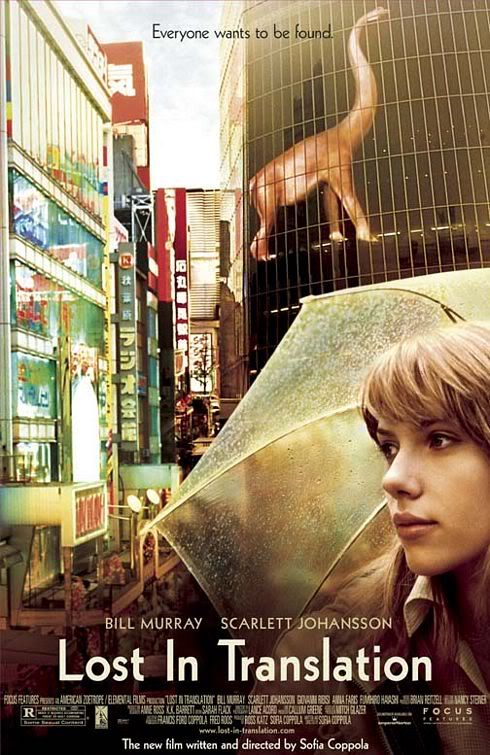
Lost in Translation (Coppola, 2003)
At the heart of what is likely Sophia Coppola's most iconic film, Lost in Translation, is the idea of two lost individuals finding themselves in a land where reality mingles with artifice. Obviously this does not imply that Japan is some stand in for society at large, but the location should not be trivialized as it is in a film like Before Sunrise, where the location is tangential to the overall romance. No, here Tokyo is almost essential to the central relationship because it exists as just far enough away, displaced enough to ensure that Charlotte (Scarlett Johansson) and Bob (Bill Murray) are going to have to spend some time together if only to pass the time, to have someone else who will listen. The film champions the most basic of human connections, and from there it continues to grow.
Coppola is known for being able to set moods in her films thanks to strings of visually evocative images that are interwoven with fairly simplistic stories. Lost in Translation proves to be no exception, especially for much of the first half of the film. Sure Murray is able to make the viewer empathize with a man who has apparently been beaten down by life. Despite being a once successful actor he is not passing on passion projects in order to cash in on his likeness. Johansson's Scarlett is just as aimless, being trapped in a relationship that keeps her locked away during the days and nights, simply passing the time in this high quality hotel. What is a philosophy major to do? Contemplate. These are two people who may not be lost, so much as stagnant. And despite the beautiful construction of scenes the film sort of stagnates with a couple half laughs and some passing interest in the singular lives of these two characters, but it never really picks up until they both begin leaving the hotel behind.
Shedding the confines lifts a type of oppression from the film, and the the vibrant streets of Tokyo make for an excellent retreat from the retreat when paired with the energy between the two leads and Coppola's wonderful camera. A run through a Japanese pachinko parlor, basically a slot house/arcade hybrid if my American interpretation of the game is reliable, stands out as one of the early sequences where we can begin to see the bonds between the two developing. While it would not be difficult to put a decidedly sexual undertone to the whole relationship, it seems more to me that each are simply learning from one another. Charlotte seeks affirmation that her life will get better than Bob's, and he seeks reaffirmation that there's still reason to continue with his life. As the film continues to build it becomes stark, beautiful, and utterly heartbreaking because the script takes the initial simplicity and, seemingly naturally, stumbles upon some of the most honest and truthful dialogue ever written.
Some films thrive on flash, and while there are plenty of visceral thrills and pleasures to be had with Lost in Translation it really is the minimalism that makes the film work so perfectly, especially towards the end. You can dig in to the film and find a complexity that is as wide open as the final encounter between Charlotte and Bob. People don't live or die, people just float. And in many ways, this film is a beautiful exercise in people floating along before encountering another individual. Having that chance to be free, to bare your soul to another, to learn and interact. It's this sense of freedom that the film captures, juxtaposing with with the newness and construction of the travel experience. We can't hold on to these feelings, but it makes us wonder why we hold this freedom back from others, how we perform for the world, and what it means to not perform. Eventually we will go on floating again, how permanent is any relationship? Maybe everyone has the answer, Lost in Translation certain appears to, but maybe we just don't want to hear it, we want to never know.
Netflix Rating: ****/*****
Rich
Comments are welcome and, for anyone with a literary mind, I encourage checking out my poetry blog filled with all original works for your reading pleasure.
Also I am on the old Twitter thing so I guess you can follow me at twitter.com/FLYmeatwad.
Coppola is known for being able to set moods in her films thanks to strings of visually evocative images that are interwoven with fairly simplistic stories. Lost in Translation proves to be no exception, especially for much of the first half of the film. Sure Murray is able to make the viewer empathize with a man who has apparently been beaten down by life. Despite being a once successful actor he is not passing on passion projects in order to cash in on his likeness. Johansson's Scarlett is just as aimless, being trapped in a relationship that keeps her locked away during the days and nights, simply passing the time in this high quality hotel. What is a philosophy major to do? Contemplate. These are two people who may not be lost, so much as stagnant. And despite the beautiful construction of scenes the film sort of stagnates with a couple half laughs and some passing interest in the singular lives of these two characters, but it never really picks up until they both begin leaving the hotel behind.
Shedding the confines lifts a type of oppression from the film, and the the vibrant streets of Tokyo make for an excellent retreat from the retreat when paired with the energy between the two leads and Coppola's wonderful camera. A run through a Japanese pachinko parlor, basically a slot house/arcade hybrid if my American interpretation of the game is reliable, stands out as one of the early sequences where we can begin to see the bonds between the two developing. While it would not be difficult to put a decidedly sexual undertone to the whole relationship, it seems more to me that each are simply learning from one another. Charlotte seeks affirmation that her life will get better than Bob's, and he seeks reaffirmation that there's still reason to continue with his life. As the film continues to build it becomes stark, beautiful, and utterly heartbreaking because the script takes the initial simplicity and, seemingly naturally, stumbles upon some of the most honest and truthful dialogue ever written.
Some films thrive on flash, and while there are plenty of visceral thrills and pleasures to be had with Lost in Translation it really is the minimalism that makes the film work so perfectly, especially towards the end. You can dig in to the film and find a complexity that is as wide open as the final encounter between Charlotte and Bob. People don't live or die, people just float. And in many ways, this film is a beautiful exercise in people floating along before encountering another individual. Having that chance to be free, to bare your soul to another, to learn and interact. It's this sense of freedom that the film captures, juxtaposing with with the newness and construction of the travel experience. We can't hold on to these feelings, but it makes us wonder why we hold this freedom back from others, how we perform for the world, and what it means to not perform. Eventually we will go on floating again, how permanent is any relationship? Maybe everyone has the answer, Lost in Translation certain appears to, but maybe we just don't want to hear it, we want to never know.
Netflix Rating: ****/*****
Rich
Comments are welcome and, for anyone with a literary mind, I encourage checking out my poetry blog filled with all original works for your reading pleasure.
Also I am on the old Twitter thing so I guess you can follow me at twitter.com/FLYmeatwad.
Subscribe to:
Posts (Atom)