Saturday, August 8, 2009

I Wish You Could Swim Like The Dolphins, Like Dolphins Can Swim


The Cove (Psihoyos, 2009)

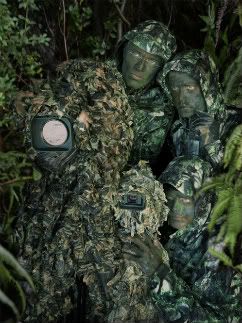
While I would not consider myself very well versed in documentary film making, I do have an interest in these types of films and, when one builds buzz like The Cove, I feel compelled to do everything in my power to check out these types of films. Luckily, The Cove opened at a local theatre this week and I did not have to go incredibly far out of my way to see the film. The power of a documentary is something that few other films, or even many other artistic mediums, can effectively wield because, quite obviously, a documentary has the advantage of, at least to an extent, presenting life in its purest form. I knew little of the material that would be covered, only that dolphins in Japan were a focus, so I was hardly prepared for what I was about to witness.

About a year after the mesmerizing, and Academy Award Winning, doc, Man on Wire, The Cove begins to set up as a documentary that draws influence from various styles of film, most notably espionage films. While The Cove has far fewer constructed sequences than Man on Wire, the comparisons to these genre films are still incredibly warranted because, even without the construction, the entire film is practically an adrenaline rush of social and political intrigue that had me riveted from beginning until end. The action sequences here, and by action I mean the car tailings, the cop stuff, and the actual infiltration, are all nicely handled and enhanced by one of the best scores of the year. The film is surprisingly suspenseful for the type of film that it is and, quite masterfully, never skips a beat in terms of narrative, which is and of itself an impressive characteristic in any type of film, let alone a documentary.

Of course the film also succeeds as a standard documentary as well. The interviews all serve the film's purpose, the examination is immediately identified and builds throughout, and the whole thing advertises a payoff that, unlike in other docs, hits incredibly hard. For example, the film goes about humanizing the dolphins incredibly effectively. However, to say that the film is simply about dolphins is misleading, as Food, Inc, as well as other older documentaries, has chronicled an abusive industry. No, the tragedy of The Cove is elevated by the dolphin trade, but the actual sadness is in the exposure of government policy, the corruption of power, and the countless victims that will result in the future, all of which the film covers nicely. These aspects are all universal, and I would argue that every individual a part of at least once, usually for extended portions of time. The struggle is tragically heartbreaking and seems to be overlooked in favor of the film's more overt material.

SPOILERS FROM HERE ON OUT...I reckon. I mean the trailer kind of spoils it, and I have made references earlier. Still, spoilers.

Still, I do not mean to lessen the effect of the dolphin killings on screen, as the film serves wonderfully as a call to arms for that particular cause as well. The entire film's intrigue is built on seeing the inside of this cove, and once the film really starts to drive at that things start to pick up immensely. And of course that all leads to the hidden cameras in the cove, and the final fifteen minutes of the film, which also happen to be the best fifteen minutes or so of the year in cinema thus far. Soul shatteringly gruesome, the massacre of these dolphins is shown in full force, capped off by the greatest shot of the year, a cove where the water has gone completely red. The film then starts to wrap things up in grandiose fashion. One interview we have been seeing throughout the entire film is revealed to have taken place after the discovery of the footage, as O'Barry, after just being shot down with "I told you, we are not going to talk about what ifs," pulls out a camera and asks the man to take a look at some footage. Sure it's not very professional, I guess, but it's such a satisfying conclusion, you just want the man to be confronted with this evidence. And his reaction is priceless. Cue the reveal at the IWC, the final monologue, the obligatory call to arms, and then the mesmerizing introduction of David Bowie's "Heroes" as the credits start to roll.

It started during that hidden camera sequence, but by this point I had been effectively bowled over. I recall getting upset over films, I recall weeping after seeing George Washington, but until watching The Cove I had never broken down in tears in a movie theater. The political implications I talked about earlier, mixed with the chilling score and the scenes of the red water left me practically immobile. Does the film have some flaws as a documentary? Probably, as there are one or two points that really do not go very far. Does The Cove present all the facts? I don't really know. However, as I finally worked up the strength to leave the theater and began stumbling my way to the car before breaking down again, I was practically positive that The Cove is nothing short of one of, if not definitively, the best films of the year so far.

A+ or 4.9128934721842374230174

Comments are welcome and, for anyone with a literary mind, I encourage checking out my poetry blog filled with all original works for your reading pleasure.

Also I am on the old Twitter thing so I guess you can follow me at twitter.com/FLYmeatwad.

Take A Look At Eye Full Towers, Never Trust Them Dirty Liars


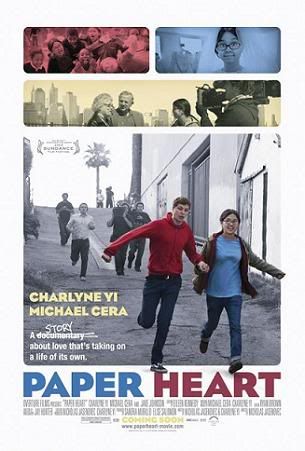
Paper Heart (Jasenovec, 2009)

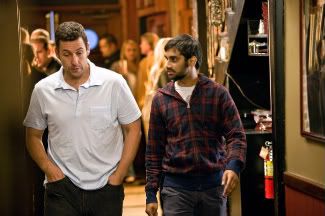
In a year that has seen its fair share of incredible comedies and phenomenal documentaries, Paper Heart pulls both genres together, sits them in a room, and tells them to fight. In many ways this film is likely the physical result of the make up sex of that encounter. Featuring the infectiously endearing Charlene Yi as she travels across the globe in a quest to define love, Paper Heart sits somewhere between film and mockumentary with a noticeable grace. Now after seeing the film I am still not entirely sure what it should be classified as, the actual interviews seem to be genuine, but the film is clearly a fabrication. Regardless, the tactic is mighty interesting and plays with the notions that viewers have both of film and drama while adding to the questions about what is real and what is constructed when deal with the idea of love, so the film certainly succeeds in its assembly.

Speaking of constructed, the actors on display here are pretty fantastic. In many ways the only actor in the film is Jake Johnson as he plays the film's director, Nicholas Jasenovec, but I am fairly sure that each cast member in the film, that is the non interviewees, are all performing. Yi is spectacular, and she needs to be for the film to succeed at any level, but her real strength constantly seems to be her reluctance mixed with her curiosity. These traits keep the interviews compelling, but they also help build her character progressively throughout the film. Still, the obvious standout has to be Michael Cera. Cera plays an altered version of himself, seemingly embracing and challenging the notions of him always playing the same character, with tremendous humor and subtlety. Cera is mighty spectacular in the role, slightly reminiscent of his time on the Clark and Michael web series but also a good deal more refined. He does not play himself, Michael Cera plays the public perception of Michael Cera.

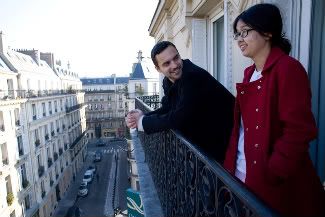
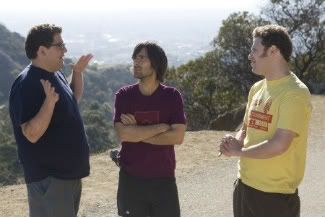
As for the technical aspects, the film is actually impressive as well. Designed to keep the viewer off guard, Paper Heart switches from overly documentary sequences, where the film grain is kicked up to enormous levels, to really beautiful and disciplined shots, like the walk through the forest between Yi and Johnson. However, the sequence that stands out would have to be the scenes in Paris. At the drop of a hat the film takes these entirely constructed sequences and switches the way they are presented almost instantaneously, which is even more impressive the more I look back on the film. However, the direction is not the only striking visual aspect showcased here. The film has numerous charming sequences where interviewees detail their own personal love stories while Yi animates the stories with hand crafted puppets. These scenes are some of the most visually striking of the film and are used to great effect. The film is also enhanced by the score, which is mighty top notch.

In many ways, Paper Heart is probably a comparable film to Bruno, and I would actually be interested in doing a follow up comparison of the two films so someone should make me do that in the near future, in the sense that both subvert a viewer's notions of what a docu/mockumentary should be and how the topics should be covered. Obviously, Paper Heart is more of a film than Bruno, and even more complex as I begin to write more and more about my short time, about an hour and a half, with the film, but they both share some downfalls as well. Not all of the interviews land and the laughs, though clearly there, are not as big as in a straight comedy. However, all of these minor problems are practically irrelevant when looking at the bigger picture. Paper Heart is a layered and complex film that does not only examine love, but examines the entire idea of fabricated realities. At first I was not entirely blown away by the film, but, as is the case with every great film, the more thought I allot to Paper Heart, the better the film appears.

A/A- or 4.389289472308147810234723104


Comments are welcome and, for anyone with a literary mind, I encourage checking out my poetry blog filled with all original works for your reading pleasure.

Also I am on the old Twitter thing so I guess you can follow me at twitter.com/FLYmeatwad.

Thursday, August 6, 2009

Another Morning, Another Opportunity To Do Something Progressive, To Prove That He's Worthy


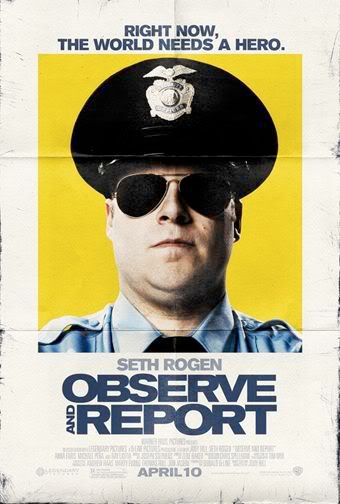
Observe and Report (Hill, 2009)

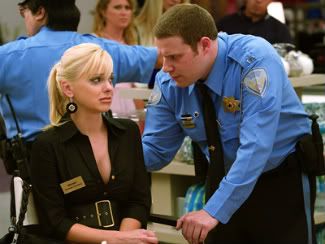
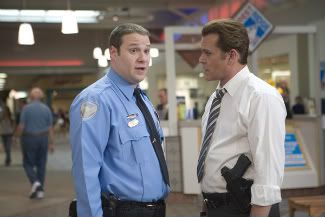
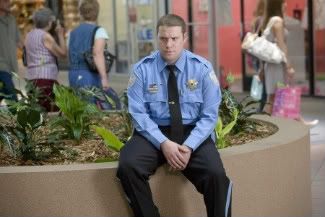
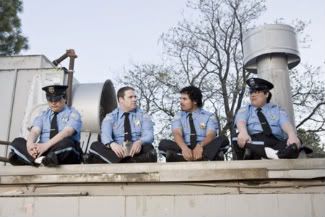
I recall when this film was first released, I was interested in checking it out but never had the chance to getting around to the theatre because school was pretty hectic at the time. Upon finally getting around to the film I find myself pretty disappointed that I did not get out earlier and actually support it during the theatrical run. In many ways Observe and Report is far from a perfect film. Hell, it's far from a great comedy. Still, I could not help but being fascinated by the entire implications of releasing this major Hollywood film on unsuspecting audiences. Obviously following the release of Paul Blart: Mall Cop a few months earlier the initial comparison is to think this film will be a slightly more mature, in terms of humor, film that operates on a similar premise. Now while I have not seen Paul Blart, I feel mostly confident in saying that the similarities between these two films are likely very minimal. Observe and Report is a black comedy that breaks so many conventional rules of standard Hollywood comedies that I am practically obligated to at least respect the film, but thankfully it also works as a film incredibly well. Also, I should state before getting into my review, that the film has drawn criticism for a 'sort of date rape' scene. I'm not going to talk about that because the scene is used very nicely in the film's context and the real problem people should be having with the depiction is not the sex, but rather the fact that Seth Rogen had a huge glass of beer during the date, yet he still drove Brandi home. Buzzed driving is drunk driving!

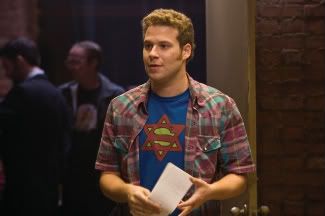
By this point in his career Seth Rogen has started establishing himself as a talented actor. While many would likely point to the recently released Funny People as his coming out party, those who watched Kevin Smith's Zack and Miri Make a Porno from last year should already know of his acting abilities. That being said, Observe and Report is likely Rogen's best performance to date. Ronnie gives Rogen a character that experiences and expresses a range of emotion while remaining distinctive enough that Rogen must make the character his own. Not surprisingly, Rogen approaches the role with a certain amount of respect and hits all the major aspects of the Ronnie characters perfectly. As for the supporting cast, Anna stands out because she is pretty funny and mighty pretty, while Michael Pena and Ray Liotta turn in two really great performances as well. Actually, next to Rogen I would have to say that Liotta provides the second best performance, both dramatically and comedic.

Of course the film's strength is not really in the actors themselves but really in the writing and the different characters on screen. Faris, for most of the film, plays the perceived 'love interest,' but Hill makes it clear from the very beginning that she is, despite being physical beautiful, one of the least attractive people in the entire film. Similarly, Ronnie plays the protagonist, but he is so deluded and misguided that any perceived positive qualities are constantly underscored by the obvious negatives. Mixed in with some genuinely funny comedic writing, Observe and Report is set to be decently successful from the start; however, the film always seems to be self aware as well, which actually enhances the entire experience instead of detracts. The line that stands out to me is uttered in the police station by Ben Best, "I thought this was going to be funny, but it's actually kind of sad." The film shifts from humor to drama at the drop of a hat, and instead of feeling disjointed or out of place it actually meshes nicely simply because it is so off putting. Hill seems to know what he is doing with the writing and the film does not feel manipulative just to elicit a response, it seems to directly mirror Ronnie's character. Not to mention that, in a genius move, the film takes a pseudo-There Will Be Blood approach and has a finale that is cleverly shot as realistic but actually is a fabrication in the mind of the main character.

Thankfully the writing here is so strong because, sadly, the technical aspects are nothing worth mentioning in any detail. The direction is mostly solid, but very few shots actually stand out as definitive marks of Hill's style. The film does have a nice sequence where Dennis and Ronnie are going around the mall causing havoc which is shot wonderfully though, and is also really funny. The lack of definitive direction is made up for with a pretty stellar soundtrack that features a ton of perfectly used songs. Still, the one that stands out the most is the song that is used in conjunction with the finale, the tipping point that solidifies the sequence as one of Ronnie's creation rather than any sort of reality. Next to Adventureland and Hannah Montana: The Movies, Observe and Report probably has the best soundtrack of the year, unless I am overlooking an obvious choice to two, which is fairly likely.

On the whole, Observe and Report is much more than the sum of its parts. The film is not side splittingly funny throughout. The movie is not a revolutionary drama. It is not even the most in depth or amazing of character studies. Still, Observe and Report is one Hell of an experience that proves to be both casually entertaining and deceptively complex, depending on how a viewer decides to approach the film. There is a certain genius in the way the film is constructed and the way it was marketed. It is hardly a typical comedy, much like the year's stand out gem Adventureland, but it can exist as a fairly typical comedy. I am a sucker for these multi-layered films and Observe and Report is no exception. Now it looks like I need to go back and check out Hill's previous works since he apparently deals with similar ideas in both his television series and The Foot Fist Way.

A- or 4.1892342748213750213760572348

Comments are welcome and, for anyone with a literary mind, I encourage checking out my poetry blog filled with all original works for your reading pleasure.

Also I am on the old Twitter thing so I guess you can follow me at twitter.com/FLYmeatwad.

Tuesday, August 4, 2009

There'll Always Be A Few Things, Maybe Several Things, That Your Gonna Find Really Difficult To Forgive


Princess Mononoke (Miyazaki, 1997)

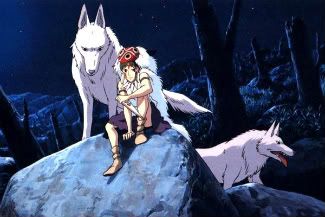
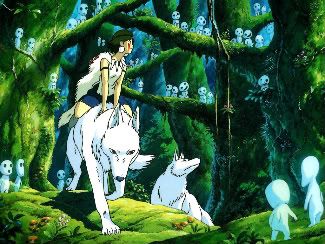
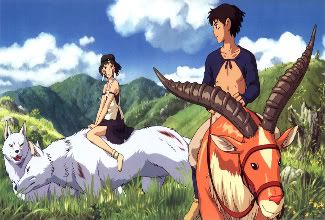
Well, I suppose it is about time that I get to Miyazaki's crown gem, or what I assume is his crown gem considering that Spirited Away is not nearly that great. Going into Princess Mononoke I had only the film's reputation to go on as I did not know anything of the film's plot. Of course as I gazed down at my Netflix sleeve to see that the run time was listed as two hours and fourteen minutes I found myself pretty worried that this film was going to be a bit too long for its own good, after all, the best Miyazaki films are the shorter ones. Oh yes, I was also pretty sure that I heard this film dealt with some environmentalism crap, and since I have made it my mission in life to personally see my own carbon footprint before I die I was pretty sure that any overtly environmentally friendly themes would end up pissing me off. But hey, I'm an open minded kind of guy, so bring on the Mononoke!

The first striking characteristic the film possesses, well aside from the visual aesthetic, is found in the form of the story. Now I do not use the word story in the sense that the word refers to plot, but rather I mean to say in the way the story is told. In many ways Princess Mononoke is a fairy tale, not unlike classic Disney films that focus on Princesses, albeit with much more characterization, as it possesses all the whimsy of a magical world existing in a mostly realistic setting. The world is really well established. The story is simple enough that it feels like it is being told instead of watched, a characteristic that is captured perfectly in the film, but I do not think designating Mononoke as a simple fairy tale completely does the film justice. In many ways Princess Mononoke feels more like a myth, lore passed down from generation to generation and being refined through each progressive telling of the tale. Now I'm sure I got this feeling because of the film's context, it does take place in historical Japan, I think, so the fact that it feels like a myth rather than a fairy tale is expected. However, what I found particularly fascinating was how it felt so culturally specific yet works so well for an audience member who is not a part of this culture. I think part of Miyazaki's ability is to craft and play with this universal magic without sacrificing the Japanese element of the film. In short, the way the story is presented is pretty wonderful.

Of course that is not to say that the film is all whimsy and child friendly. The content is rather mature, limbs fly all over the place and blood plays a hefty part in Mononoke, but it is all handled so gracefully. And there is that little environmental aspect, but the film handles it more as a reverence that is nicely disguised to work with the time instead of being something that hits the viewer over the head. Plus the film does not take the whole 'all technology is terrible' route either, so I can definitely appreciate that given the way Miyazaki openly says that both sides can coexist peacefully. The film works as an allegory alright, but as a straight up film it works as well. The opening sequence is riveting and really all of the action sequences are high energy filled thrill rides. On top of that the film mostly nails all of the sombre moments as well, so I am mostly confident when I say that the run time, despite being a little lengthy, is not a detriment to the film at all, though I did need to take a break during the run time for what that is worth. Actually though it is refreshing to see an animated film willing to stretch out the run to over two hours, as most great animated films I generally want to see more of, so having Mononoke take on a lengthier feel, which also enhances the mythological epic feeling, was a wise choice.

Speaking of animated films, all the technical aspects on display here are top notch. From character animation to the way scenes are drawn, the film is a visual power house. Obviously the imagination in the fantastic characters is going to stand out, Miyazaki has a way with designing these larger creatures that oozes originality, but the real strength is the way that he designs the worlds. The forests, the mountains, and the towns all have a believable beauty to them, not to mention that the traditionally drawn animals are incredible. However, to enhance these creatures, the ones that actually speak are voiced with an insane intensity that makes for numerous great voicing performances. Now I watched the film with subtitles so really all I could go on was how the lines were delivered, but even with this I found myself mostly swept away with the characters. A lot of effort apparently went into the dub as well, so I watched a few scenes with the American voice cast and I can mostly say that the quality of the voice acting there is at least on the level of the Japanese voices. The film, all around, sounds spectacular. Mix that with a brilliant score and the film records high marks in terms of technical quality as well.

So by now it should be pretty obvious that I loved my time with Princess Mononoke. The film is mature, complex, and pretty much a master piece. It avoids the pitfalls that plague some of Miyazaki's lesser works like Spirited Away and Howl's Moving Castle, and I would have to say that it rivals My Neighbor Totoro and possibly even Porco Rosso as the best Miyazaki film that I have seen. Okay, well maybe not Porco Rosso, but I certainly love it as much as Totoro. Any minor problems that I found with Princess Mononoke have quickly been forgotten in one night's time and I am left remembering all of the breath taking positives. On the whole, the film seems to capture what is great about animation, both Eastern and Western, and I think for that alone Princess Mononoke deserves to be championed as an artistic accomplishment. Truly one of the best films ever made.

A+ or 4.83748324623954163596159

Comments are welcome and, for anyone with a literary mind, I encourage checking out my poetry blog filled with all original works for your reading pleasure.

Also I am on the old Twitter thing so I guess you can follow me at twitter.com/FLYmeatwad.

Monday, August 3, 2009

Bobby! Should I Take 'Em To The Bridge?


Soul Power (Levy-Hinte, 2009)

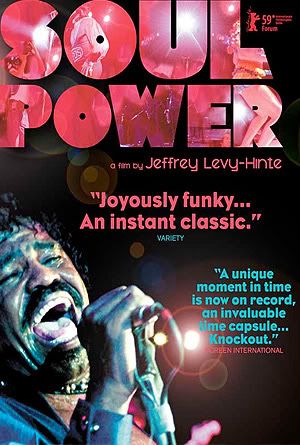
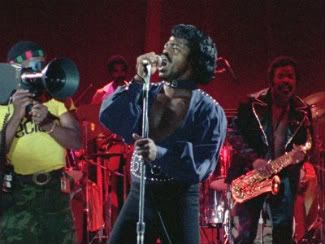
So I basically knew nothing about this film going in to my viewing. I had seen the poster and figured it would be archival footage of James Brown singing songs, and maybe having some interviews about his life. The film pretty much put that thought to rest about five seconds in when the film tells the viewer that the footage was recorded during a concert in Africa during 1974 that was paired with a Muhammad Ali fight. So the film is mostly not about James Brown, well except at the beginning and the end. Still, seeing all of this footage that I have to assume was not released until this point in time is an interesting prospect, so I reckon that the film can sustain itself on the promise that this event, in all its glory, has been captured and preserved over the years. Plus the music is funky, so it is kind of like a concert film that is not in 3-D, which is kind of cool.

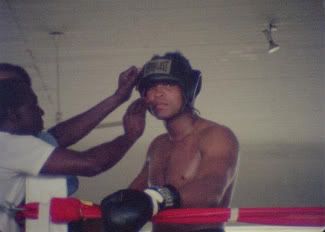
Of course the film does not act as just a concert film. Sure the film documents the whole affair from set up to performance, but it also touches on so many other topics. Ali rants and raves about the injustices of America and American society at numerous points throughout the film, making me understand what people saw in the man as he hits on a ton of truths, while the film also shows us the men organizing everything and how they are basically just pushing the product that Ali talks about. That construction is well handled and could make for a compelling film.

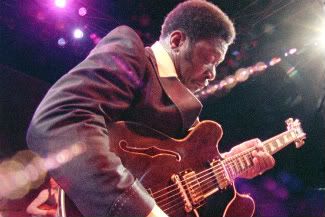
Naturally all the concert footage could make for a compelling documentary as well, placing Brown and B.B. King alongside traditional African acts, all making up mostly the second half of the film. Hell, the film even has a bit about how music is universal. Though I suppose by now it seems pretty obvious what I am driving at: the film does not really seem to know what it wants to be and mostly results in an erratic mix of half way followed through concepts. The whole thing, sadly, lacks the focus that could have tied everything together. Whether or not this is a fault of the documentarian, a lack of footage, or something completely different I cannot say with certainty, but the film is very uneven in its presentation.

If I was to evaluate Soul Power as a time capsule I suppose it would be a perfect film, every idea and benefit tied to the idea of preserving, hiding, and then revealing objects of an older era is present in the film, but as a documentary the whole affair is far too scattered to be worth much more than a watch simply to marvel at the cool footage. I can see people taking ideas away from the film, Hell, I took ideas away from the movie, but no single topic is really fleshed out enough for the film to add up to a meaningful whole. The credit sequence is great though, and be sure to stick around for them to finish completely because the film maker puts a wonderfully effective scene after the screen goes black. Also, the James Brown performance at the end is worked in perfectly to the film and provides for an electric conclusion. Kind of odd that the film did not show the fight though, as that seemed to be a large portion of the film, and it really did little else but cement the idea that the film really is supposed to be about Brown. Still, the time capsule effect is so damn compelling.

B or 3.5483274823512350152370156

Comments are welcome and, for anyone with a literary mind, I encourage checking out my poetry blog filled with all original works for your reading pleasure.

Also I am on the old Twitter thing so I guess you can follow me at twitter.com/FLYmeatwad.

Companionship Is Where You Find It, So I Take What I Can Get


Funny People (Apatow, 2009)

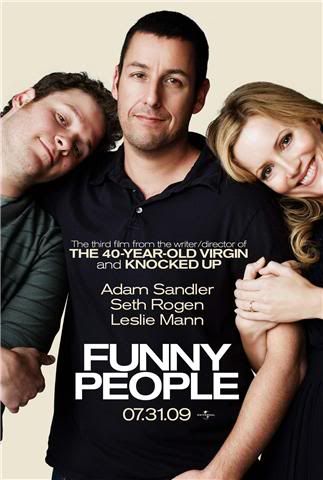
After two major successes where he spent time at the helm, and what seems like a million 'Produced By' attachments to the end of trailers, Judd Apatow returns with the Adam Sandler and Seth Rogen vehicle Funny People. After seeing the trailer it seemed to be another formulaic Apatow film that was going to present the audience with a standard situation, heighten it up a bit, throw in some laughs, make things a little depressing, get a romance going on most of the time, and then wrap up nicely. Well, taking a page out of the Adventureland book to non-success, the trailer does not do the film much justice. The romance aspect of the film is but a footnote to the story of Ira and George, Rogen and Sandler respectively, and how these two men bond during the course of the film. Think I Love You, Man except better. The movie is about characters and comedy, not love and loss.

Clearly the film's greatest strength comes in the form of the lead actors. Both Rogen and Sandler are fantastically funny yet emotionally sound. Sandler has already shown his ability as an actor in Punch Drunk Love, but seeing Rogen be a bit more than what he was in Knocked Up was a nice change of pace. Sandler is the obvious stand out in the film, but Rogen mostly matches him blow for blow, as the comedian mindset the film explores makes necessary. As for the supporting cast, things are a little lack luster. Mann plays her same type of role, which is nice, Bana is pretty damn funny, Hill is mostly good is limited time, but Jason Schwartzman is clearly the best of the supporters. He plays his role of the gloating and arrogant friend realistically and perfectly, capturing what is so disgustingly human about, well, humans. As for Apatow's kids, they have worn out their welcome and really slow the film down when it has already lost steam. The two are not really funny, they are not really cute, and they do not do anything to enhance the film.

Speaking of losing steam, the film is phenomenally strong for the majority of the first hour and a half. Then the narrative decides it wants to take a prolonged stop in romantic comedy territory. For something that is so focused on how Seth and Sandler interact with each other, which is clearly the point of the film as the ending so clearly implies, the amount of time that Sandler spends needlessly wooing Mann is both sloppily integrated and pretty dull. Sure it adds in some laughs, but at the expense of a more complete narrative. The film is dark and comedic early on, it even seems to have the perfect opportunity to end when a line is delivered from an unexpected face, "Then what are you celebrating?" The film would have been a masterpiece if it just stopped. The script could have been altered slightly to tie up the Rogen/Sandler plot line and the film's tone would not have been undercut, but for some reason Apatow cannot do that. The 40 Year Old Virgin has similar problems, and Knocked Up has similar problems. Apatow just cannot write endings.

Thankfully he can work a camera. While the direction is not mind blowing, it does range from solid to really good on numerous occasions. Early on the opening scenes following Sandler are really great, the one wide shot where there are a few pineapple shaped trees on the lawn is pretty great, and the dinner scene is cool as well. Still, Apatow does not prove himself to be one of the best men working with a camera, but at the same time he also never does anything really bad with the camera, so I suppose that means this is mostly a wash. Probably not though because he has some really great parts, right? Sure, let's go with that. Okay, the direction is pretty good, I guess Judd can work a camera. Still, it's not his strong point, but the film still works fine without all that technical flair, mostly because of the first hour and a half. Mostly everything before the rom-com bits.

Damn romantic comedies. Damn advertising. Damn mismarketing. Damn it all. You want to laugh? Well then you're probably better off watching Judd's previous two films, of which The 40 Year Old Virgin is the funniest, but if you want to see Apatow's best film then you should probably see Funny People and just pretend that the bit after the celebration scene doesn't exist. Despite the film's failures, it proves to be the most complex of Apatow's films because it departs most radically from the common Apatow formula that the trailer implies. Funny People examines comedy, it examines humanity, and it tosses in enough penis jokes to appeal to the people who could care less about these two previous explorations. Is the film a transcendental comedy? No. But any film that presses the fourth wall like this while showing the potential to be a masterpiece is good in my book. Plus the bits where Adam Sandler just about openly mocks his career and almost admits that the majority of the films he acts in are shit is pretty great. Keep up the good work Judd, and just learn to write a little less generic.

B+/A- or 4.18213907214746123784691

Comments are welcome and, for anyone with a literary mind, I encourage checking out my poetry blog filled with all original works for your reading pleasure.

Also I am on the old Twitter thing so I guess you can follow me at twitter.com/FLYmeatwad.

To Give Me The Needed Professional Help To Protect Me From The Enemy, Myself


Depart From Me (Cage, 2009)

Second installment of my music reviews takes us to the latest from Definitive Jux rapper Chris Palko, better known as Cage. After radically changing his style from his debut record Movies for the Blind, Cage released his critically praised, but core 'fan' shunned, follow up Hell's Winter. Songs like "Ballad of Worms" and "In Stony Lodge" had prefaced Cage's lyrical shift, and once again the man has evolved as an artist and elevated his musical style with the release of his latest record four years after his previous. Stand outs like "Shoot Frank" and "The Subtle Art of the Break Up Song" paved the way for Cage's growth as a musician as Depart From Me begins to mark the artist's self proclaimed beginning of the end.

Nothing Left To Say - Starting off with a spacey pseudo-techno, pseudo-Radiohead background beat, Cage recites some thought provoking rhymes in a more poetic and subdued style, setting the album's tone perfectly, and then the drums blast in with a booming presence before Cage starts rapping quickly, as per usual. Then he starts singing, apparently dedicating the song to the late Camu Tao, before letting the instruments play wonderfully. Cage finishes with a solid verse and closes by singing the chorus again as the instruments mash up beautifully. A great establishing song to kick the album off.

Best Line: "Awaiting the hand of god knowing I stand to fall
I stared into the pitch black to no hand at all"

Beat Kids - Cage departs slightly from the style of the previous track to let the power chordy beat take centre stage as he slowly spins a chilling yarn before transitioning to a catchy chorus that juxtaposes the subject matter nicely. The mastery of the delivery here is apparent as Cage challenges conventional expectations and asks the listener to question and compromise established beliefs. The use of children in the second chorus backing up Cage is an effective technique too that adds to the song's themes.

Best Line: "And as he forces himself inside her
Her eyes dart around with pain
He says, “You can talk but no one listens to liars.”
But you will surely get yours one day"

Dr Strong - Introducing the song rather quietly and quickly, Cage simply states his former membership of Stony Lodge Hospital before the song picks up a powerful beat that makes great use of more modern industrial metal instrumentals. The song picks up a melodic and trippy semi-piano part about half way through the first as Cage begins exploring the forced drugs of his time in the mental asylum. This aspect is paired beautifully with a tragically moving chorus that Cage belts out impressively. The song ends with the final line of this chorus painfully held to mirror Cage's beaten down state that he describes before completely calming out with a wonderfully diabolical final line.

Best Line: "When you wake up drugged it’s tough to get your thoughts sorted
And you realize you’re tied down about to be drawn and quartered
But there’s no horses about to rip you limb from limb
But the tranquilizer in your blood is what they give to them"

I Found My Mind In CT - The opening minute of guitar here beautifully establishes the song's mood and tone while working to further showcase the album's embrace of more musically oriented tracks. Cage's instrument experimentation is particularly impressive on this track, and he certainly does not skimp on lyrical quality or delivery either. The subject matter is intense and morbid, particularly devoid of hope. The song is beautifully constructed, written, and delivered. Cage even integrates a bit of humor into the dreary lyrics that drip with a distinctive macabre.

Best Line: "My brain left me in PA, departed DC
Then begged me take it back crying in a bar in CT"

I Lost It In Havertown - Continuing the title from the previous song, Cage completely changes gears on this track to make for a fabulous one two punch. The insanely short run time is matched with an up tempo beat with a mash up of instruments that powerfully enhance Cage's lyrics. The distinction here is clearly that the style is more reminiscent of his older and quicker flows of albums past. The track effectively shows that Cage can still rap like he used to, but it also allows room for him to experiment with sound and grow as an artist. The song is great, but the two paired together are incredible artistic triumphs.

Best Lines: "You're tongue in your cheek and you're adorable weeping
Your water can leak in
Fill up the room as soon as I'm stuck in the deep end
I cling to a beacon I was sinking my teeth in
I flew from your region, left you some of my demons
You were some kind of treatment or something else"

Teenage Hands - Cage continues the run of short songs with one of the album's stand out tracks. Telling the story of a sexual deviant on the prowl, targeting high school girls and showing off to relive the apparent glory days, until the second verse when Cage perfectly transitions from the theme of the first verse to a more politically geared tale of a youth enlisting in the army and becoming another cog in the machine. To think that he does all of this in a mere thirty seconds is not only impressive, but a testament to Palko's ability as a master story teller.

Best Line: "Kissing on her neck and squeezing her hand
Like the lungs in your chest trying to breathe in sand
Knife in your stomach and they shut the van door
So you can find out they've got special plans for -

YOUR LITTLE TEENAGE HANDS"

Eating Its Way Out Of Me - The song starts off with a repetitive beat that mirrors a saw, a nice effect that adds an unsettling feeling to what Cage is about to present. The song's lyrical material is probably the most diabolical so far, dealing with a masochist's mentality and detailing a dysfunctional relationship that flips the abuser/abusee role. Cage really shines here as a writer and a musician, establishing his style and perfectly blending the lyrics to the instruments. Clearly one of the record's most successful experiments.

Best Line: "Reopen the scab in my head that never healed right
I can say I’m happy, just don’t know what it feels like"

Kick Rocks - Cage really shows his ability as a story teller here, scripting the song at first before starting off with the chorus. The majority of the song actually plays out more as a dialogue than a song. The song is mighty magical and one of the record's more definitive. Cage really does not rap on the track at all, but the whole track is incredibly catchy and for some inexplicable reason works musically and is certainly one of the record's most fun songs to listen to, despite not being much of a song at all.

Best Line: "Hey, I'm sorry to hear about that mom, but uh look, I'm kinda busy right now
Help you move furniture!?
You're kinda breaking up...
Can you hear me!?
MOM!?!?!"

Captain Bumout - beginning with another spacey/trippy beat, the song quickly becomes very produced and eventually picks up an upbeat guitar as the song leads to the chorus. The song is actually an odd track, but once again shows strides in Cage's ability to adapt his lyrics and delivery to beats that become less and less standard and much more instrumental. Cage breaks a ton of barriers with this song and bridges a lot of gaps between rap and rock, not to mention the semi-tongue in cheek radio-esque chorus. An incredibly interesting track and one of the album's finest.

Best Line: "I'm such a misfit in social situations, I hate it
Depression medicated yet you're insecure and naked
I'm trying to loosen up, you're dying to read my sullen eyes
This intellectual black hole reeks of cologne and lies"

Strain - The record starts to wind down, but the instrumentals certainly do not let up. Cage starts to really nail the beat to delivery thing from here on out, so I am probably going to start cutting down on how much he develops over the run of the album. The song's lyrics are a mish-mash of standard Cage themes, but the lyrical prowess here is mighty impressive and is paired with one of the album's catchiest hooks. Seemingly designed to sing along to, the song is easily one of the highest points of the fourteen tracks.

Best Line: "I won’t let you go if you hate me, just don’t amputate me
I won’t try to kill myself today as long as you save me"

Fat Kids Need An Anthem - Certianly one of the record's strangest tracks, Cage breaks from his beat and delivery experimentation to experiment with sounds. Mimicking the famous rant from Suicidal Tendencies's "Institutionalized" Cage turns in an inspired effort where he begins to have a little fun with the record. While the song is not overly complex, it is a fun listen and touches on a few nice points. The absurdity of it all is what really makes the track stand out though and it provides a nice little bit of breathing room before the heavier final three tracks.

Best Lines: "I remember I was watching Fight Club with my ex-girlfriend and the part came up where he had bitch-tits and she laughed and I had bitch-tits so that means she was really laughing at me."

Look At What You Did - We may have just hit the high water mark. Everything about this track works flawlessly. Cage effectively makes use of instruments while capturing the sound that older fans love without compromising his newer sound or material. Cage weaves a tale, he makes a song, and he puts out an incredibly catchy chorus. The song is standard single stuff, but it is one Hell of a ride and pretty damn thrilling. All of these experiments seem to be paying off as Cage begins perfecting his sound.

Best Line: "Bloodsuckers looking at me stuck with mice
I got the blood of Christ on a cup of ice
She took my eyes and she put em on her somehow
Now I understand why she gets up after sundown"

Depart From Me - The penultimate track is also serves as the record's title, so expectations for the track should be mighty high, especially considering the slew of hits that Cage has been on up to this point. Thankfully, the track does not disappoint. In many ways it elevates even the previous track. The catchy chorus is replaced with one that contains an air of hurt arrogance, meshing with the lyrics wonderfully. The track actually does blend rock and rap perfectly, the experiment seems to mostly be complete and the results are clearly successful. Complex and beautiful, "Depart From Me" is something magical.

Best Lines: "All you need to say
You can share it with the dude in your bed
You did your crying career and started climbing
I thought it could be forever
Now on all my records you're dying"

"You knew it was so hard to see my brother die
so pardon me, you just depart from me
You ruined art for me..."

I Never Knew You - Closing things out with the record's first single is an interesting choice, but it only proves that Cage did make the record he wanted to make and that every song is ordered specifically to enhance the CDs themes. The chorus here showed the flashes of brilliance that would come with the record as the guitars on the chorus elevate with the chorus to flood the song with emotion. The subdued style juxtaposes the loud chorus for a mesmerizing effect. As a song the track works, but as a story it succeeds on more levels than E Harmony uses. A perfect cap to what is truly one Hell of a record. The song ends on a chilling note, the machine that started everything off shutting down. It's so beautiful.

Best Line: "If there was a way out I think you would've taken it
My hands and arms are the only way that you can leave
Face to face for the first time you feel what I'm feeling
Selfishly no longer breathing
Because
Of me "

In just about every way Depart From Me is an upgrade for Cage as a musician. Yes some tracks fall flat, but the record allows him to once again refine a sound form a previous concept he had worked with on a previous album to make something magical. Cage spread his wings with Movies, he refined and perfected his lyrical material on Hell's Winter, and now he has started refining the way instruments work with lyrics in hip hop on Depart From Me. The strength that the final half of the album possesses tells me not only that Cage has carefully constructed the record in such a fashion that the full power it holds can only be experience when one sits down and actually listens to everything from start to finish in one sitting, but it also implies, given his previous track record, that his next record can potentially be one of, if not the, greatest CD ever made.

Personal track rankings below. I should also note that iTunes has a bonus song titled "Hugs and Kisses" which I do not have because I purchased my copy directly from Def Jux; thus, this review does not include that track.

14. Fat Kids Need An Anthem
13. Beat Kids
12. Kick Rocks
11. Captain Bumout
10. I Lost It In Havertown
9. Dr. Strong
8. Teenage Hands
7. I Never Knew You
6. Strain
5. I Found My Mind In CT
4. Nothing Left To Say
3. Eating Its Way Out Of Me
2. Look At What You Did
1. Depart From Me

I shall likely return next Monday, on my birthday, with a review of Chamillionaire's final entry in the Mixtape Messiah series, Mixtape Messiah 7.

Comments are welcome and, for anyone with a literary mind, I encourage checking out my poetry blog filled with all original works for your reading pleasure.

Also I am on the old Twitter thing so I guess you can follow me at twitter.com/FLYmeatwad.